
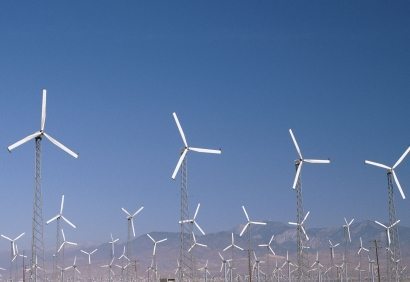
 A long-term goal of 100 percent renewable energy is increasingly possible for large corporations and local governments, according to a new report by Clean Edge.
Ron Pernick, managing director for Clean Edge, said he would have scoffed at such a report just a few years ago. “Now we’re seeing it,” he said.
One of the largest areas to have achieved 100 percent renewable energy is Schleswig-Holstein, Germany, a state with nearly 3 million people. The windy rural northern German state is now producing as much renewable electricity as it consumes — although that is a net calculation.
The current push for all renewables among global corporate powerhouses such as Google, Microsoft and Unilever has largely been met through tradable credits. But there is a strong shift toward onsite generation or direct power-purchase agreements, the report notes. The ambitious goals set by many large corporations started as sustainability programs, but are increasingly economic decisions.
The report, funded by SolarCity, outlines five trends that are enabling the shift to 100 percent renewables: the falling cost of distributed solar; maturing utility-scale renewables; maturing energy storage; efficiency and net-zero buildings; and a more intelligent electric grid.
Pernick said that all five building blocks were equally important to getting to 100 percent renewables. “We focus on the renewables because we need to generate the electron, but by no means do we think the deep efficiency isn’t critical,” said Pernick.
Efficiency is necessary to enable cleaner sources to meet total energy needs. The U.S., for instance, wastes at least 20 quadrillion BTUs annually, more than double the amount of electricity sold in the country each year. Waste heat from a variety of industries, from mining to automotive to oil and gas, also represents a tremendous opportunity to increase efficiency.
The report notes the importance of deep efficiency in the built environment. But it did not wade into the messy mechanisms of actually realizing those deep savings.
Investment in cutting-edge technology to allow for two-way power flows is another critical building block to enabling 100 percent renewables for companies and communities. But it is still early days on that front as well — and that could act as a barrier to enabling large cities to go fully renewable.
The goal of the report is to highlight the top performers in renewable energy integration. “We’re tracking corporations and governments that are leading the charge and hoping others can learn from that,” said Pernick.
Even though technology changes are making the goal easier, there are some significant caveats.
The discussion about 100 percent renewables is centered around electricity, which is only one part of the energy picture. In the U.S., electricity accounts for less than half of total energy consumption. Tackling transport and heat will be a much more formidable challenge.
For instance, Friedberg Pflüger, director of the European Center for Energy and Resource Security, recently told CleanEnergyWire that it is very possible that Germany will be importing as much natural gas a decade from now as it does today, even if it generates most of its electricity from renewable sources.
Source: Greentech Media. Reproduced with permission.
The goal of the report is to highlight the top performers in renewable energy integration. “We’re tracking corporations and governments that are leading the charge and hoping others can learn from that,” said Pernick.
Even though technology changes are making the goal easier, there are some significant caveats.
The discussion about 100 percent renewables is centered around electricity, which is only one part of the energy picture. In the U.S., electricity accounts for less than half of total energy consumption. Tackling transport and heat will be a much more formidable challenge.
For instance, Friedberg Pflüger, director of the European Center for Energy and Resource Security, recently told CleanEnergyWire that it is very possible that Germany will be importing as much natural gas a decade from now as it does today, even if it generates most of its electricity from renewable sources.
Source: Greentech Media. Reproduced with permission.