

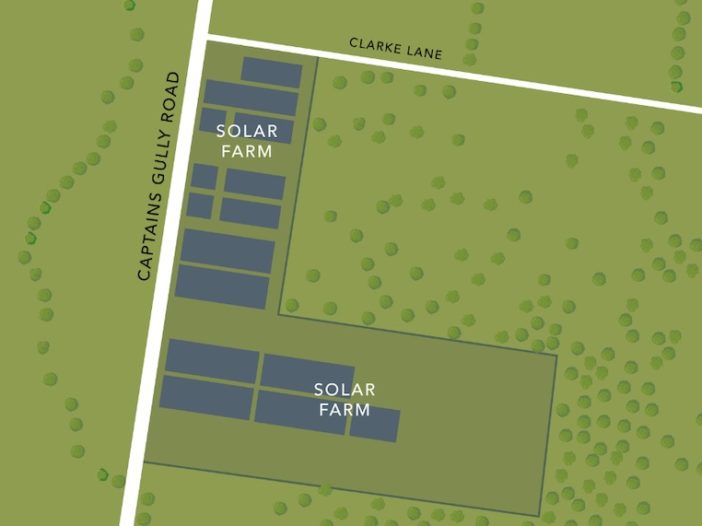

This week, the Renewable Newstead project has kicked off an expression of interest (EOI) phase, seeking retail, solar farm (finance and EPC), and demand management partners to build a solar farm up to 9MW, with a minimum 2MW allocated to Newstead residents via a retail offer.
Renewable Newstead has had a long-held goal to demonstrate a scalable model for 100% renewable energy supply, that can work independently of cross-subsidies and rebates that distort the true cost of energy supply.
For example, earlier project studies found it would be up to 50% cheaper to supply 100% renewable energy via a shared solar farm with single-axis tracking, relative to rooftop solar, once cross-subsidies were removed.
The project has been developed and de-risked by a deeply engaged community group. Land has been secured, the planning and network connection processes are underway, and local community/customers are primed.
With material funding from the state government recognising the project’s value and ability to scale with relationships in place across Victorian communities “The Newstead Model,” as it has become known, is well positioned.
These are the 5 key barriers to scaling renewable energy supply in Australia, and this is how the Newstead model addresses each one:
1. Constraints and congestion on the network
As developers have rushed to prime solar locations, network congestion has escalated project risks across Australia. In contrast, Newstead is targeting the 22kVa distribution network, with land secured, the planning process (DA lodged) advanced, and preparations with Powercor well underway for a formal connection process, targeting minimum 5MW initially, and potential for future expansion to 9MW, subject to AEMO and network approval.
2. The duck curve
Oversupply of daytime energy undermines its value and hollows out the day-time price paid for energy. In collaboration with a retail partner being sought for the project, Newstead proposes to offer residents a very low daytime rate for energy, enabled by a Powercor tariff that encourages load shifting, including use of smart hot water load management to match demand with supply. In this way, the problem becomes the solution, similar to “solar sponge” tariff options being developed by network providers across Australia.
3. The perceived need for renewable subsidies
Time and again, the debate around renewables hinges on an assumption they must be subsidised. However, the Newstead model is able to leverage the Powercor tariff, levelling the playing field between solar farms and rooftop solar, and showing renewables can reduce energy bills for all consumers. The option to create a long-term (10 years) retail contract to further de-risk investment, and accrue value via avoided retail churn costs, is the icing on the cake for a model that stacks up for all project partners.
4. Fuel switching
We can’t just switch to a renewable grid, we need strong incentives to switch from gas and unsustainable wood fuel too. The Powercor tariff with higher fixed charges and lower variable charges, combined with pass-through of low-cost solar rates, creates a very strong incentive to fuel switch from wood and gas to electricity. This is because each additional demand increment gets cheaper and cheaper to supply with renewable electricity. Over time, this also means enhanced network utilisation and downward lower cost of supply for all regional towns like Newstead where networks are unconstrained. It’s not as sexy as a micro-grid on the rural fringe, but a good example of matching solutions to their problems.
5. Intermittent supply from renewables
Granted, this is a problem of perception more so than reality, but one that has to be addressed. The Newstead model leaves scope to add storage behind the meter or in front, deppending on partner preferences, or to simply balance local supply from centralised generation and storage in combination with control of hot water loads. As described above, low daytime rates and a strong incentive to match demand to supply are key, just as we did to solve the ramp up and ramp down limitations of thermal (coal) generators. This ensures customers and project partners can benefit from solar’s unique generation profile.
—
On the back of this EOI phase, Newstead will strongly encourage a single applicant to lead the response to the more detailed RFQ, expected to commence in September.
Our expectation is that this single applicant will represent a consortia of companies that can deliver all project elements in an integrated solution, comprising solar farm finance, solar farm EPC, offtake and retail supply, as well as demand management innovation (smart hot water load management, battery storage, etc).
The EOI phase is both an opportunity to respond and indicate interest, but also to begin a process of collaboration, recognising that consortia may require lead time and coordination effort.
Visit www.renewablenewstead.com.au and download the EOI documents here.