A program shifting Aboriginal communities in Western Australia’s remote Kimberley region from diesel powered electricity supplies to a much cleaner mix based on shared rooftop solar is slashing household energy bills by nearly $500 a year.
The Kimberley Communities Solar Saver (KCSS) program is a collaboration between WA government-owned regional energy provider Horizon Power and the state department of communities, backed by both state ($12.6m) and federal ($7.3m) funding.
The program, first launched in 2023, will ultimately install up to 300 rooftop solar systems totalling around 2 megawatts (MW) of combined capacity across five communities, and deliver an average annual energy bill saving of around $450 to roughly 430 households.
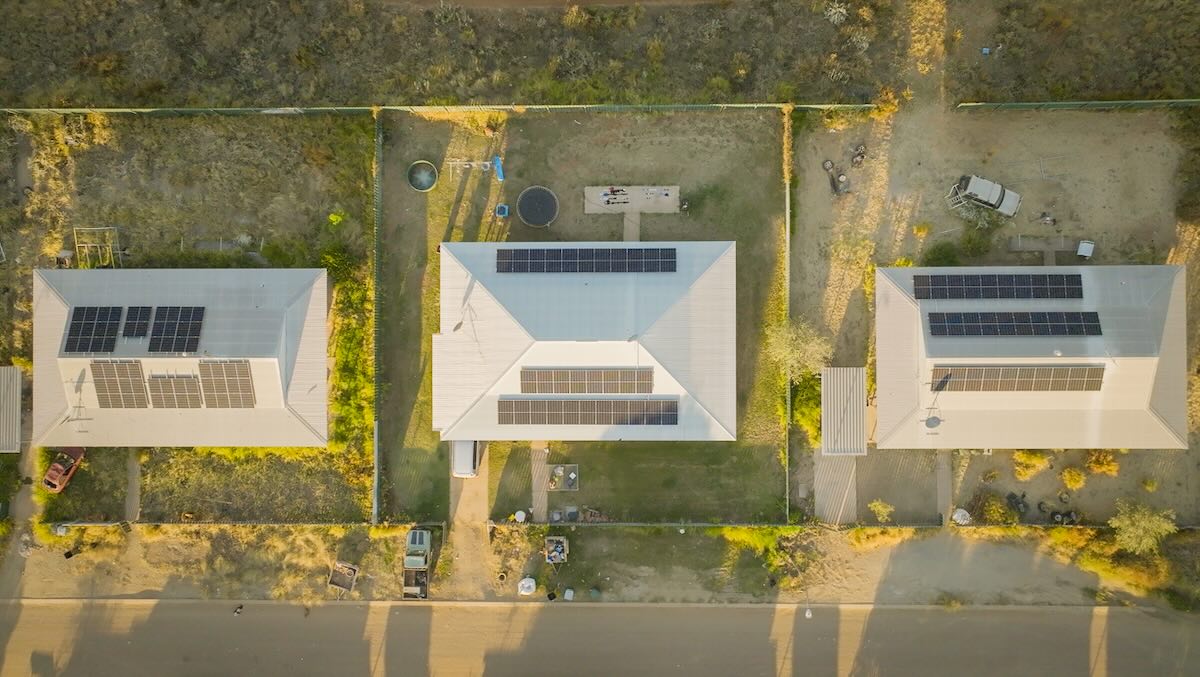
So far, a total of 422 kilowatts (kW) of rooftop solar has been installed in Warmun (pictured above and below), a township in the northeast of WA, and being shared across the 78 properties in the community, delivering nearly $30,000 in energy saving credits since August of 2024.
In Bidyadanga on the northwest coast of WA, the state’s largest remote Aboriginal community, a total of 356.4kW of rooftop solar has been installed across 33 properties, with benefits being shared across 133 households and delivering energy saving credits of around $33,000.
Work is now underway installing solar in the Dampier Peninsula community of Ardyaloon, with around 21 homes set to receive rooftop solar systems and the benefits to be shared across around 85 households.
Dylan Hearty, Horizon’s customer programs manager, says the program was devised to address the soarings costs and increasing risks of relying on diesel to power the remote communities, as well as a desire for “cleaner country.”
“We go to these right communities, we yarn to customers … and there’s really strong desire for more renewable energy… [including for] cleaner country or reducing the noise of generators and reducing fuel movements and stuff like that, but largely around accessing the financial benefits.”
And, of course, cutting the cost of the annual energy supply to these communities – which is currently heavily subsidised by thousands of dollars per household by the state – is a big financial win for government, too.
“These [communities] are all diesel-fired power stations. You know, you’ve got places like Warmun, a couple hours south of where I live, in Kununurra… or Yungngora, that’s … a hell of a lot further away.
“So there’s huge costs for trucking diesel out there [and] obviously volatility around diesel prices. Wet season gets cut off, you can’t get fuel trucks there, all that sort of stuff.”
Hearty says the decision to install a shared network of rooftop solar systems was landed upon as the best path forward for Horizon, as an energy utility, but was also based on the need to ensure equitable access to cheaper, cleaner power across the community.
“How this system works is we put the solar on… we gross meter it so it doesn’t impact the customer’s consumption – so their meter still ticks over as if there was no solar there – and we realise the [diesel] fuel savings.
“We clip the ticket on the way through on the cost of capital …and we retain some [money] for future operations and maintenance reserve, and then the benefit gets paid back to everybody’s meters in the community [as credits].
“So, automatically, on our two-month billing cycle, everyone will get a credit … dependent on how much energy they use.
“And then we have a contract with the community to monitor the performance of those assets, and then we’ll go in and maintain them as needed.”

Like many Aboriginal communities in remote regional Australia, access to electricity in the WA communities is usually through a prepayment meter system – although in WA this is not mandatory and residents have the option to switch to post-paid.
Pre-payment for electricity has been a controversial subject, because it can require customers to go to a store to purchase top-up credits to keep up their power supply running. If they run out of money, or time, the power goes off.
“It’s a really divisive topic, because some people see it as really punitive,” says Hearty. “The feedback that comes from our customers [is that] they actually find this a really useful tool to manage humbug and avoid getting into debt.”
But Hearty says the debate over pre-paid vs post-paid is among the subjects his team hopes to explore further through the KCSS program, using feedback from communities as well as the experience of other energy providers and industry experts.
“We’re really keen to look at how you can evolve this product – and that’s why it’s so interesting talking to other people about these solutions,” he tells One Step Off The Grid.
“Like, how could we reduce the delivery costs, so maybe we can increase the benefit paid out? How can we make the systems more robust? How can we improve the customer experience so they can activate that credit when they want to, instead of it just automatically getting applied?”

The team is also considering the possibilities of adding battery storage to the equation, to slash the use of diesel even further, although Hearty says that, currently, cost and complexity stand in the way.
“We did look at scoping this project up with batteries, both individual residential systems or community batteries… [but] the main concern at moment is the [operation and maintenance] on them, so moving contractors out to fix them… or anything like that.
“I mean, putting storage into no brainer, right, from a benefit perspective. You’ve just got to get someone to pay for it.
“As the robustness of those systems increases and it drives down that maintenance cost, [storage] becomes really attractive.”
For the meantime, however, slashing diesel through the installation of shared rooftop solar has been a great success, Hearty says.
“[It’s] something that I’m really proud of… because there’s a huge amount of collaboration around where the systems go, explaining to the community that if you don’t get solar, you’re still getting the benefits … building up energy literacy.
“Just working with these communities … those relationships are just so important.
“We’re going into people’s homes, so they need to know that you’re doing things in the right way and that you’re not going to blitz in and stuff everything up for them.
“It’s been a really, really nice way to do business. Instead of just saying, ‘hey, we want to build a power station on your land’ … for us to be able to say, ‘look, we’ll bang it on the roof, we’ll do it as a distributed solar farm’ – there’s no impact on country, there’s no trenching, there’s none of that sort of stuff.”
It’s also relatively quick. Hearty says that within 12 months of the first talks with Warmun they had built a 430 kW solar farm, with the benefits going to everyone.
“It’s probably the quickest way you’re ever going to get renewable assets up in a remote community.”