


Rooftop solar installations have picked up sharply after several quiet months, as battery-solar combinations become homeowners’ preferred choice.
And the systems being installed are getting bigger, likely because homeowners are adding to their solar arrays so they can use home batteries to store the excess, according to the latest Sunwiz solar rooftop market update.
“There has been a step-change in volumes in the sub-3 kilowatt (kW) range, quite likely due to PV system extensions associated with battery installations,” the report says.
“There’s also been a step-change in 8-10 kW and 15-20 kW PV installations, quite likely affiliated with battery installations.
“The national average solar system size increased sharply, reaching 10.4 kW and is higher than the same time last year. Larger residential PV systems (likely associated with large batteries) and a growth in 75- 100kW systems are to thank.”

The federal battery rebate was introduced in July as the fulfilment of Labor’s election promise. According to federal climate and energy minister Chris Bowen, speaking on the latest episode of the Energy Insiders podcast hosted on One Step’s sister site Renew Economy, the numbers have now swelled to 72,000.
The Clean Energy Regulator (CER) has blamed recent dips in rooftop PV installations on the new battery rebate, saying it caused many consumers to wait for their batteries before installing new PV systems, and the sheer volume of new battery installs that took up most of the time for installers.
But the CER now expects solar installations to bounce back.
The data appears to be bearing this out.
Sunwiz says the national market rebounded to its equal third- best month this year with 237 megawatts (MW) of systems registered in September, a month where volumes usually go backwards.
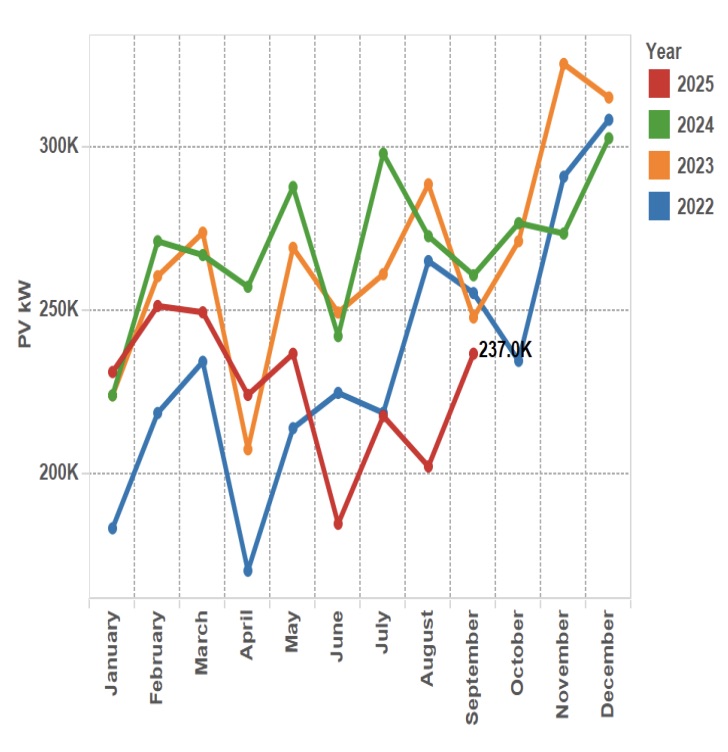
“All states grew, and are above trend. Western Australia was the larger state with the greatest percentage uplift [of 23 per cent month-on-month], though NSW saw the greatest MW increase,” Sunwiz’s report says.
“Victoria languished at 4 per cent growth.”