
RenewEconomy
The Conversation
Australia, like much of the rest of the world, is in the midst of an energy transition. With falling electricity demand and the uptake of household solar panels in just under 1.4 million homes, the most important question is not whether this transition is happening, but how we manage it to maximise the benefit to all Australians.
Community energy is one of the answers. Community energy projects are those in which a community comes together to develop, deliver and benefit from sustainable energy. They can involve energy supply projects such as renewable energy installations and storage, and energy reduction projects such as energy efficiency and demand management. Community energy can even include community-based approaches to selling or distributing energy.
Community energy projects allow individuals to be involved in clean energy beyond the bounds of their own homes or businesses and in so doing bring a range of benefits and opportunities for their household and for the wider community.
Global movement
Community energy has and continues to underpin the energy transition in countries like Germany, Denmark, the United Kingdom and even the United States. The first modern wind turbine – Tvindkraft – was literally built by a community in Denmark in 1978.
In Germany, 47% of the installed capacity is owned by citizens and communities while in Scotland there are now 249 community energy projects.
Here in Australia, while the community energy sector is still new, a recent baseline assessment found that there are now 19 operating community energy projects, which have as of the end of 2014 generated 50,000 megawatt-hours of clean energy – enough to power more than 9,000 homes. The community energy sector has already contributed more than A$23 million in funding for sustainable energy infrastructure.
Some prominent examples of community energy in Australia include:
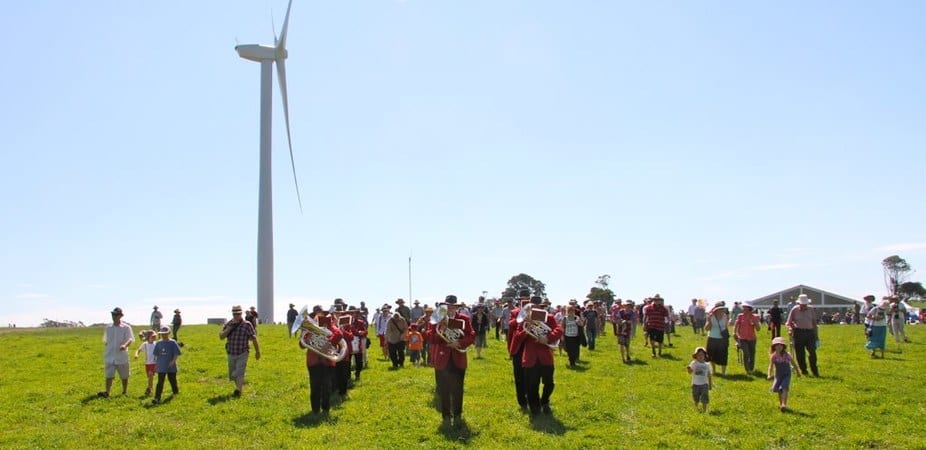
- the international award-winning Hepburn Wind in Victoria – Australia’s first community wind farm;
- Denmark Community Wind in Western Australia – Australia’s second community wind farm;
- Repower Shoalhaven – a community-owned 100-kilowatt solar array on the Shoalhaven Heads bowling club on the New South Wales south coast;
- Darebin Solar Savers in Melbourne – a project that saw the Moreland Energy Foundation put solar on the roofs of 300 pensioners, who use the savings to pay back the cost of the system through their council rates;
- several donation-funded community solar projects on community buildings across Victoria, NSW and South Australia.
Starting with solar
There are more than 60 groups across every state and territory in Australia developing community energy projects. The most popular are community solar projects.
While it’s clear that Australians love solar, there are more structural reasons why communities are starting with community solar projects.
Firstly, solar’s “scalability” means it can be easily tailored to a community’s energy needs. Groups can start with small projects and build their capacity and know-how.
Secondly, Australia has high retail electricity prices and low wholesale electricity prices. This means that business models such as community solar tend to stack up much better if they can reduce energy consumed at the meter, rather than competing with large coal-fired power generators in the wholesale market.
Indeed, the Coalition for Community Energy has recently released a guide to “behind the meter” models of community solar.
Going further
However, while many communities are starting with solar, many have more lofty ambitions, including the Zero Net Energy Town project in Uralla, NSW, the 100% Renewable Yackandandah initiative in Victoria, community bioenergy projects in Cowra and northern NSW, and many more.
This ambition and the potential of community energy in Australia led the Australian Renewable Energy Agency (ARENA) to fund the development of a National Community Energy Strategy, led by the Institute of Sustainable Futures at University of Technology, Sydney. This outlines a range of initiatives that are needed to grow the community energy sector in Australia and maximise the potential benefit of the energy transition to all communities.
Community energy projects are disruptive business models with financial and social value. The motivations for community energy are many and varied including wanting to act on climate change, wanting to reduce the amount of money that goes out of a community in power bills, and increasing social capital and community resilience.
We are starting to see the rise of community entrepreneurs innovating and developing new models, and in doing so reshaping the future of energy in their communities. With the support mechanisms outlined in the National Strategy, there is no reason that Australia can’t follow in the footsteps of other countries, to allow all communities across Australia to benefit socially and financially from the energy transition.

Nicky Ison is Senior Research Consultant, Institute for Sustainable Futures at University of Technology, Sydney.
Ed Langham is Research Principal at University of Technology, Sydney.
Source: The Conversation. Reproduced with permission.
This article was first published at RenewEconomy.