
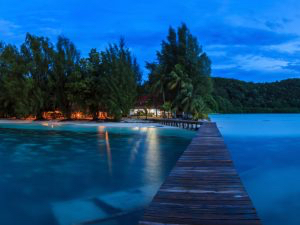
Eco-resorts in Southeast Asia are installing microgrids to keep the lights on and the tourists coming as economic terms increasingly favor renewable energy over stand-alone diesel generators.
An eco-resort in the Maldives, for example, has operated a 4.1 MW off-grid microgrid since October 2016 to serve an average 63% of electricity demand and cut diesel fuel use by 423,000 liters per year.
A more recent example is Batu-Tengah Island, a private eco-resort in Malaysia’s Johor Marine Park. The resort is installing a microgrid that uses solar, battery energy storage and diesel to meet some 30% of its electricity needs.
Singapore’s Canopy Power developed Batu Batu-Tengah Island’s microgrid, one of five eco-resort microgrid projects the company has completed to date, Daniel Rye, Canopy’s senior manager for business development told Microgrid Knowledge.
Favorable economic terms
Typically located at remote sites where there’s little or no prospect of grid access, or where grid service is poor or expensive, the resorts often depend on expensive stand-alone diesel generation. They are seeking alternatives
“The key driver pushing them towards renewable energy is cost of energy from diesel generation” Rye said in an interview
Some of Canopy Power’s eco-resort customers purchase microgrid systems outright.
Others, typically those investing from $0.5-$1 million or more, use the company’s save-to-own finance product, which comes at no upfront cost — an approach now used by many microgrid developers, often in an energy-as-a-service model.
In Canopy’s case, customers typically enter into a five to eight-year lease agreement with Canopy that matches or beats the operational savings they expect to realize, Rye said.
“This is attractive because not only is no capex required by the customer, but their opex is reduced or unaffected. Plus they own the system after a set lease period of 5-8 years, while the system lifetime is 20 years plus,” he said. When other sources of financing are lacking, Canopy partners with a European fund manager that specializes in renewable energy, Rye added.
Renewable energy projects require a large capital expenditure, typically equal to 20 years of electricity costs. On-site diesel generation, in contrast, is intensive in terms of operational expenses, which is pay as you go.
That said, “if the customer is open to a new model [a renewable energy microgrid], likes the ROI and has the capital to deploy, then it’s simple. But if they want to remain on pay-as-you-go, we have developed a finance mechanism for our solutions that effectively matches what they are used to,” he said.
Other ways microgrids benefit eco-resorts
Rye listed several secondary factors leading eco-resorts to invest in renewable energy microgrids:
- Enhancing sustainability and gaining “eco-credentials”
- Reducing the complexity of resort operations, especially diesel fuel logistics and generator maintenance
- Increasing energy self-sufficiency and security
- Reducing local pollution, emissions and noise
Canopy develops its projects in-house, handling engineering, procurement and construction post sale.
The company encourages customers to act as partners by providing their own staff to help build the system, which helps Canopy keep costs down and eases customer acceptance, as well as microgrid deployment, operations and maintenance.
“This has the added benefit of significant technology knowledge transfer, and it’s helpful for local operation of the system,” Rye said.
In addition to the five projects it has completed, Canopy Power has two more under construction and one in the planning stages. All told, it has 20 projects in its development pipeline at present. Four of them are close to closure, according to Rye.
Source: Microgrid knowledge. Reproduced with permission.