

More than five million households in Australia are connected to the gas network. Tackling climate change requires homes and businesses to move away from gas, and instead embrace electric appliances as the power grid shifts to renewable energy.
People can save considerable money by switching away from gas – even more so if they have solar panels installed. But still, millions of Australians haven’t yet made the move. Why?
Our new research, released today, seeks to shed light on this question. We focused on lower-income households in Victoria and found while most participants supported the transition from gas, few owned electric appliances for heating, cooking and hot water.
There were two main barriers: people couldn’t afford the upfront cost of buying new electric appliances, or were renting and so had little or no say over what appliances were installed. Overcoming these and other challenges is crucial to ensure no-one gets left behind in Australia’s energy transition.
Making it fair for all
Victoria has committed to net-zero greenhouse gas emissions by 2045. To help achieve this, the state government is developing a plan for the state to electrify. Other states and territories are also moving in this direction.
But to date, not enough research and policy attention has been paid to making this transition fair and equitable for everyone.
(Editor’s note: Please check out our new web-site focused on electrification, SwitchedOn).
Low-income households spend a larger proportion of their income on energy bills compared to higher-income households. This is despite those households using less energy.
The affordability of gas will become worse as more households electrify. That’s because part of a gas bill includes the fixed cost of running gas infrastructure – so as progressively fewer people use gas, the remaining users pay more.
And those who don’t make the move away from gas miss out on the long-term economic benefits. Analysis last year suggested a typical Victorian household could reduce its annual energy costs by A$1,020 by replacing gas heating, cooking and hot water systems with electric ones. The figure rises to $1,250 for those with solar power. These savings will be amplified if the price of gas continues to rise relative to electricity.
That’s why it’s important to help as many lower-income people as possible to make the switch to electric appliances. Our research set out to understand what might prevent or enable that shift.
We studied households in Victoria: the state with the highest prevalence of residential gas use in Australia and where plans for an economy-wide transition away from fossil gas are underway.

What we found
We conducted an online survey, which received 220 eligible responses. We also undertook focus groups with 34 people. All participants were from lower-income households.
Most participants – 88% – used gas in the home, reflecting its prevalence in Victoria.
More than two-thirds indicated some level of support for a transition away from household gas to cleaner energy sources. Support was greater with higher levels of education. There was no significant difference based on financial stress, housing tenure, location or age.
But this support had not translated into action. Just one in ten surveyed households had replaced gas appliances with electric ones within the past five years. Among those who had switched or planned to switch, the main reasons were lower running costs and environmental benefits.
Respondents considered electric appliances to be safer and better for the environment. Gas appliances were considered better for heating and cooking. Many respondents were unsure about the relative benefits of electric versus gas appliances when it came to cost, reliability, safety and the environment.
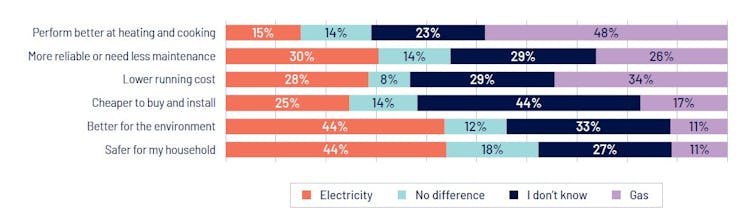
Preferences were strongly linked to what people were currently using. Most people preferred gas cooktops over electric ones, because of the perceived speed, ease and flexibility. However, few participants had used electric induction stoves, which can also offer these benefits.
People who spoke a language other than English were significantly more likely to prefer gas for heating and hot water.
For those who had not replaced gas appliances, being a renter was one of the biggest barriers to electrification. Some renters said they lived in poor housing, but were unwilling to request improvements in case the landlord increased the rent or evicted them.
Respondents also said they would struggle to afford the upfront costs of electrification, such as buying new appliances and, in some cases, wiring upgrades and other building modifications.
Many participants were aware of and had received state government assistance to help with energy bills. But far fewer people knew about or had used programs that could support them to adopt electric appliances.
Embracing the switch
An overall strategy is needed to help all households make the shift to electric appliances and technology. Our research suggests this must include specific measures for lower-income households, such as:
- targeted and well-promoted electrification programs
- more evidence-based information on the benefits of electric appliances
- incentives for landlords and standards requiring efficient electric appliances in rental homes
- means-tested rebates for electric appliances such as reverse cycle air-conditioners and heat pump hot water, and where appropriate, no- or low-interest loans.
These measures should, where possible, be linked to measures to improve household energy efficiency. And lower-income households, as well as others facing barriers to getting off gas, must be included when planning the transition.
(Editor’s note: Please check out our new web-site focused on electrification, SwitchedOn).
Researchers David Bryant and Damian Sullivan from the Brotherhood of St Laurence contributed to this article and co-authored the research upon which it is based.
Sangeetha Chandrashekeran, Senior Research Fellow, Australian Research Council Centre of Excellence for Children and Families over the Life Course, The University of Melbourne and Julia de Bruyn, Associate Investigator, ARC Centre of Excellence for Children and Families over the Life Course, The University of Melbourne
This article is republished from The Conversation under a Creative Commons license. Read the original article.