

I’ve been helping friends, colleagues, and other acquaintances work through adding solar for years. In most cases, the economics of adding a home battery didn’t stack up.
That has changed with the federal government’s Cheaper Home Batteries Program. Many of the families I’ve helped are now accepting quotes to add a battery.
These are the key pieces of advice I give when asked to help:
Selecting battery size and installer
– Get at least three quotes from reputable installers before deciding to go ahead – prices can vary by 100 per cent, or more.
– A rough battery sizing rule is to cover at least one-third of your average daily usage; if you can afford it, two-thirds is ideal.
– You can only benefit from the federal battery rebate once [per dwelling], adding more storage later isn’t as efficient as installing what you need upfront.
– Specify clearly if you want your battery to back up the house or critical circuits in the case of a grid outage.
– Consider adding more panels to your system if you haven’t already filled your north, east and west facing roof space.
After installation
Once you have your home battery, you can maximise the value it creates by switching to a retailer that gives you exposure to the wholesale price of electricity and effectively manages your home battery without conflicting interests.
– Traditional retailers buy financial hedges to protect themselves from price spikes and build the cost of this hedging into your retail rates. Your battery acts as a physical hedge against high prices, so you no longer need to pay your retailer for that financial hedge.
– Your battery will often have spare capacity to export to the grid when prices spike – creating additional value for you and the grid as a whole.
– Avoid signing up to a big gentailer’s virtual power plant – they don’t pass across the full value of your home battery to you and have incentives that don’t always align with yours. You can read more about these conflicts of interest here.
Return on investment
Expect a payback period of roughly five years – or a 20 per cent internal rate of return. Your actual savings are likely to be even larger, and the payback period shorter, as electricity prices continue to rise.
For example, earlier this week the Australian Energy Regulator approved a 8.5% to 9.7% increase to the Default Market Offer in NSW.
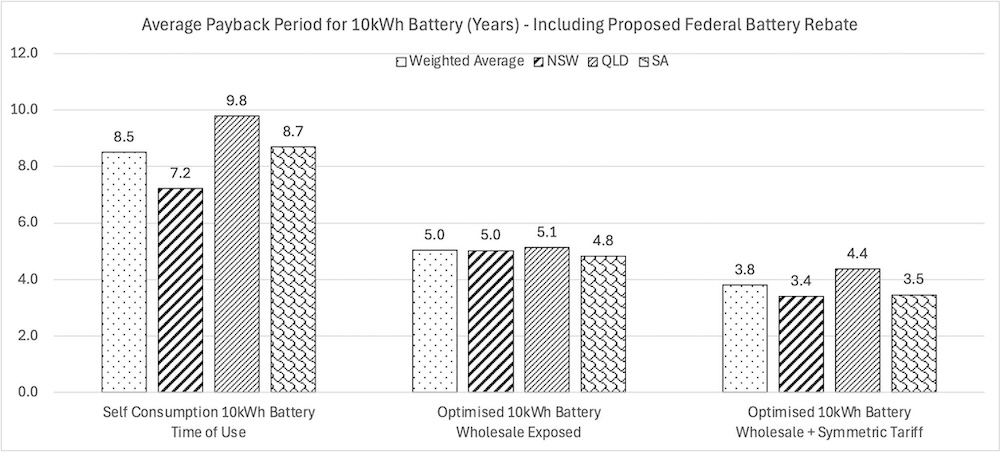
Additionally, over time, DNSPs [distribution network companies] will be required to pay fairly for the distribution value created by consumer exports to the grid during peak network utilisation periods.
This should bring payback periods below 4 years. If you are interested in that topic, or the analysis behind the payback estimates, you can read more here.
Fred is a renewable energy advocate and experienced tech executive, currently pursuing a Master of Renewable Energy Engineering at UNSW. He brings deep expertise from leadership roles in media tech, strategy consulting, and distributed energy projects.
This article was originally published here. Reproduced with the author’s permission.