
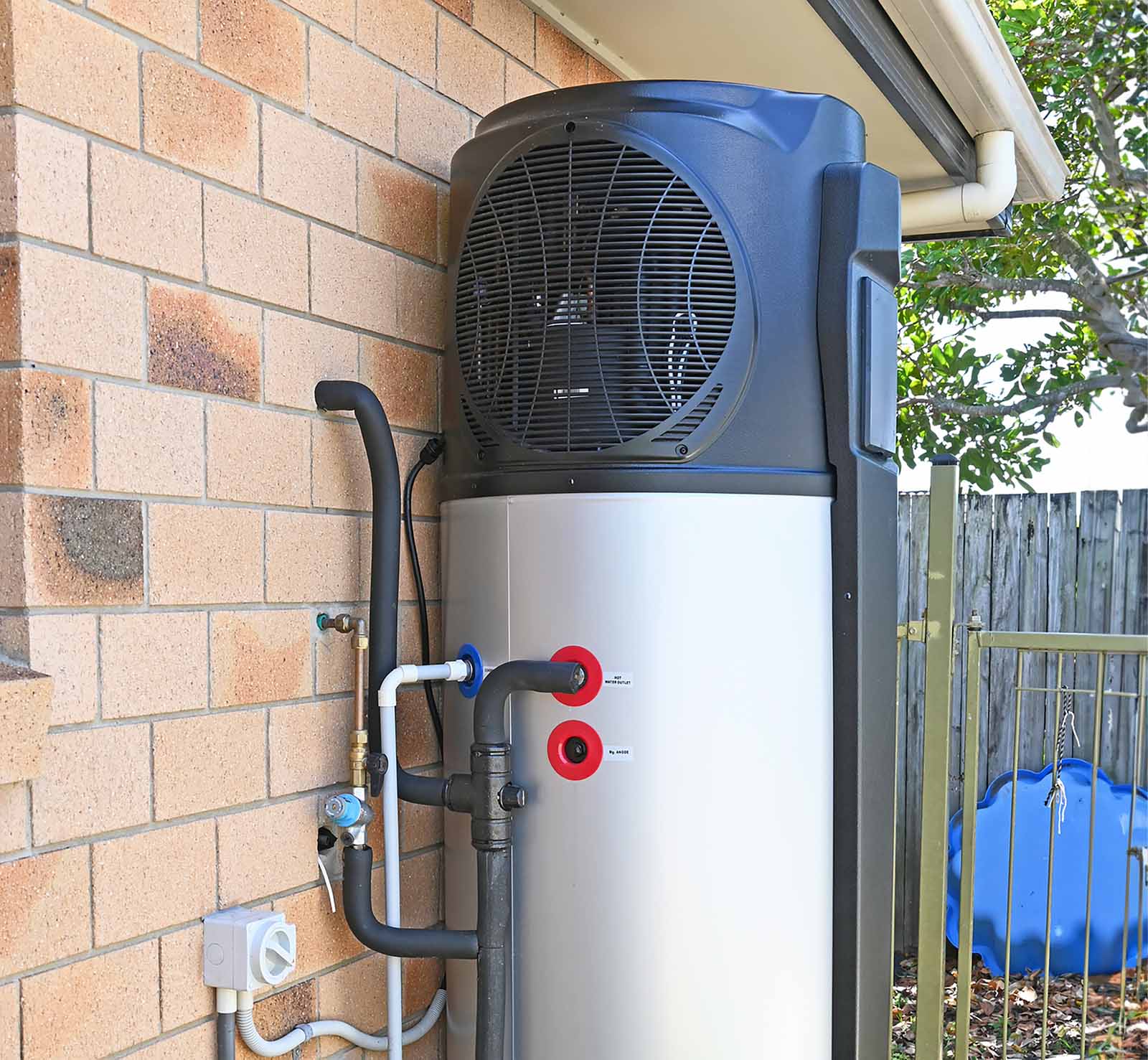
Last week Australia’s federal and state energy ministers committed to fast tracking the introduction of national minimum energy standards for hot water heat pump systems (HWHPS).
The announcement was welcomed by some of the main hot water heat pump manufacturers, who are concerned Australia is being flooded by low quality, poor performing and unreliable products fuelled by government incentives and rebates that are now available.
More than 104,000 heat pumps have been installed in the last 12 months in Victoria and NSW as part of the Victorian Solar Homes, Victorian Energy Upgrades, and NSW Energy Savings Schemes.
Chris Taylor, the managing director of Reclaim Energy, one of the manufacturers, estimates that 90% of the heat pumps now being sold and installed in Australia are what he calls “faux heat pumps.”
Unlike their gas and electric resistive counterparts, there are currently no minimum energy performance standards (MEPS) for HPHWS being installed in Australia.
Taylor has been pushing for minimum energy standards which he says will provide a regulatory framework to ensure quality products. Minimum standards will also help clean up the industry which has seen several new players enter primarily to capitalise on government rebates.
“There are businesses that are developing new products, and new names entering the market specifically to capitalise on rebates,” says Taylor. “Their whole primary focus is to make as much money as quickly as possible.”
Last week the Energy Efficiency Council (EEC) released the Roadmap for Heat Pump Hot Water Systems in Australia, funded by the Victorian and NSW Governments, which also identifies minimum energy standards as a fundamental way to develop consumer confidence in hot water heat pumps, and protect consumers.
The Roadmap argues that the delay in developing standards will result in lower-quality appliances not able to be sold in Europe or North America being dumped into the Australian market.
It says the lack of minimum energy standards for hot water heat pumps “represents both a lost opportunity for higher energy performance and emissions reductions, and a risk.”
The concern about the influx of low quality or poor quality products has seen some of the major players in the industry – including Rheem, Rinnai, Dux, Chromagen, Stiebel Eltron, and Reclaim – come together “to protect the category.”
“If we don’t do this the [hot water heat pump] category will suffer and people will consider heat pumps don’t work, when in fact specific products might not work and might not be fit for purpose and as a consequence shouldn’t be sold,” says Taylor.
“The last thing the hot water industry wants is another pink batts.”
Other industry advocates say they sounded the alarm with governments to ensure consumers are protected and public confidence in hot water heat pumps is not jeopardised.
The industry is also concerned that in the absence of national standards, more progressive states like Victoria would go-it-alone and manufacturers would have to comply with different state standards.
Whilst minimum standards for hot water systems are imperative, Taylor argues that it’s not just the quality of the products that’s important, “it’s also the quality of the install.”
“Industry is very concerned about the high proportion of non compliant heat pump installations, especially in regards to electrical, plumbing and refrigerant safety.”
Quality installs are also identified as a priority in the Roadmap, which recommends governments with hot water heat pump incentives should ensure that high-quality, independent audits of installations are undertaken.
Taylor says householders in NSW who are concerned about the way their system has been installed should contact IPART, the Independent Pricing and Regulatory Tribunal, and request an audit.
“If plumbers take shortcuts, then the plumber should be dragged back on site to rectify the problems and make sure that the systems are compliant.”
The typical process for developing new minimum energy performance standards is usually lengthy, and often takes several years. But Taylor says we don’t have that long.
“The government needs to move quickly. Ideally we would have loved to see MEPS enforced and in place a year ago.”
“We need to see a framework that is out for consultation in less than 6 months time, and then something in place in no longer than 12 months.”

Anne Delaney is the host of the SwitchedOn podcast and our Electrification Editor, She has had a successful career in journalism (the ABC and SBS), as a documentary film maker, and as an artist and sculptor.