
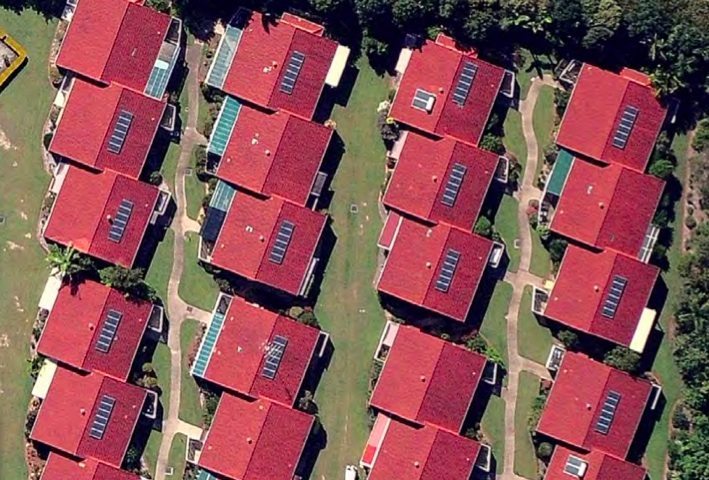
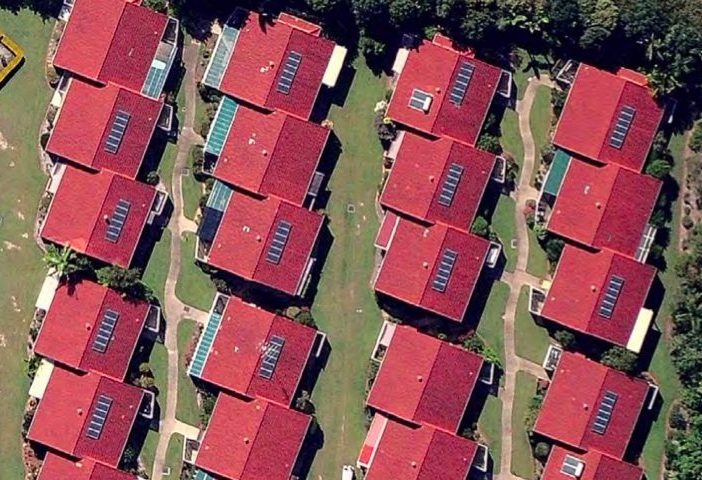
Rooftop solar is becoming as “common as insulation” in some parts of Australia, a new report has found, with 14 suburbs now recording penetration above 50 per cent, and many others recording uptake far above their state’s average, sometimes as high as 65 per cent.
The report is the Climate Council’s latest round-up of data on the performance of renewable energy in Australia’s states and territories. As you can see in the table below, at the state and territory level, South Australia, Queensland, and Western Australia all have a higher share of Australia’s solar PV installations than their share of the population (Table 3).

But in terms of the percentage of households with solar PV, South Australia and Queensland are still leading the country, with PV penetration levels fast approaching one-third of all households. Western Australia comes in at third place, with solar PV panels on one in five households.

In the suburbs of Australia, the data tells a slightly different story, with some postcodes charting a solar PV penetration rate much higher than the average of the state or territory they are located in.
As you can see in the table below, there are now 14 postcodes in Australia where half or more of households have rooftop solar PV.

Angle Vale in South Australia and Leinster and Sir Samuel in Western Australia are leading the charge with 65 per cent. “In these suburbs,” the report says, “rooftop solar could soon be as common as home insulation.”
Interestingly – and in contradiction of now less commonly espoused claim that rooftop solar is a middle class luxury – the report also notes that suburbs with highest levels of rooftop solar PV generally have low to medium income levels and tend to be located in the outer metropolitan “mortgage belt”, or in regional areas.
It says that factors encouraging higher levels of solar uptake are likely to include level of home ownership, building suitability, energy bills as a proportion of household income and renovation
activity.
New suburbs, meanwhile, are being built with 100 per cent solar: “Denman Prospect in Canberra, will be the first suburb in Australia to require a minimum of 3kW of solar PV on every house,” the report says.
And Breezes Muirhead in Darwin, which is being developed by Defence Housing Australia, plans to include a 4.5kW solar system and charging points for electric vehicles on each house – features anticipated to save residents over $2,000 a year on their electricity bills.
All up, the report says Australia remains a world leader in household solar PV, with double the rate of take-up (15 per cent of households on average) compared to the next country, Belgium where about 7.5 per cent of households have solar.
But it said that the increasingly low amount solar households were being paid for the energy they exported to the grid was starting to change consumer behaviour.
Currently, the amount solar households receive for excess electricity fed into the electricity grid currently ranges from premium levels (between 44-60 cents per kilowatt-hour offered in the ACT, New South Wales, Queensland, Victoria and South Australia, but most of these tariffs are soon to end), to rates of between 5-8 cents per kilowatt-hour.
“The disparity between feed-in tariff rates and retail electricity prices is a key driver for battery storage systems,” the report says.

Sophie is editor of One Step Off The Grid and editor of its sister site, Renew Economy. Sophie has been writing about clean energy for more than a decade.