
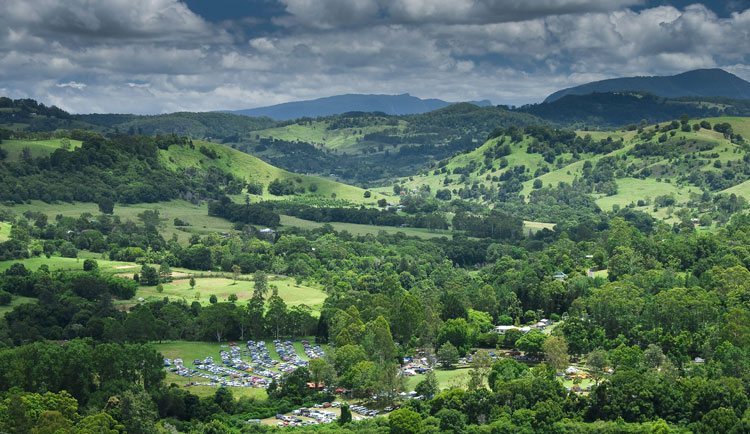

The iconic coastal and tourist region of Byron Bay and its surrounding towns has become the first local community to conduct a full audit of its greenhouse gas emissions as it maps out a plan to reach 100 per cent renewable energy and zero emissions by 2025.

The emissions inventory – unveiled at the local RenewFest festival that attracted some 2,000 people on the weekend and formally released on Tuesday at the National Assembly of Local Government in Canberra – assessed emissions from energy, buildings, land use, waste and transport, and possible solutions.
The Zero Emissions Byron baseline report estimated total emissions for the shire came at 263,199 tonnes of Co2 equivalent, which relates to around 8 tonnes per person living with the Byron shire. That is around one half of the Australian average, but nearly twice the global average of 4.9t/Co2-e.
Stephen Bygrave from Beyond Zero Emissions, which is partnering with the shire, said his team were surprised by the low emissions by per capita. It may have something to do with the alternative lifestyle of many people within the shire. But he says more work needs to be done.
Mayor Simon Richardson said it was critical to begin the work towards zero net emissions by measuring them. “It is really exciting,” he told One Step Off The Grid. “It is leading work and can be a template for councils around Australia to work out the exact nature of their emissions, and it makes it easier to put projects in place to reduce them or eradicate them.”
Richardson said that being a leader would also open new options. “We know that what we are doing is significant. As soon as you can broadcast an ambition, those who are interested in developing solutions will come to Byron to participate.”
Byron Bay is already playing host to the nation’s first community owned retailer, and is also pioneering trials of “virtual net metering”, where the output of solar installations on one council building can be credited for the power use of another building.
Bygrave, however, said that work by communities was being hindered by the lack of national policy.
“The national government should be assisting not hindering action,” Bygrave said. This pointed to the state of climate policies, renewable policies, and the loss of a local government action plan which was lost when the Australian Greenhouse Office was closed.
The Zero Emissions Byron report showed that half the emissions came from energy, with the shire still sourcing 80 per cent of its electricity from coal-based sources. The shire, and several individual towns, have ambitious targets to reach 100 per cent renewable energy.
Transport was the next biggest contributor, accounting for just over one third of emissions , while land use and waste were the other major contributors.
Among the mitigation strategies being considered are energy efficiency measures and a shift to renewable energy. “The cost of wind and solar power has declined to the point that it would be cost-effective for Byron shire to be supplied entirely with renewable energy,” the report says.
It proposes that solar PV, combined heat and gas, biomass and wind energy can gradually replace all fossil fuel energy over the next 10 years. It expects to team up with the new community-owened and renewable energy-focused retailer Enova to help achieve that outcome and to generate, distribute and export renewable energy.
It also cited the work of the COREM – Community Onwed Renewable Energy Mullumbimby – which is raising funds for community owned installations in and around the township, as a model that could be replicated through the community.
Byron shire currently has around 9MW of renewable energy capacity, almost entirely from rooftop PV, although there is potential for this to be increased to 48MW. This level of solar penetration, combined with energy efficiency measures, could meet all home energy requirements in the shire.
 It also says bio energy – such as those installed at local sugar mills – could provide 28 per cent of the shire’s electricity needs.
On efficiency, the working group estimated that a typical home in Byron shire could reduce its electricity consumption by 48 per cent through straightforward efficiency measures, such as reverse-cyle air conditioning and LED lights.
On the transport sector, the working group suggests encouraging cycling by extending the network of chcule lanes, improving local bus services, re-establishing the local railway line for use by trams or other on-car transport, and promoting car share schemes and electric vehicles.
On land use, it recommends re-vegetation , improved use of fertilisers and manure management, and selective breeding and herd reduction.
“The national government should be assisting not hindering action,” Bygrave said. This pointed to the state of climate policies, renewable policies, and the loss of a local government action plan which was lost when the Australian Greenhouse Office was closed.

Giles Parkinson is founder and editor of One Step Off The Grid, and also edits and founded Renew Economy and The Driven. He has been a journalist for 35 years and is a former business and deputy editor of the Australian Financial Review.