
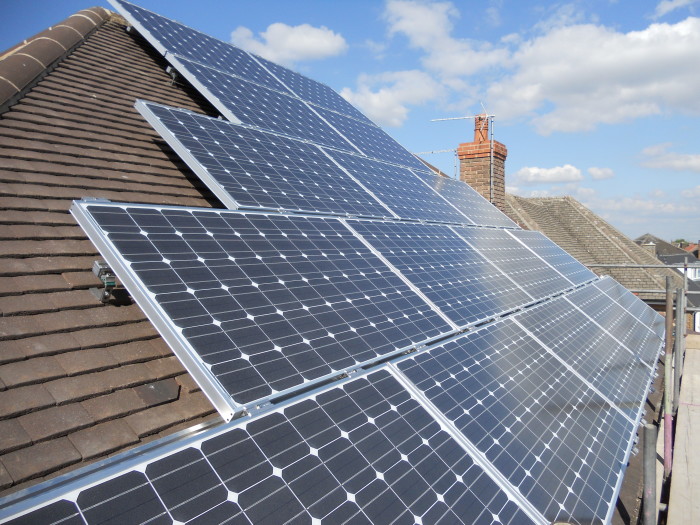

Over the last few years, Ray Miller has invested a lot of money to make his home on the Gold Coast as efficient as he can. He has installed the most energy efficient appliances, 1.7kW of rooftop solar PV, and a 2kW inverter. He says the house has a 9-star energy rating and is a net positive energy house, which means it produces more than it consumes.
 But now he must wonder why he and others like him bother. Two years ago, his service fee from the local network operator Energex was $105 a year, with the rest of the bill dependent on how much electricity he used. His annual service charge has since jumped to $428.81 – a fourfold increase in just two years.
Miller laments the impact on households like his that have chosen to install solar and become energy efficient. As RenewEconomy pointed out when the new charges were unveiled more than a month ago, it means that low energy consumers – including single occupancy homes or pensioners – are being charged at the massive rate of more than 42c/kWh.
But Miller says the rate is even worse for him. With a new metering charge applied to solar homes, his “fixed” and unavoidable network charges are $468 a year. That means an effective rate of 62/kWh for the amount of energy he uses from the grid.
It seems that the less people consume, the more they are charged. The more they consume, the less they are charged.
Welcome to the new reality of network charges. The same story is being repeated across Australia, as network operators, faced with falling demand, are imposing a massive tax on consumers to protect their revenue streams.
In Queensland it is effectively a government tax, because the network operators are government owned. Ditto in NSW, where the government is trying to lease the networks and wants to get the best price. But in Victoria and South Australia, where the networks are privately owned, the same thing is taking place.
And it’s not just householders that are copping the brunt of the increases. Business customers are the new target market for the rooftop solar industry, but the networks are fighting back by changing the tariff structure.
As RenewEconomy reported last week, in our story “Rooftop solar suffers another blow as networks switch tariffs”, business owners are facing massive increases in fixed costs through new tariff structures.
SA Power Networks slashed the electricity usage component of its network charges to just 3.3c/kWh, just one-fifth of its previous peak rate, and imposed hefty “demand charges”. But even these demand charges fall away the more the business consumes.
Now, the situation may get even worse. The Energy Networks Association is proposing new tariffs that would make it compulsory for home-owners and businesses to pay for the grid, even if they were not connected.
It also proposes penalties, or fees, for homes and businesses that choose to quit the grid. It suggests this could be equivalent to the “historic share of network capacity dedicated to that customer.”
It says the compulsory network connection fee would be specifically designed to “avoid the potentially inequitable outcomes” where some users sought to ‘exit’ the grid.
This is known as the “death spiral”, and has prompted warnings that networks may have to write down the value of their assets, particularly in light of the fact that much of the expenditure may have been unnecessary.
The networks, however, are resisting fiercely, and are looking to protect their revenues whichever way they can. Regulators have argued that these tariffs are “cost reflective”, but the solar industry says they are anything but, because they do not reflect peak network demand.
“If you plot the total cost of the energy per usage, the cost per kilowatt-hour increases for the efficient/frugal users (who can be those on pensions) have been disproportionate,” Miller says.
“The more you use the cheaper the rate. The users who are extremely inefficient ( and use more of the network capacity) have not been paying their fair share of the network upgrades. We continually get the ‘cost reflective’ argument, but only from a very narrow ‘energy industry’ perspective.”

Giles Parkinson is founder and editor of One Step Off The Grid, and also edits and founded Renew Economy and The Driven. He has been a journalist for 35 years and is a former business and deputy editor of the Australian Financial Review.