
Whichever way you look at it, microgrids are going to play a key role in the world’s future energy mix. In Australia, in particular, they are seen as an obvious solution to its combination of soaring electricity costs and an ageing and sprawling grid.
Remote and off-grid, or connected to the grid in densely populated areas, the ability of microgrids to operate independently while combining different assets and loads will be vital to the kind of flexibility our future grids will need, as they move away from centralised energy and accommodate more and more distributed and locally generated renewable energy sources.
Last week, we discussed all this in detail with Maxine Ghavi, the global head of microgrids at power and automation tech giant ABB – a world leader in the sector. That interview will be published later this week, but in the meantime, for OneStepOffTheGrid, we asked Ghavi to name a couple of her favourite examples of microgrid technology, doing what it does best.
After some deliberation (“Do I have to pick just two?”) Ghavi named two projects ABB had helped develop, both of which happen to be here in Australia.
So let’s have a look at them…
1. Marble Bar, Horizon Power, Western Australia
Ghavi says: “One of my favourites is the solar-diesel hybrid microgrid we have had in Marble bar …since 2010.
“That, really, when you think of a microgrid, it’s fantastic – the economics, the reduction in diesel. Also it has the highest penetration of renewables in a microgrid anywhere in the world.”

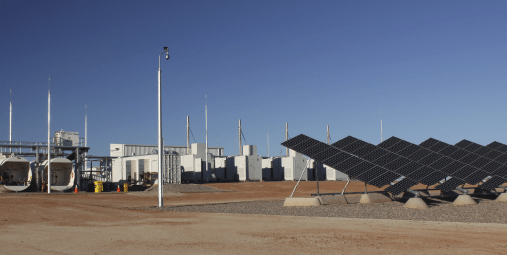
We say: ABB’s Marble Bar hybrid microgrid, installed by Horizon Power, features four 320kW diesel gensets alongside a 300kW single-axis tracking solar PV array and a 500kW PowerStore flywheel storage system. The solar array supplies 60 percent of the grid’s daytime electricity demand, saving 405,000 litres of diesel fuel a year.
One of the keys to the Marble Bar system’s success is its flywheel-based microgrid stabilisation technology, called PowerStore, which was developed by ABB engineers in its research facility in Darwin. The technology can hold 18MWh of energy and shift from full absorption to full injection in 1 millisecond.
Simply put, it enables very high levels of wind and solar power penetration on isolated and traditional diesel powered grids, to ensure utility-grade power quality and grid stability, while reducing dependency on fossil fuels.
As we wrote here in September, this same technology will be used at the Marsabit wind farm in northern Kenya, after it was ordered by the development’s owners, Socabelec East Africa.
For the remote WA township of Marble Bar, it has succeeded in reducing power outages from an average of about 38 minutes a year to less than 8 minutes a year.
2. Ausnet’s Grid Energy Storage System (GESS), Thomastown, Victoria
Ghavi says: “The Ausnet project is brilliant. It has all the elements of cost saving, providing reliability, and looking at (microgrids) from a different perspective; showcasing such different applications, and all the benefits of microgrid technology.”

We say: Australia’s first grid-integrated ‘network’ battery, the Thomastown hybrid Grid Energy Storage and Diesel Generation System was developed by ABB and Samsung SDI for the AusNet electricity distribution network.
Launched in January 2015, the two-year GESS trial aims to improve the quality of Ausnet’s power delivery, providing active and reactive power support and other power quality functions, when connected to the network. It can also provide power as part of a mini grid when parts of the network becomes isolated (islanded).
According to ABB’s website, the 1MWh battery system and smart inverter are the primary energy source, while the 1MW diesel generator acts as back-up to extend the capacity available. The system must comply with the distribution grid codes when grid connected, must transition into island mode when the network controller gives the command, and must switch back to grid-connected operation without any power supply interruption.
This is all managed by ABB’s Microgrid Plus System – another technology developed the company’s Microgram Solutions team in Darwin – and is implemented as a transportable power station consisting of seven outdoor containers and kiosks.
The system at the Thomastown Industrial Estate will be a pilot plant for potential future similar grid-integrated generation and storage systems. If successful, AusNet may choose to embed GESS systems for additional supply capacity during high demand periods to offset or delay expensive investment upgrades of power lines.

Sophie is editor of One Step Off The Grid and editor of its sister site, Renew Economy. Sophie has been writing about clean energy for more than a decade.