
RenewEconomy
The New South Wales pricing regulator has decided that the range of recommended solar feed in tariffs for the state’s 350,000 solar households should double from July 1, following the sharp jump in wholesale electricity prices.
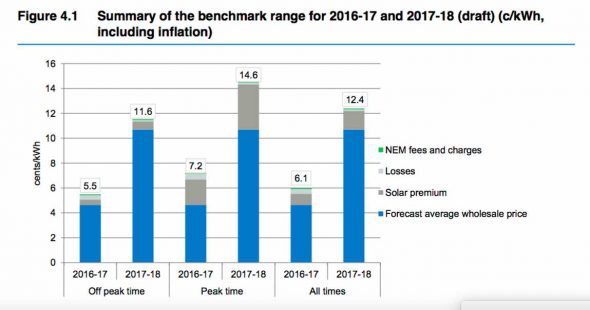
IPART, the Independent Pricing and Regulatory Tribunal, has recommended that the benchmark price paid for solar power exported back into the grid should jump from a range of 5.5c/kWh to 7.2c/kWh to 11.6c/kWh to 14.6c/kWh.
Unlike in other states, the FiT is not compulsory, and some retailers, such as Enova and Origin Energy, have been offering tariffs of up to 12c/kWh.
The new pricing range was calculated on the forecast wholesale electricity price for NSW, with a “solar premium” also added for the fact that solar produces during the day, when prices are normally higher.
However, IPART has not followed its Victorian counterpart in including, or attempting to include, a social or environmental or climate benefit from solar, suggesting it would be difficult for retailer to recoup the cost, and it did not want to create a subsidy.
The recommended tariff for Victorian solar households were told in February that their solar feed in tariffs would more than double from July 1 from 5c/kWh to 11.3c/kWh, thanks to a jump in wholesale prices, and the inclusion of a “carbon cost”, although some criticised the rate for not reflecting the true rate of wholesale price increases.
The Essential Services Commission said any further network benefits from solar should be decided by the market. It also said it was unable to value any environmental benefits from producing solar rather than burning coal.
The NSW move will be good news for solar households, most of whom have lost their premium solar tariffs of 60c/kWh for all solar power generated. That ended on January 1, although most customers should have been able to secure a higher tariff than the minimum 5c/kWh if they shopped around.
However, it also signals the fact that all NSW electricity consumers will be hit with higher grid prices, because the rises in wholesale prices that allowed a doubling in the solar tariff will also feed in to the retail electricity tariff, which also included the cost of networks and retail margins.
NSW minister for energy and utilities Don Harwin said the benchmark feed-in tariff will more than double, which will help customers negotiate a better deal from energy retailers.
“I have heard the concerns of solar households and asked IPART to update the benchmark tariff for the energy they feed into the grid,” Harwin said in a statement.
“The tariff is not subsidised by other energy users so it won’t increase power prices. It will help deliver lower energy bills for NSW’s 350,000 solar households,” he said.
“It’s not mandatory for retailers to offer a feed-in tariff but I strongly urge retailers to offer one, and for consumers to shop around to get the best deal,” Mr Harwin said.
Ben Franklin, the parliamentary secretary for renewable energy in the state Coalition government, said the financial benefit of solar goes beyond feed-in tariffs, because it added to energy security.
“The Government wants to expand access to solar power to help with bills, particularly for vulnerable households through our Home Energy Action Program.
“The CSIRO says 35 per cent of generation by 2050 could come from rooftop solar. Solar and batteries in homes and businesses are critical to future supply,” he said.
Originally reproduced on our sister website RenewEconomy.

Giles Parkinson is founder and editor of One Step Off The Grid, and also edits and founded Renew Economy and The Driven. He has been a journalist for 35 years and is a former business and deputy editor of the Australian Financial Review.