
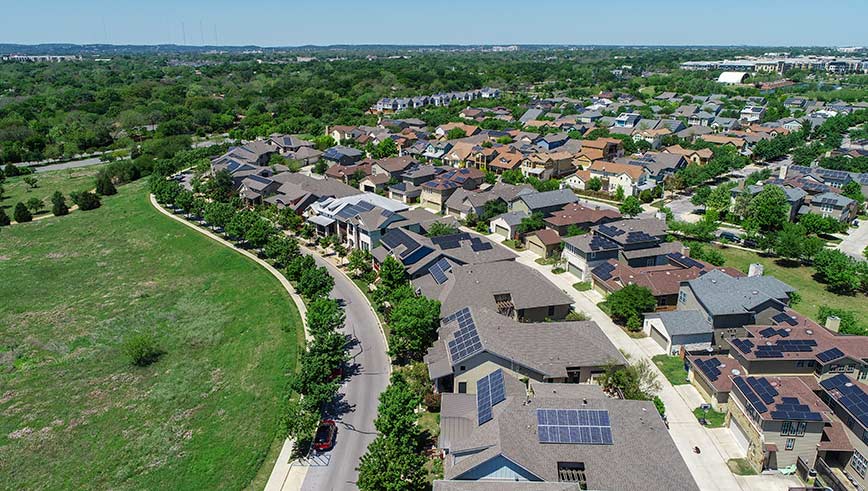

A University of South Australia study has found that the nation-wide habit of facing rooftop PV panels to the north could be short-changing solar households – and adding to the “duck-curve” shaped problems of Australia’s increasingly solar saturated grids.
The study, by UniSA solar researcher Kirrilie Rowe and Associate Professor Peter Pudney, calculated the optimal self-consumption panel orientations for a community of 29 individual dwellings and a residential building with 42 apartments in Australia.
And what it revealed is that when it comes to solar self-consumption, optimal panel placement is rarely towards the equator.
The study found that in both cases – of the individual dwellings and the apartment building – if the panel area was small enough so that the household would not export, then facing the panel north remained the best option.
But as rooftop solar system sizes increased, it became better to mount the panels facing north-west to meet the afternoon loads, and if even more panel area was available then panels should be faced north-east and west.
“The real challenge now facing the solar industry is finding ways to balance production and consumption by maximising self-consumption for the solar panel owner,” said Rowe in a UniSA release on Monday.
“Solar panels on residential dwellings are typically installed facing the equator to maximise the energy collected, but the power generated by an equator-facing panel peaks at around midday, whereas residential loads typically have peaks in the morning and afternoon.
“By orienting panels in different directions rather than just facing the equator, it’s possible to minimise the shortfall between load and generation.
“This benefits the end-user by decreasing the amount of electricity required to be imported, and the stability of the grid by decreasing the amount of variability between peak and low loads.”
Rowe says this kind of thinking, placing the emphasis on rooftop solar self-consumption, could be very valuable in the near-term as distributed solar uptake increases and the cost of solar batteries remains prohibitive.
The University says it offers a simple approach to improving self-consumption without increasing set-up costs on new PV systems, and potentially also for use in remodelling existing systems.
“The information on how to orient solar panels to minimise power shortfall is useful to groups developing housing precincts and has been used to design a renewable energy system for a retirement village with 24 dwellings,” Rowe said. “Future work will incorporate energy storage into the model.”

Sophie is editor of One Step Off The Grid and editor of its sister site, Renew Economy. Sophie has been writing about clean energy for more than a decade.