
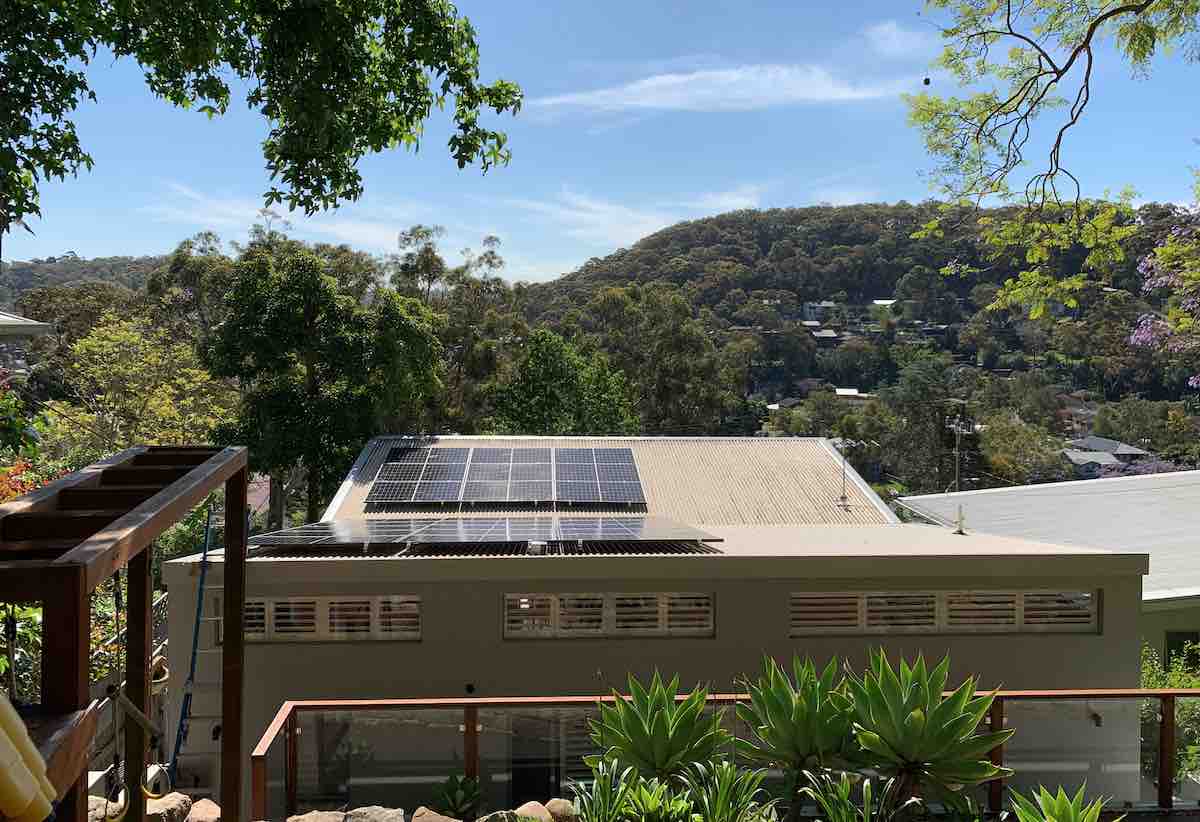

Investing in rooftop solar and battery storage is no easy business. Presuming you can get the financial side of the equation sorted, then choosing the right panels, the right inverters, the right smarts, and – if you’re adding storage – the right battery can feel overwhelming.
Alex Georgiou is a residential solar, battery and virtual power plant specialist who is also the co-founder and CEO of ShineHub, a market leading online solar marketplace and virtual power plant integrator with active projects in South Australia, Victoria, and New South Wales.
This week, Georgiou has shared with One Step Off The Grid his own experience of building the “perfect” solar system, a journey that – when combined with a few energy saving and other key tips – is shaping up to take his household from electricity bills of up to $500 a month to *$250 credits.
The house
Georgiou’s household has four bedrooms and three bathrooms, with electric cooling and heating and everything else, except for a gas hot water heater and cooktop. There is also a home office and “lots of gizmos.”
The gear
– LonGi 370W Monocrystalline Half-Cut Panels x 24 = 8.88 kW panels + 24 Tigo solar panel optimisers*;
– Kehua 5kW Solar inverter;
– Alpha ESS SMILE Hybrid Inverter;
– Alpha ESS 13.3 kWh battery.
Note: Some of this tech is rated independently higher than the likes of Tesla at a significantly cheaper price, says Georgiou.
The result
Before the rooftop solar system was installed, Georgiou says his household’s bills in winter were reaching up to $500 a month when the family first moved in 2020.
Once the 8.8kW solar system was installed (before the battery was added), the home’s power bills would wind up $72 in credit over the summer quarter, despite the air conditioner being on “the whole time.”
But Georgiou says he soon noticed that most of solar power generated by the rooftop system was going out to the grid – and for little financial return. So he invested in a 13.3kWh battery energy storage system.
Georgiou’s projections, now the battery has been installed, are that under the same scenario the household will be around $250* in credit on its bill for the summer – a quarterly saving that could be used to offset the household’s remaining winter bills.
The plan, then, is to sign up to participate in a local virtual power plant, which Georgiou notes are free to join, while promising to add an extra $10-20 per month to the savings column for supporting the grid.
Tips from a professional
Georgiou says:
– Put as many solar panels as you can fit on the roof. The cost of panels has come down so much, you can now cover whole rooftops for the same price that used to amount to a very small system.
– You get a federal government incentive (rebate) for each panel you put on. So it is very cost effective to add a few extra panels.
– Spread your panels out: “Only north facing panels” is a thing of the past! We split our panel location in opposite directions – one set facing east (8 panels), the other set facing west (15 panels). This way they get solar production from sunrise (east facing panels) to sunset (west facing panels) and can generate power from 6am – 7pm (in summer).
– Factor in shading: If one solar panel is shaded, it makes all the other solar panels produce less power as well. Weakest link theory. Our roof has a lot of shading hitting a panel or two here and there throughout the day. With a standard setup, this would have made my system perform terribly, making very little power.
To get around the problem, the Longi Half Cut solar panels are designed so that if there is shading on one half of the panels, it doesn’t affect the other half. We also installed *TIGO solar panel optimisers to minimise the impacts of shading on the system. These ensure that if one panel is shaded, it doesn’t affect the production of the other panels. Another option instead of panel optimisers is microinverters, but these can impact battery efficiency.
Other tips on maximising the efficiency of a solar system:
– Run the air-con during the day, particularly in the early afternoon once the battery has filled up. Keep it on a low setting all day rather than turning it on full blast right at sunset (when there is no panel power).
– Make sure you have energy monitoring installed as part of your kit so that you can always know if you have extra solar power or not.
– When you first get the monitoring, turn everything in the house off, and then go around one by one turning things on to see what energy impact it has. Within 15 minutes or so you can understand exactly what is driving your energy use, and can modify accordingly – either up or down.
– There are only a few appliances that make a big dent in energy usage: the air con and the clothes dryer are often the main offenders. Going around turning things off at the power point does next to nothing, so don’t worry about all that annoying little stuff – focus on the big ticket items.
*This amount was adjusted down from $500 by Alex Georgiou to reflect the recent reduction in the local feed-in tariff.

Sophie is editor of One Step Off The Grid and editor of its sister site, Renew Economy. Sophie has been writing about clean energy for more than a decade.