

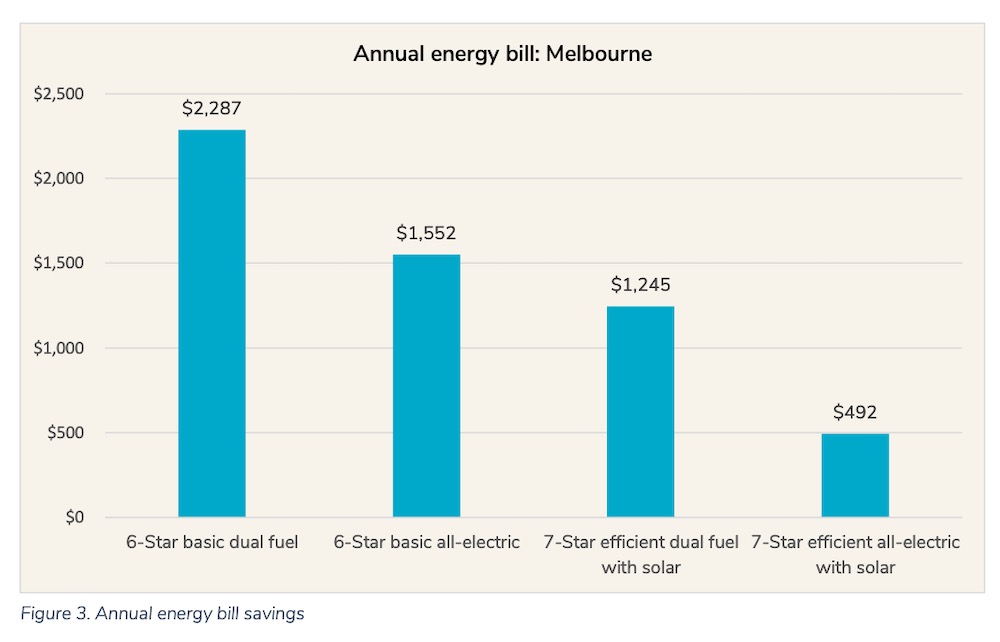
A new report out of Victoria has found that Melbourne households with an average 6-Star efficiency rating and no rooftop solar could save more than $700 a year on energy bills simply by choosing to go all-electric and quitting gas.
The Environment Victoria report, which combines energy efficiency modelling by Renew with existing studies on the costs to households of using and being connected to gas, found that even a basic, no-frills all-electric home in Melbourne would save $735 annually over a basic dual fuel home.
An efficient (7-Star rated) all-electric home with solar saved $1795 a year, cutting bills by 78% from a basic dual fuel home. But even when compared to an efficient dual fuel home with solar, the all-electric 7-Star home with solar still saved an additional $753 by cutting gas out of the equation.
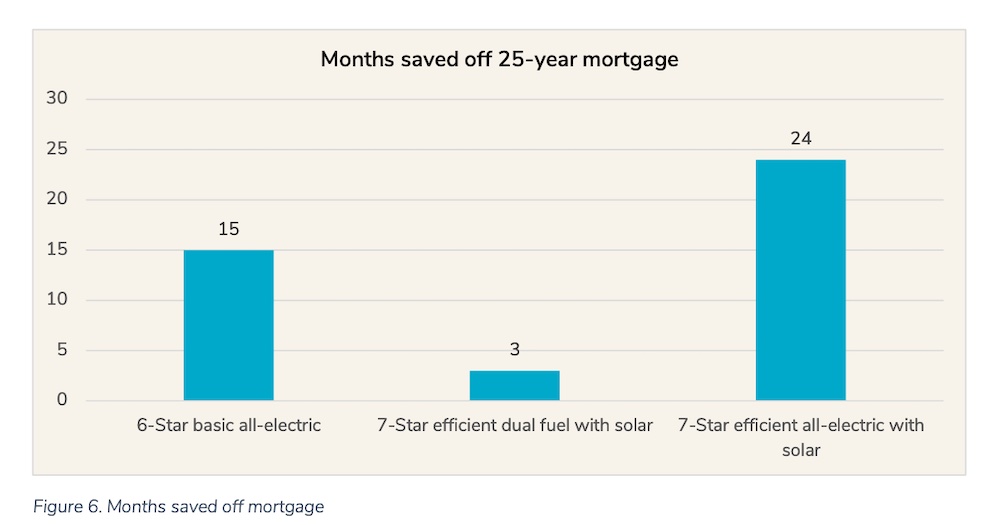
To drive the point home, Environment Victoria notes that, if these energy bill savings were diverted into paying off a mortgage, “an efficient all-electric home can reduce a home loan by two years.”
So why isn’t everyone doing it? This question brings us to the crux of the report, which is that quitting gas in Victoria – where households consume almost two-thirds of all gas burned in Australian homes – is no easy matter.
In Victoria, 83 per cent of Victorian households are connected to main gas and, on average, these households consume almost three times more gas than households in NSW, the state with the highest overall residential gas consumption after Victoria.
Three quarters of gas used in Victorian homes is for space heating. Around one quarter goes to water heating, and a small fraction is used for cooking.
“Influenced by industry, successive Victorian governments have hooked Victorian homes on gas through decades of programs and regulations that have acted as a subsidy for the gas industry,” the report says.
“These government policies locked households into using a polluting and increasingly expensive fuel.”
The report cites a series of state government programs that only recently were used to boost residential gas connections, including $100 million between 2011-2017 to expand the gas distribution network into rural Victoria, “at a massive cost to taxpayers.”
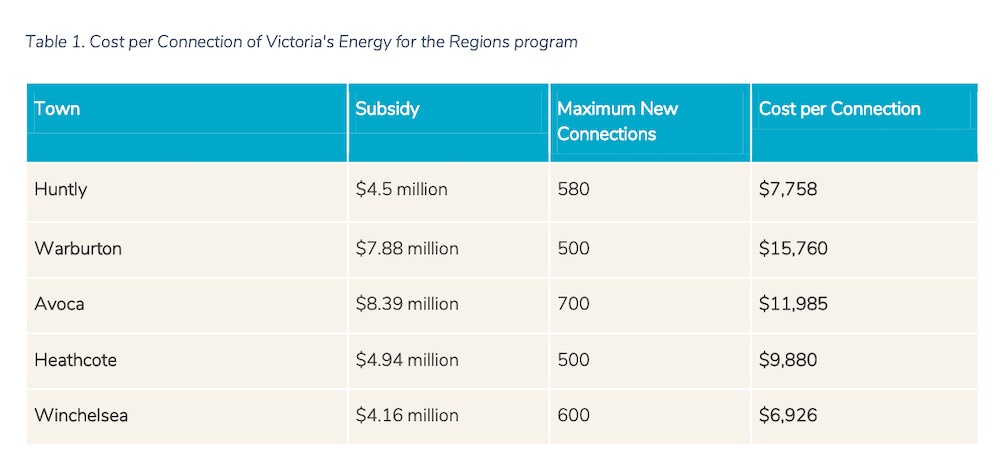
Essentially, the report finds that a combination of government support for the gas industry and outdated planning regulations means that gas connections are still increasing in Victoria, rather than decreasing as they should be, and that this is forecast to continue well into the coming decade.
This is a shame, because by avoiding gas connection costs and replacing gas ducted heating with reverse cycle air conditioners (heat pump technology), the upfront cost of an all-electric home was found to be less than a dual fuel home by over $6000.
So what can be done? First up, planning regulations need to be changed and, on that front, Infrastructure Victoria has recommended that the Victorian government make key changes to planning laws to stop encouraging residential gas connections.
But, as the report notes, “merely removing outdated regulations will not be enough to ensure a transition away from gas at the speed necessary to avoid destructive new supply projects and meet Victoria’s emissions reduction targets.
“The Victorian government should go further and require, or at least strongly encourage, new buildings to be all-electric. This is the most straightforward path towards carbon-neutral buildings.”
In the meantime, there are a number of home builders (see The Cape on Victoria’s Bass Coast) and even major property developers around the state offering all-electric new-build homes. And for those households already connected to the gas network, this can be undone if the home no longer has the need or want for gas – although this approach can have its own set of difficulties (and costs) that are regularly lamented on the highly recommended Facebook group, My Efficient Electric Home.

Sophie is editor of One Step Off The Grid and editor of its sister site, Renew Economy. Sophie has been writing about clean energy for more than a decade.