
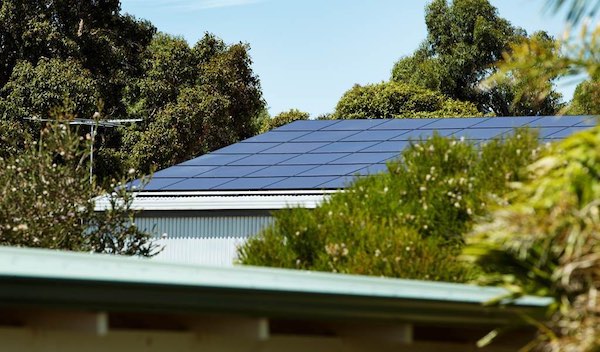
The “father of PV,” UNSW Scientia Professor Martin Green has predicted that the average Australian solar household will soon be installing “tens of kilowatts” on their rooftops, probably coupled with battery storage, as panel costs continue to fall and batteries becomes more affordable.
Green, who just last week told the Smart Energy Conference in Sydney that solar module prices were headed to 10 US cents a watt by 2023, around half their current prices, believes that the lure of this “insanely cheap” energy will drive some major changes in the way consumers approach self-generation.
In an interview with Nigel Morris on this week’s episode of the new Great Solar Business podcast, Green notes that the downwards price trajectory that solar PV had taken – to which the Professor and the rest of the UNSW team have made no small contribution – had been mirrored by an upwards trajectory for rooftop solar system sizes.
This has been evident in the monthly data from industry analysts SunWiz, with the current average size of residential rooftop systems sitting at just over 8kW, compared to an average of around 6.6kW two years ago. But in Green’s own case, over the past couple of decades, the pattern is clear.
“You know, every 10 years, it seems to be I upgrade [my rooftop solar system],” Green told the podcast. “My first one was 1kW, and that cost $20,000 … back in 1999. The second one was 3kW, and that cost $20,000; that was in 2009. And now I’m looking at putting 14kW on my roof and that’s going to cost about [$20,000], too.
“So I guess everyone’s going to bigger systems now because it’s so affordable. So I guess that’s one way each job is going to be bigger. So rather than doing 1kW, like you were doing at the turn of the century, you’ll be doing, you know, tens of kilowatts,” he said.
This could depend, somewhat, on the fate of the solar export charge recently proposed by the Australian Energy Market Commission. As critics of the proposed rule have suggested, moving to tax solar households for excess generation they send to the grid could serve as a major disincentive to install solar at all for some consumers, and would certainly not encourage the adoption of larger systems.
Conversely, as some proponents of the rule change have argued, a solar export charge might work to encourage greater self consumption, including through the adoption of home batteries, that allow households to use solar stored over the course of the day during the evening peak.
For his part, Green believes that battery storage will increasingly become a part of the home solar equation.
“Battery prices are coming down as quick as solar, so, you know, I think batteries are going to play a more important role, definitely, in the mix.
“So that’s a way of boosting revenue and I think, you know, Tesla in the US are now only selling solar systems with a battery, so I guess that’s a model for installers to look at,” he said.
Based purely on the cost of solar, though, a shift to bigger system sizes does seem likely.
“If you just plot the history of … reported average selling prices [of solar PV], it turns out they’re decreasing at about 20% a year. …So if you just continue the trajectory that the industry has been on, for at least the last eight years, and I think before then price reduction was even quicker, you know, we should get to 10 cents a watt within the next three or four years, unless something untoward happens,” Green said.
“And there’s plenty of technology in the pipeline. I think with the introduction of PERC and all its attributes yet to be fully exploited, that’s going to help drive those costs down. So I feel quite confident we’ll get to 10 US cents a watt, I certainly hope in the coming decade, but I think definitely within the first half of the decade that’s coming up.”

Sophie is editor of One Step Off The Grid and editor of its sister site, Renew Economy. Sophie has been writing about clean energy for more than a decade.