
Hardware giant Bunnings is making a dramatic entry into Australia’s booming rooftop solar and household battery market, with a zero upfront installation cost subscription offer, and ambitions to rapidly become a major player in the sector.
Bunnings has teamed up with digital energy management company Intellihub to offer a new service that is has dubbed Zelora, and a range of options for solar arrays and household batteries which can be accessed online.
It will use solar and battery products supplied by two relatively new, but well regarded entrants into the Australian market: Das Solar panels and SigEnergy batteries, which has already staked a significant share of the market.
See: Australia’s new top-selling home battery is a brand you’ve probably never heard of
The launch comes just weeks after the federal government started the roll out its $2.3 billion battery rebate program, which aims to have a million batteries in Australian homes by the end of the decade.
It also comes just months after Bunnings started selling home EV charging equipment in its stores, but it is believed that Bunnings has been mulling such a move for several years.
The move by such a powerful brand, backed by Australia’s biggest conglomerate, is sure to shake up the home energy market, which while strong has been a low margin business because of the intense competition.
Bunnings chief operating officer, Ryan Baker, says Australian households are looking to transition to renewable energy and for practical solutions in the home.
“Many customers find home electrification complex and may not be aware of the benefits it can offer,” Baker said. “Zelora has been developed to simplify the home battery and solar opportunity for customers in a cost-effective way.”
In a later statement to One Step Off the Grid, Baker said the company hoped to expand beyond the Newcastle and Sydney regions.
“We have ambitions to become a leading destination to help customers access home battery and solar solutions to electrify the home.
“Zelora provides an all-inclusive, simple subscription on solar and battery packages, delivered in a cost-effective way because there is no big upfront payment.
Every household’s electricity requirements are unique so savings will differ depending on the customer. The Zelora website takes the customer through every step with an option to upload an electricity bill which gives a better idea on estimated savings and guidance on which battery and solar package is right for their home.”
Intellihub’s executive general manager in Australia, Alastair McKeown, says the company was drawn to the partnership because of Bunnings’ unrivalled brand recognition.
“They wanted to move into home energy space, and we wanted to create something different, so we co-designed a product that gives access to people who don’t have $15,000 to $20,000 to spend on solar and batteries.
“That’s why we designed the subscription based model. People either don’t have the money, or they want to keep the money in the bank. That’s why we designed a subscription based model.
“Bunnings is the most trusted brand in Australia. we felt that combining that trust element with our optimisation tech, the customer will get the best outcome.”
Intellihub, which has been rolling out smart meters across Australia – around 30,000 to 40,000 a month – will use much the same network of installers and electricians for this roll, and will also provide the smarts for the app that Bunnings will provide to its solar and battery customers.
“The app will give insights into savings for the customers, and let them know that there is a problem. Often people install solar and batteries and don’t even know that the equipment is not working properly.” It also provide options for EV charging and pool pump controls.
The Zelora product is to be trialled first across Newcastle and greater Sydney before being rolled out across the country.

The web page already gives an indication of pricing, with subscription for solar and battery systems priced from $126 a month for 3.96 kW of solar and 7.8 kWh of battery storage, up to $174/month for a 10.56 kW of solar and 15.6 kWh of battery storage.
Subscriptions for batteries only start at $80/month for a 7.8 kWh system, up to $126/month for a 15.6 kWh system.
“Our subscription plans are designed to work with the Australian Government’s battery rebate scheme,” the site says. “We handle the admin, and the full rebate value is applied to your subscription term — lowering your monthly fee, with no big upfront purchase required.”
Most of the subscription offers could be expected to be cash flow positive immediately, meaning that the bill savings will outweigh the cost of the subscription.
Solar only systems are advertised at between $4,470 for a 3.96 kW system to $6,980 for a 10.56 kW system, but these appear to be upfront costs, and with no subscription offer available – possibly reflecting the fact that solar only systems now deliver minimal offsets to bills because of the way tariffs are now structured.
McKeown says the offering will have a significant impact on the market. “Given the size of Bunnings, we have spent a lot of time and energy on this, and we want to make a dent in the market.
“That will be down to the customers, but we’d like to the main player in the market, to be the market leader in non-too distance future.”
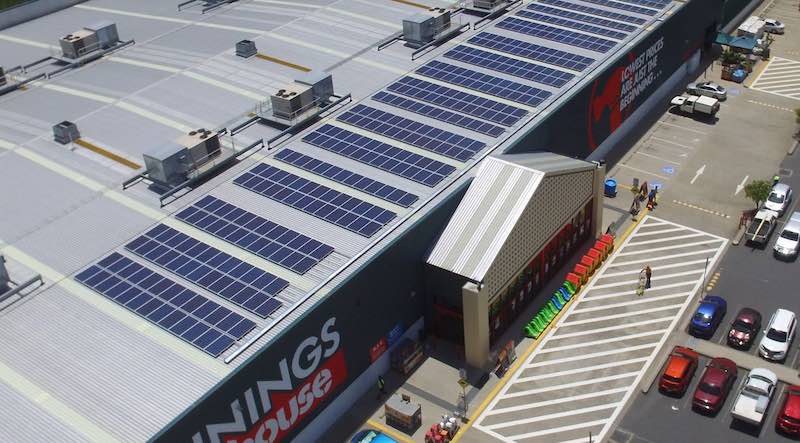
Earlier this year, Bunnings announced it has achieved its 100 per cent renewable electricity target milestone across its Australian and New Zealand store network, as part of its commitment to achieve net zero Scope 1 and 2 emissions by 2030.
See: Bunnings hits 100 pct renewables – including rooftop solar at 163 sites, and counting
Last month Bunnings and its parent company Wesfarmers received $100 million in low cost finance from the Clean Energy Finance Corporation to help the company add solar at more stores, and offer EV fast-chargers for the use of customers while they are at Bunnings stores.

Giles Parkinson is founder and editor of One Step Off The Grid, and also edits and founded Renew Economy and The Driven. He has been a journalist for 35 years and is a former business and deputy editor of the Australian Financial Review.