
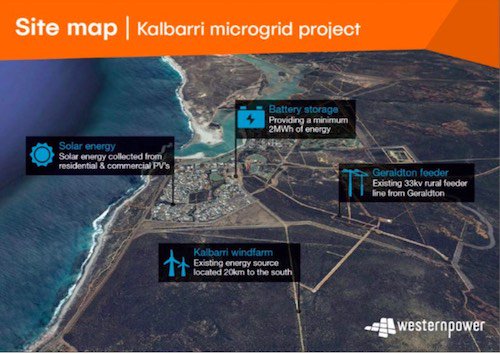
Carnegie Clean Energy and Lend Lease have won a tender to build a wind, solar and battery storage micro-grid in Kalbarri that will be the largest of its type in Western Australia.
The 4.5MW/2MWH battery storage will work with local wind and solar generation to boost reliability for the town, which suffers frequent outages because of its dependence on a wobbly link with centralised generation further south.
The 33kV line connecting Kalbarri, 500km north of Perth, to the rest of the grid is often affected by storms, wind-borne sea salt and sand, and can suffer extended outages.
Energy minister Ben Wyatt described it as a “game changer” for regional communities who rely on power from long feeder lines.
“It is a game changer for regional communities who rely on power from a long feeder line, which is subject to environmental factors that can cause outages,” Wyatt said.
(Wyatt borrowed exactly the same words as his predecessor, Mike Nahan, when the project was first foreshadowed by the then Coalition government in December, 2016).
“The improved reliability for the region will boost the local tourism and retail operations, as well as enhance the lifestyle of residents,” Wyatt said.
“(It) also supports the Kalbarri community’s desire to be renewable-powered, with this project being one of Australia’s biggest 100 per cent renewable microgrids.”
W.A. is emerging as a leader in renewable-based micro-grid, with regional utility Horizon seeing much of its power being sourced through such projects.
Western Power, which operates the main grid, is also looking to micro-grids to create a “modular” grid that is cheaper, more efficient, and more reliable than the current centralized model.
The question for other states is to what extent they will follow. Micro-grids are being created or considered in major cities, like Adelaide’s main produce market, in Tasmania, and at the edge of grid locations.
The $6.8 million Kalbarri contract – tendered by Western Power – was won by Carnegie’s wholly owned subsidiary Energy Made Clean (EMC) and joint venture partner Lendlease Services.
The two companies said in a statement that the battery system will have capacity of 5MW and “overload capacity” of up to 10MW, and would be part of the largest grid-connected micro-grid in WA.
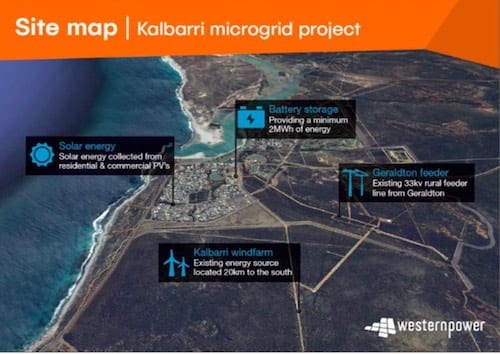
It will tie in with the local Kalbarri wind farm, around 20km to the south of the town, and with solar energy collected from the rooftops of homes and businesses.
The battery storage system will have two modes of operation – meaning that Kalbarri will now be able to be supplied reliable energy through “island mode” when the connection to the main grid goes down, and enjoy greater reliability through network stabilisation relating to voltage and frequency, and balancing renewables.
Carnegie CEO Michael Ottaviano said Kalbarri has been suffering from poor supply “since forever”, and this micro-grid would offer a cutting edge solution.
“This is an incredible opportunity to provide an economic solution – it will able to hold local load when grid the goes down.
“And for about $6 to $7 million investment it will be able to deal with 95 per cent of the reliability issues.
“It shows we can deliver cheaper, clean, more reliable solutions than what is available today”, noting the “huge subsidies” paid to diesel generators and their environmental impacts.
“The altenative to the (micro-grid) was big diesel, and I can tell you that the residents were dead against that, or building another line up the coast which would cost hundreds of millions of dollars. This is a very economic solution.”
Design work for the project commences immediately, with construction scheduled to commence in November 2018 and operation by June 2019.

Giles Parkinson is founder and editor of One Step Off The Grid, and also edits and founded Renew Economy and The Driven. He has been a journalist for 35 years and is a former business and deputy editor of the Australian Financial Review.