

New research into the best ways to shift Victorian homes and businesses to all-electric power has warned that the gas brand is “strong and stubborn” in the state, and that pushing people to give up gas – either for economic or environmental reasons – is the wrong way to go about advocating for electrification.
The research, conducted in June by the City of Moreland in Melbourne’s inner north, surveyed 58 participants from the local government area’s “growth corridors,” who were classed as either home upgraders or new home buyers.
Moreland City Council, which was the second Victorian local government and the third in Australia to be Certified Carbon Neutral for its corporate operations, conducted the research to inform its public campaign for all homes and businesses to be powered by electricity, only.
The results of the research, which was led by Essential Media, have been published by the Council as the The Electrify Everything: Communications Message Guide for Households, an open online resource for any organisations seeking to drive a shift to electrification.
According to the Guide, the research provided valuable insight into participants perspectives on powering their homes, including around health, costs and the environment – “much we expected to hear, with some surprises.”
One of the key themes that stood out from the research was that participants were happy to use gas in their homes and largely on board with the industry’s marketing message that gas is “natural,” clean and cheap.
This may not be surprising, in that, as the guide puts it, “the gas brand is strong and stubborn.” Indeed, as Tim Forcey wrote on RenewEconomy, the gas industry has recently ramped up its public-relations offensive, targeting householders and decision-makers at all levels of government.
But it is surprising when you consider that none of these things are actually true. The use of gas in the home has serious pollution and health impacts all along the supply chain, and particularly at the source, where CO2 and methane are removed from the gas and vented into the atmosphere.
In terms of cost, as Forcey puts it – and you can check out his calculations here – Australian gas left the “cheap” zone years ago. And soaring prices in the UK and elsewhere in Europe leading into the northern hemisphere’s winter serve as a warning of what’s to come in Australia.
Despite all this, participants in the Moreland survey by and large saw gas as an efficient, reliable and cheap energy source for residential usage, and weren’t overly aware/concerned about its environmental or health impacts.
Most crucially, perhaps, “they did not agree that electricity is currently cheaper than gas. Some even suspect that the transition to renewables will drive prices up in the short- to mid-term.
“The research… demonstrated that people weren’t convinced about the cost benefits of switching to electricity; that they didn’t believe electricity was cheaper or would even be so in the future,” the report says.
“Therefore, messages that pitch electricity as a cheaper more comfortable and more convenient solution don’t necessarily work.
“Upfront costs to switching are also a barrier for most people – no matter how much we talk about long-term savings. We need to highlight available rebates and initiatives wherever possible.”
Another surprising result from the research was that while renewable energy technologies like rooftop solar were strongly supported, climate change and environmental messages were found to be “polarising” and disengaging.
“Research shows that talking about the need to reduce emissions can evoke anxiety about people’s future quality of life and their financial security,” the report says.

“Research showed that although most Australians feel positively about renewable energy, they feel neutral about fossil fuels, and pitting them against each other can activate a political frame that disengages the message.”
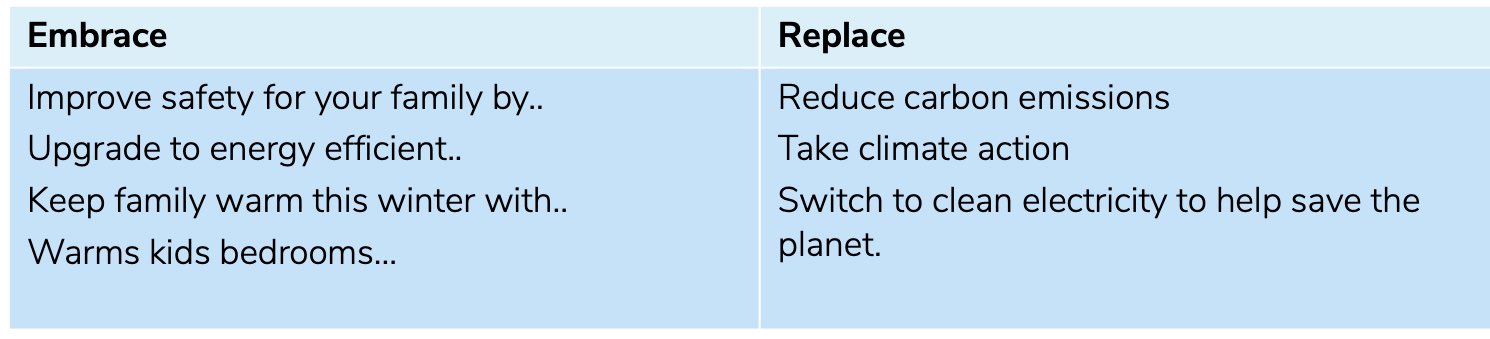
Ultimately, the main message from the Moreland research was Don’t Mention Gas: Don’t talk about it; don’t ask people to give it up; don’t pit it against renewables.
“[A] key tactic of this campaign is that we are not fighting gas,” the guide says. “The campaign is not mentioning gas, negating the gas industry’s point of view, or providing FAQs or education sessions on gas vs electric homes.
“The gas brand is strong and stubborn. Changing this incumbent ‘story’ is difficult and, arguably, not our role.”
A better approach, the guide recommends, is through the use of “aspirational messages” that show households a positive, actionable way to improve outcomes for both themselves and the planet.
“Encouraging people who are building and renovating to build for the future, rather than installing appliances that will eventually require retro-fitting, could be a persuasive argument,” the guide says.
This is all good food for thought and probably very good advice on many levels, but busting the myths of the gas industry remains an important job, if not for local governments then for the media. Governments at all levels, meanwhile, should get busy with incentives and messaging that make clear the benefits of switching to efficient electric appliances and – where possible – powering those appliances with renewable energy.

Sophie is editor of One Step Off The Grid and editor of its sister site, Renew Economy. Sophie has been writing about clean energy for more than a decade.