
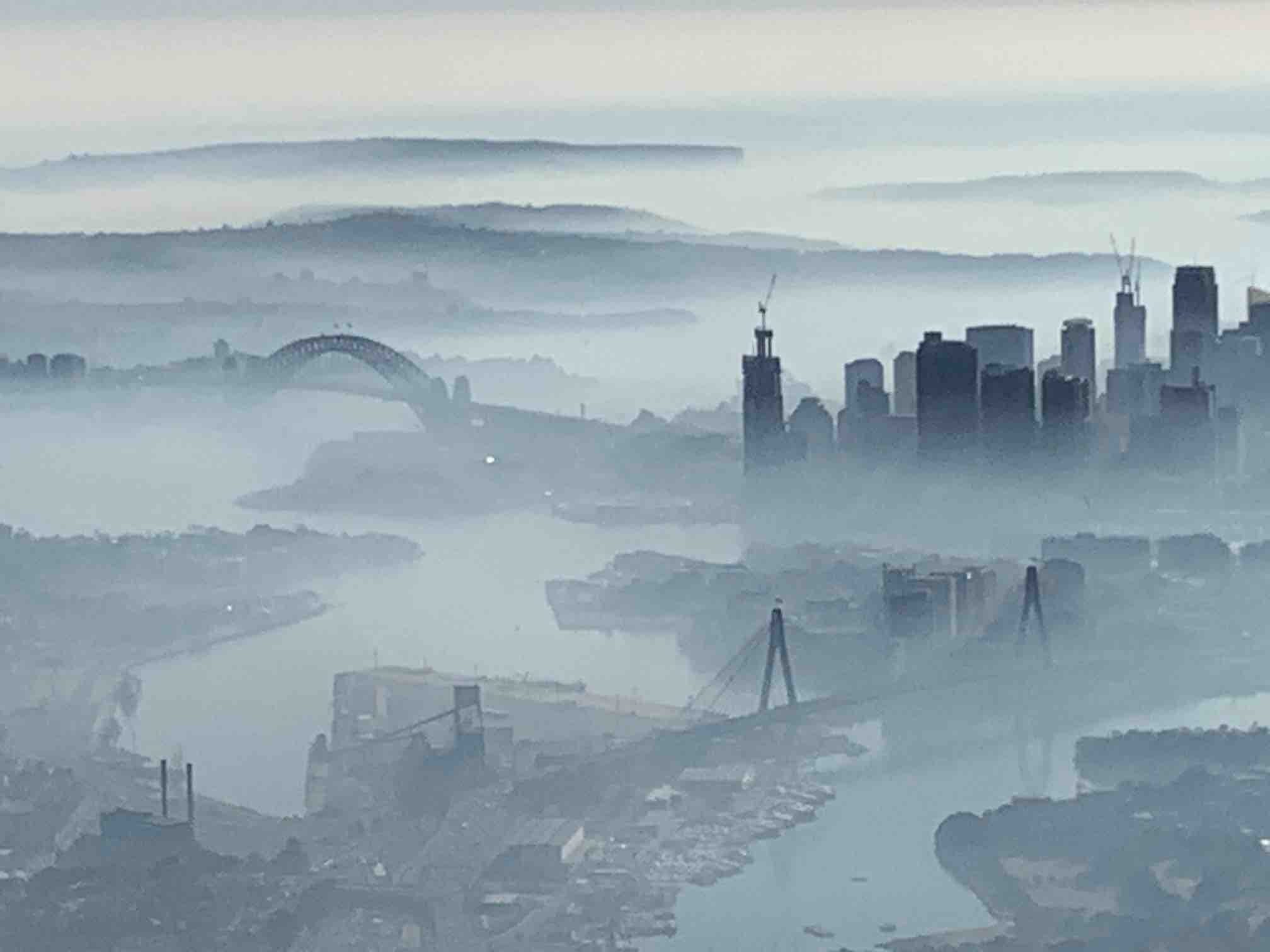
Solar owners in smoke affected areas, particularly those who’ve been sheltering in air conditioned homes more than usual, might be wondering how well their rooftop systems are performing under the haze.
Solar monitoring company Solar Analytics has found that rooftop PV systems in Sydney and Canberra saw PV output plummet by 15 – 45% on heavy smoke haze days.
Solar Analytics monitors the energy consumption and solar PV performance of 35,000 sites across Australia.
On New Year’s Day, when Canberra choked under highly hazardous smoke haze with an AQI in excess of 3400, PV output in the capital plummeted by a costly 45%.
Analysis of PV sites in Sydney on December 10 showed a 15% drop in production, and on December 21 this rose to a hefty 27% drop.
December 10 was one of the more heavily smoke-affected days in Sydney with the Air Quality Index (AQI) levels classified as hazardous.
On this day, Solar Analytics’s algorithms detected a drop in Solar PV production in Sydney. A closer look showed that the median energy generated at 2200 Sydney sites on clear days during the first two weeks of December was found to be 26.6 kWh but on December 10, 2019, median production was down to 22.7 kWh.
Further analysis of the output of solar PV sites in Sydney on December 21, a cloud-free but very smoky day, showed a 27% drop in the energy being generated from PV systems when compared to a clear day from 2018 (17 December).
[Note: The output on Dec 21 in Sydney and New Years Day in Canberra was defined as the average specific power across all monitored sites. Average specific power is the output divided by the installed capacity, or kW/kWp.]
Is your solar affected?
If you’ve had very poor air quality at your solar PV site, you can assume it has impacted your solar production.
Solar Analytics customers can view their system’s output in the ‘Production’ page and the ‘Performance’ page and check if there’s been a drop during the smoke affected periods.
Haze is a solar PV problem, and not just from bushfire smoke
A 2018 study by Andre Nobre and Ian Marius Peters published in Energy and Environmental Science explored the impact of haze on urban solar installations.
It found that in Delhi, where haze from pollution is persistently high, the average annual reduction in solar panel output was about 12 percent.
On December 10, the Air Quality Index in Delhi was at 356, while in Richmond in Western Sydney, on the same day the AQI was an astronomical 2211.
A high AQI can have a significant impact on the financial returns from a solar PV system, especially if the problem is persistent.
Some panel types are better suited to hazy conditions
The study also explored the efficiency of different types of solar cells in hazy conditions, compared to standard silicon panels.
Different cells – gallium arsenide, cadmium telluride, and perovskite – have different spectral responses to haze.
Interestingly, standard silicon panels performed the best, and perovskite, a promising new solar cell material was affected most severely (with 17% losses in Delhi).
Will air conditioning protect you from the smoke pollution?
Central air conditioning units are heat exchangers. This means they extract the heat from the air already in your home with a closed coolant system and then use fans to push a lot of outside air over the coolant to suck out the heat and exhaust that heated air outdoors.
Outdoor air does not get into your home through the unit.
TIP: How to reduce your air con energy consumption
Set your air conditioning units to their ‘eco’ mode.
Eco mode increases the fan speed and and the set point for the temperature. You’ll be just as comfortable but by taking the work away from the energy guzzling compressor you’ll save energy.
We hope you stay safe and comfortable over the summer. Our thoughts are with all of those who’ve suffered so much from these devastating fires.
Source: Solar Analytics. Reproduced with permission.