
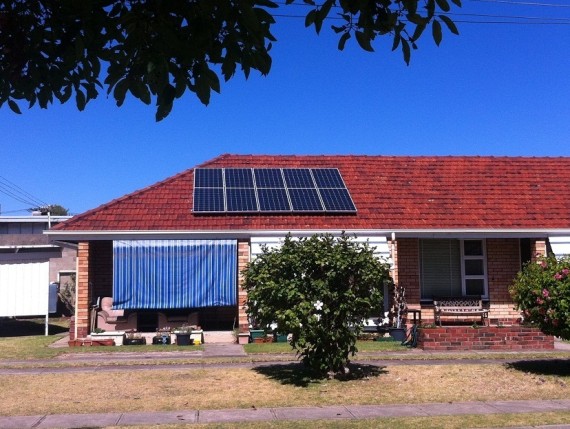
So you’ve got rooftop solar, and you’ve got an electric vehicle. But can you power both your house and your car with the one PV system?
The answer, of course, is complicated. It depends on the size of your rooftop solar system, the time of day you want to charge your car, the battery size of your EV, and how much you drive around every day.
The short answer, however, from solar brokerage company ShineHub, is that it is possible to get extra panels and batteries to cover most if not all ordinary commutes – as long as you “top up” each time. It will be hard to charge a car battery from near empty to full with only rooftop solar.
“Instead of aiming to recharge a completely flat battery, households should endeavour to be able to recharge the car from a typical day of driving around your community,” says ShineHub CEO Alex Georgiou.
“This is much more achievable and won’t break the bank.”
But it will still mean adding extra panels, and possibly a battery storage system, depending on when you are most likely to need to charge your car.
ShineHub put together the below table working on a few assumptions, including that a typical home uses around 20kWh of electricity a day – which could be covered by a 5kW (16 panels) solar system; and that a typical driver has a commute of between 10km/day to 60km/day.
Table: How many panels you would need to cover your daily EV driving with solar?

By ShineHub’s calculations, a commute of 40 km/day would use only around 15 per cent of the battery of a Nissan Leaf, or around 8 per cent of a Tesla battery.
In terms of kWh of electricity, you would need an extra solar supply of 6kWh/day for the Nissan Leaf, or 8kWh/day for the Tesla, to recharge your EV from solar for that 40 km/day.
Which means that, for most people, the average solar system of around 5kW would be plenty to provide the day-to-day top ups, during the day.
By adding a battery storage system you can use some of that electricity at night. A system ranging from 5kWh to 15 kWh would to store between 25 per cent to 75 per cent, respectively, Georgiou says.
As for how much extra solar would be needed for a full EV charge? To work this out, you need to factor in the car’s battery size.
The examples ShineHub uses are a Nissan Leaf, fitted with a 40kWh battery pack and with a range of around 270km.
At the other end of the scale is a top-range Tesla, with a 100kWh battery pack and a range of around 540km.
Take the Nissan Leaf example to start. Georgiou says to full charge the car’s battery during the day using solar power, households would need to add an additional 10kW (32 panels) to their rooftop system.
That will produce an additional 40kWh/day which is the same amount of power required for a full car charge, he says.
If you wanted to fully charge your EV overnight, when you got home from work, you would need to install 40kWh of battery storage as well.
As for the Tesla, you would need to an additional 25kW solar system (80 panels), and 100kWh of battery storage if you want to charge it at night.
As Georgiou notes, this could be pretty difficult, considering it is rare that network operators will allow any home to install more than 15kW of solar panels.
“Renewable energy is never a ‘one size fits all’ approach,” he said.
“We’re moving towards a future where EV charging stations will be common fixtures in our communities – they will be found at our workplaces, our shopping centres, along our highways and of course within our homes, potentially as part of community virtual power plants.
“So, if you’re considering solar with an EV future in mind – make sure you consider the bigger picture, and plan for the future.”

Sophie is editor of One Step Off The Grid and editor of its sister site, Renew Economy. Sophie has been writing about clean energy for more than a decade.