
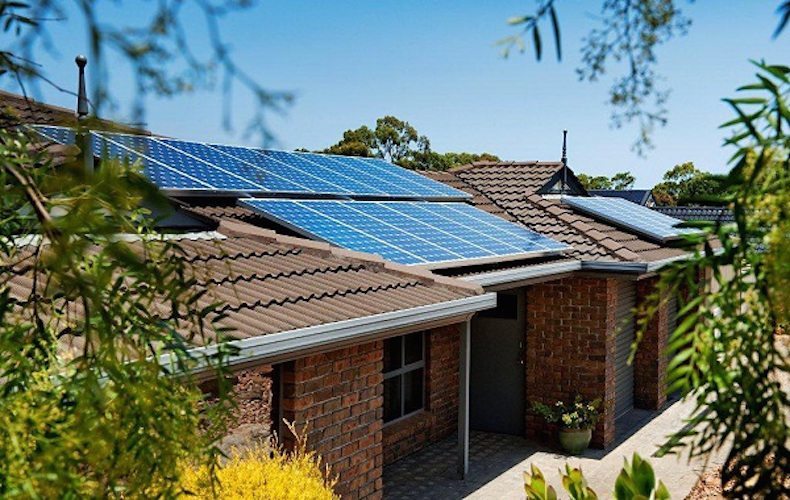

A new electricity retailer that will focus on smart meters, rooftop solar and battery storage is about to emerge in Australia as the shift to decentralized energy models accelerates across the country.

Enegeni, the brainchild of James Myatt , the founder of APG, Texas-based Entrust Energy and briefly the CEO of Sungevity Australia, and Darren Miller, the former head of asset finance at Sungevity and a former investment manager working for Kerry and James Packer, expects to begin operations in October, firstly in NSW and then in south east Queensland and South Australia.
“The business model is going to be unique,” Myatt told One Step Off the Grid in an interview this week. “We plan to fundamentally change the way energy is delivered.”

They will do this, he says, by creating a platform that will “enable distributed generation (solar and storage) to be rolled out and still maintain a viable retail business model.”
Numerous analysts have forecast big changes to the way the energy is delivered in Australia as it shifts from centralised generation to a decentralised model, based around technologies such as energy and storage.
But how this can be absorbed into current business models has not been immediately apparent to the incumbent energy industry, whose survival has already been threatened by the rapid take up of solar in Australia, and the likelihood that battery storage will follow a similar trajectory.
Enegeni proposes to offer power purchase agreements to the consumer at a price below the prevailing grid price, which means that it will own the technology, and sell the output to the consumer at a price.
Big retailers are starting to do the same thing. The difference with Enegeni is that it will do so with smart meters, and it will form the basis of its business model rather than just a small part. In some ways, it will be the taste of the future.
The details of those PPA prices will not be revealed until next month – possibly at the Energy Disruption Conference co-hosted by RenewEconomy in Sydney in September – but it will be based around the use of smart meters in customers’ homes, and the collection of data to make the most appropriate and cost-effective offering of solar and storage to consumers.
The critical point, says Myatt, is that battery storage is complex, and because every household is different in its location, the orientation of its rooftop and the way it consumes energy, the only way to understand how solar and storage can work to their advantage is to obtain the data.
Myatt says 99 per cent of consumers will have to remain connected to the grid, and smart meters were critical in providing the necessary information, and the smart technology, that could allow customers to nagivate the complex maze of tariff structures and get best value from solar and storage. That, he says, would be difficult to achieve for any household that just went out and bought batteries from Bunnings.
“You need to provide a service, not just dumb technology,” Myatt says.
The traditional retail model is already suffering a “full frontal attack” from rooftop solar, because the retailer’s profit is usually directly linked to the amount of electricity their customers consume.

Miller points to an average NSW household that consumes 7MWh of electricity a year. If this household installs an average 4kW solar PV system, then their consumption from the grid would drop by around 30-40%, making this 7MWh customer suddenly look like a 4-5MWh customer to the grid.
This may be manageable when solar penetration is only 10-15 per ent as it is now in states such as NSW, but in a scenario in which solar reaches 50 per cent penetration (it is already at near 25 per cent penetration in South Australia and south east Queensland) and energy storage goes mainstream, this could easily represent a 10-fold impact on energy retailers’ business models compared to the pain being felt today.
And those forecasts are well within the boundaries of possibility. Bloomberg new Energy Finance expects the amount of rooftop solar to rise 8-fold in the coming two decades. Market Operators such as those in Western Australia predict more than seven out of ten homes will have rooftop solar.
“Electricity prices in many parts of Australia have doubled in the past 7 years,” Miller says. “This would be acceptable had there been a commensurate increase in actual or perceived value, but in truth consumers are getting the same antiquated service as they were a decade ago.”
Miller says consumers are also confused by the billing systems, complex tariff structures and the lack of visibility.
“As an example I recently used Energy Made Easy to compare 71 offers from 17 retailers in NSW.
“The offers for an average family ranged from $1,500 per year to over $2,250 per year. This is a massive range for what is essentially a commodity. It’s little wonder that the average customer views energy bills the same way they view paying tax.”
Enegeni has already completed a first round fund raising program and will begin to roll out its product in October.

Giles Parkinson is founder and editor of One Step Off The Grid, and also edits and founded Renew Economy and The Driven. He has been a journalist for 35 years and is a former business and deputy editor of the Australian Financial Review.