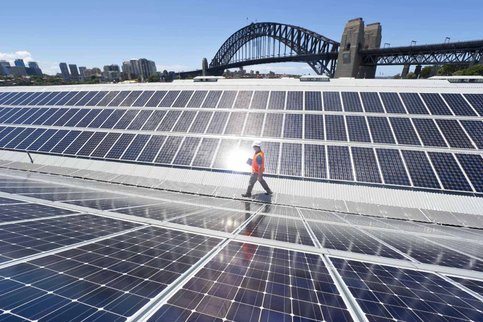

Imagine every town in Australia running off its own renewable energy projects, every farm has solar and is part of a wind, solar or bioenergy cooperative and every new suburb has its own microgrid so neighbours can share one another’s power.
It’s not that hard to envisage, right? That’s because people across Australia are already working to make it a reality. And it’s a reality that comes with a bunch of benefits.
Community-led renewable projects keep jobs and profits in the towns in which they are build. The decentralisation of energy drives down the cost of up-keeping the electricity system and hence our power bills. Supporting organisations such as community groups, farmers, households, councils and property developers that have not previously been in the energy business to lead on clean energy will also speed up the modernisation of Australia’s electricity system.
The more people deploying renewables, the quicker we move to a zero emissions energy system. And, as the household solar boom has shown, when people and organisations have a direct financial stake in its success political and social support for clean energy grows.
The Victorian Government is on the case. Two weeks ago its Energy Minister Lily D’Ambrosio established three pilot Community Power Hubs to help groups in Bendigo, Ballarat and the Latrobe Valley access legal and technical advice to get their innovative clean energy ideas up and running.
It is a widely welcomed move by organisations across the community energy sector (which campaigned for a network of 50 hubs across the country). But it’s a small step in what promises to be a long race to truly unlocking the potential of community and local clean energy across Victoria. The $220,000-$300,000 set aside for each hub and the two year timeframe of the program is not commensurate with the task at hand.
That’s because there are a tonne of obstacles along the way.
A number of energy consumers that face market barriers to installing rooftop solar and are currently locked out of the clean energy revolution. These include low-income households, renters, apartment dwellers and people with unsuitable roofs. There are business models that can overcome these barriers, but they are much more complex and thus typically more expensive than for a homeowner with a sunny roof.
The task of accessing impartial information is not simple. The clean energy sector is still relatively new in Australia and the combination of many new actors with little brand recognition and a lack of trust of incumbent energy retailers such as Origin and AGL means that consumers are not sure who’s information to trust.
Accessing expertise is also a problem. While non-experts can play a much greater role in an energy system powered by renewable energy, there is still an important role for experts. Community energy groups for example typically need to access lawyers, energy professionals and finance experts.
And, perhaps most frustratingly, the rules of the game make many projects unviable. The rules of the energy game are skewed in favour of large power plants, rather than local energy projects.
Given the benefits of consumer-led local energy projects and the barriers that have to be overcome, the establishment of a larger state and eventually national network of 50 Regional Energy Hubs that has long-term government support is really what is required.
As such, community energy groups across Victoria and beyond will continue to campaign to unlock the benefits of community and consumer-led renewables and energy efficiency projects. The next step – to see the establishment of at least 10 Victorian Hubs, with longer-term and larger funding support from the Victorian and Federal Governments.
Nicky Ison is Founding Director of the Community Power Agency