

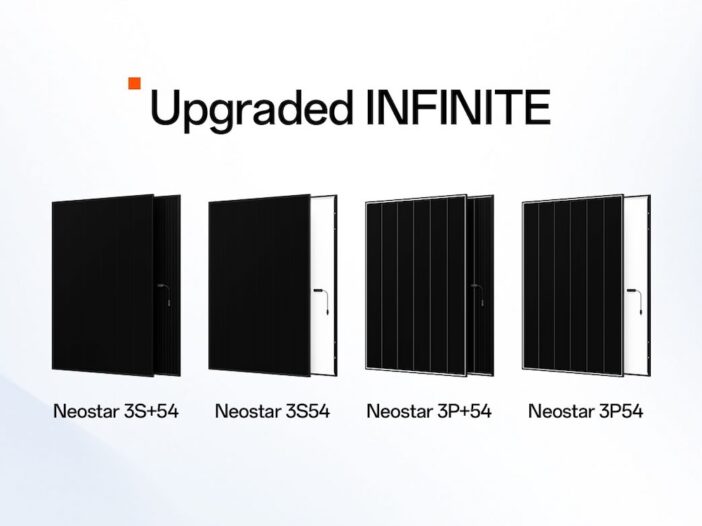
Chinese solar manufacturer Aiko has unveiled a new 500 watt (W) PV module which delivers a what it says is a “world-first” 25 per cent efficiency in a standard format under 2 square metres.
Aiko debuted the new portfolio of solar panels in September at Smart Energy Queensland but on Wednesday unveiled the complete range at All Energy Australia 2025 in Melbourne.
It came as the company also announced a one gigawatt supply agreement with leading local distributors for its new Infinite Series portfolio, and also revealed it is keeping a lid on costs by using a copper interconnection instead of the more traditional silver.
The company says the new solar milestone – the first 500 watt panel in a module less than 2 square metres – gives customers a greater choice and higher efficiency across residential, commercial and large-scale solar projects.
It will also help solve problems of limited roof space, and allow households and installers to pack in more power into a smaller space.
The gen 3 Infinite Series includes the Neostar 3P54 mono-glass module, with output ranging from 475W to 500W and module efficiency of 25 per cent.
The Neostar 3S54 mono-glass module boasts output ranging from 465W to 495W, and module efficiency of 24.8 per cent, while the Neostar 3S+54 dual-glass module offers output between 470W and 485W.
First-year degradation across the range is only 1 per cent, with annual degradation over the subsequent 29 years of only 0.35 per cent. All three model lines also feature partial shading optimisation, better temperature coefficients, high temperature restriction, micro-crack resistance, and lower balance of system costs.
The third-generation Infinite Series solar panels rely on Aiko’s patented Two-Step Passivation – a proprietary all back contact (ABC) cell process that independently optimises the n-type and p-type layers.
According to Aiko, their dual-layer approach eliminates conventional efficiency bottlenecks, helping to deliver higher conversion rates, and enabling back contact solar technology to enter mass production.
Back contact technology puts the contacts that collect electricity generated by the panel from the front to the back, which in turn allows the solar panel to capture more sunlight. ABC solar cells, also known as interdigitated back contact (IBC), is one of the most efficient solar technologies available today, but has faced several production challenges.
Radovan Kopecek, an expert on back-contacted (BC) solar cell and module technologies, told PV Magazine earlier this year that BC solar module manufacturing capacity could reach 1 terawatt (TW) by 2030, and that conventional front-contact solar technologies such as TOPCon could potentially be driven out of the market by BC designs by 2028.
The innovations Aiko has made in technology and manufacturing therefore aim to accelerate the adoption of back contact solar panels.
“Back contact technology has long been admired for its superior performance, yet its high cost has kept it out of reach for most everyday Australians,” said Thomas Bywater, head of Aiko ANZ.
“At AIKO, we believe advanced solar technology should not be an exclusive privilege. Our next-generation ABC products deliver world-class performance without the premium pricing, maximising returns for the families, businesses and communities who need it most.”
“As the industry moves toward back contact as the dominant technology pathway, Aiko’s manufacturing capability and distribution network position us to lead that transition in Australia,” added Bywater.
“Our partners are now equipped to deliver next-generation solar technology with the scale and support that large projects demand.”
Aiko also uses a copper interconnection instead of the more traditional silver, which nevertheless delivers higher conductivity and greater mechanical strength, while replacing one of the most expensive and limited inputs in traditional solar with a more sustainable material.
Announced in tandem with the unveiling of its Infinite Series portfolio, Aiko also revealed that it had signed a 1-gigawatt (GW) supply agreement with leading local distributors Solar Juice, Tradezone, AC Solar Warehouse, Sol Distribution, and Lawrence & Hanson.