The word “unique” gets attached to so many energy projects, it hardly has meaning anymore. But a new microgrid now operating near Tampa, Florida, lives up to the billing because of the technology it uses, the customers it serves, and the cost recovery structure it employs.
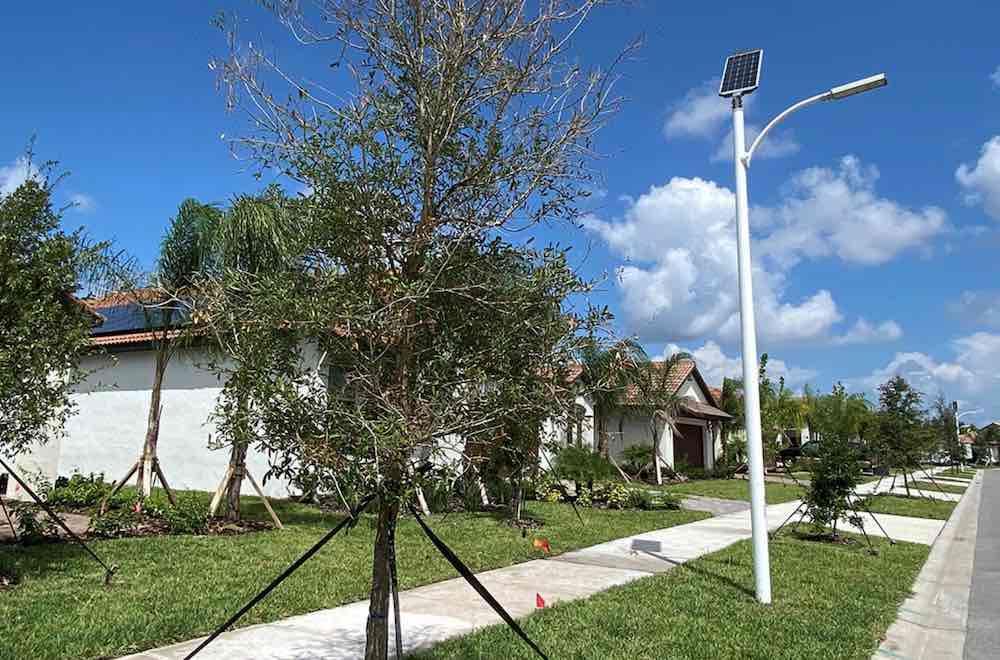
Located in the Southshore Bay housing development in Hillsborough County, the project serves 37 homes, itself unusual given microgrids are typically installed for businesses, institutions or government services. While home or neighborhood microgrids are beginning to crop up, they remain rare.
Developed by Emera Technologies using what it calls BlockEnergy, the project makes each home into a nanogrid with its own solar, batteries and control technology. An inverter converts the microgrid’s direct current (DC) power to alternating current for use inside the home.
The homes are then connected together via a cable network system — a DC bus — that loops through the neighborhood. This allows the homes to share their energy resources.
If the solar panels on the homes don’t generate enough power at any given time, the homes have a fallback system — a central energy park run on solar and natural gas that is located near the neighborhood’s entrance and connects to the homes’ network.
Emera Technologies is a subsidiary of Canadian utility Emera, which explains why the company is keenly interested in the utility market for microgrids.
In this case, Emera Technologies partnered with Tampa Electric (TECO), a utility that serves 800,000 customers in west central Florida. TECO bought the BlockEnergy system from Emera Technologies and owns and operates the microgrid.
That leads to the third aspect of the project that is unique — its utility cost recovery mechanism.
Who pays?
In several states utilities struggle to develop microgrids because regulators are reluctant to let them pay for them through rates. As these regulators see it, unless all ratepayers benefit from the microgrid they should not be burdened by the cost, however small in relation to the utility’s rate base.
The counterargument is that microgrids can serve the broader grid by providing demand response and ancillary services — which benefits all.
A microgrid can also provide help beyond its immediate footprint by acting as a refuge during a power outage — creating a place where people from throughout the utility service territory can seek shelter from severe heat or cold, charge phones, fuel vehicles and get food and supplies.
The Florida Public Service Commission said it would let TECO recover costs for the $1.99 million for the Southshore Bay pilot project.
To Emera the decision makes sense because it reflects what utilities do as part of their normal cost of business — invest in and maintain assets for their useful life.
“Utilities are expert operators, which makes BlockEnergy a win-win for customers and utilities alike. Customers benefit from more renewable energy with a step change in reliability, but without the upfront costs or ongoing maintenance of making the investments themselves in rooftop solar battery storage or backup generation,” said Scott Balfour, Emera president and CEO, during the utility’s most recent earnings call.
“The technology [BlockEnergy] allows utilities to do what they do best, invest in rate base with economies of scale, and [optimise] the flow and sharing of energy sources to reduce the overall cost for all customers.”
Several home or neighborhood microgrids are in some stage of planning and may or may not come to be. But the Southshore Bay project is up and running — and has been for several weeks, according to Chris Hooper, chief operating officer at Emera Technologies.
Emera Technologies announced the project in October 2020 and has since taken a cautious approach to building out the microgrid, adding homes incrementally because it was TECO’s first venture into this kind of project.
The company energised homes as residents moved in. The homeowners pay for electricity at the same metered rate as they normally would, with no extra grid charges or other fees for the microgrid’s reliability and sustainability benefits.
Microgrid to watch
The project won a place earlier this year on Microgrid Knowledge’s list of 22 microgrids to watch in 2022.
Dave Pickles, vice president of electric delivery at Tampa Electric, described the Southshore Bay microgrid as a way to offer “a new layer of control, operability and flexibility. It’s one that can directly benefit our customers and help us to realise our net-zero vision.”
Here are more details about the Southshore Bay microgrid:
- Participating homes each receive an inverter to convert the DC microgrid power to alternating current, along with about 7.8 kW of rooftop solar and 17.7 kWh of battery storage.
- The central energy park includes 240 kWh of battery storage and a pair of reciprocating natural gas generators totaling 350 kW.
- Lennar Homes built the houses and Metro Development Group acted as land developer.
This article was originally published on Microgrid Knowledge. Reproduced here with permission