
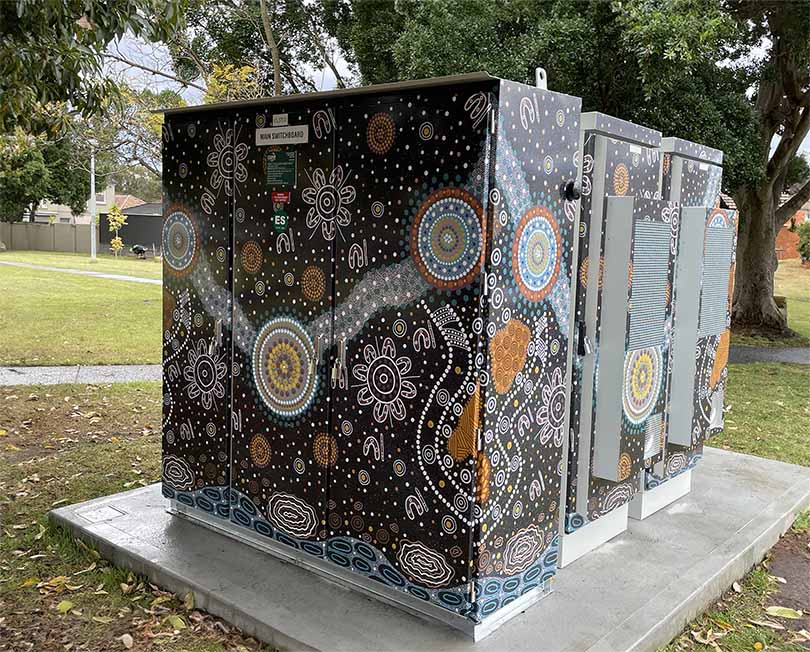

The federal government has funded over 400 community batteries to be installed across Australia that will provide shared storage for up to 100,000 households. Most of that government funding has gone to DNSPs, the electricity distributors who build and own the poles and wires.
But concerns have been raised about whether community batteries can be cost effective without government subsidies.
A recent report by the not-for-profit community energy group, Zero Emissions Noosa, found community batteries aren’t yet cost effective without a government grant.
Research by Tristan Edis from Green Energy Markets found “there are no economies of scale by moving to a neighbourhood sized battery. In fact, when the networks are involved, those batteries are substantially more expensive than a residential, household battery.”
However, Ausgrid, the largest distributor of electricity on Australia’s east coast, which provides power to nearly 2 million customers, believes community batteries are an important piece of the energy transition puzzle.
Group Executive of Distributed Services at Ausgrid, Rob Amphlett Lewis, told the SwitchedOn podcast he’s confident community batteries will become cost effective in the not-too-distant future.
Ausgrid has so far deployed nine community batteries, with funding support from the federal government, in several Sydney suburbs including North Epping, Bankstown, Cameron Park and beachside Bondi.
Amphlett Lewis concedes the first round of Ausgrid’s community batteries were relatively expensive, as they navigated the challenges of integrating this new technology into their operations.
But he says the costs of deploying and operating these batteries are coming down every time they deploy another battery, and they learn how to do it more efficiently.
Amphlett Lewis argues community batteries will become economically viable without the need for ongoing subsidies, and estimates the next round of larger, 5 megawatt community batteries will cost between 500-750 per kwH, “around half the price of a typical behind-the-meter battery.”
“We’re looking at costs which are much more akin to the utility scale costs of battery deployment, and a lot cheaper than what you’d get for a behind the meter battery deploy.”
A key part of making community batteries cost effective is ensuring they provide value to multiple parts of the energy system – from the network operator to energy retailers and, crucially, to local consumers.
Ausgrid has recently released its Energy Storage as a Service, where consumers can sign up through their retailer to access a local community battery.
Amphlett Lewis says customers will have the same benefits of a typical household battery – access to cheap renewable energy during the peak evening period – but without the significant upfront costs.
“Customers using this service will have a lower network charge due to reduced demand on the transmission, sub-transmission, and high-voltage networks,” explains Amphlett Lewis.
Much criticism has been levelled at electricity networks for receiving the bulk of government funding to install community batteries.
“These things are not in any way, shape, or form, a community battery …. [They’re] owned by a monopoly network business …. they are in the business to make a profit,” says Tristan Edis.
However, Amphlett Lewis argues that the name of these medium sized batteries is less important than what they can do.
“They provide a value to the community in terms of helping to manage the power quality and the network in that community.”
“We want the community to directly benefit from these batteries, and we want the community to understand that these batteries being where they are will improve the power quality and that the energy system for the community.”
As to whether community batteries should be owned and installed by non-DNSPs – community groups and councils for instance – Amphlett Lewis says it’s too early to tell.
He says we all need to “lean in” to the challenge of building storage for the energy transition.
However he also argues managing electrical infrastructure “is by definition, dangerous stuff. There are consequences from getting it wrong, and [Ausgrid has] a very long history of managing assets very effectively within the community, very safely and very reliably.”
You can hear the full interview with Rob Amphlett Lewis on the SwitchedOn podcast.

Anne Delaney is the host of the SwitchedOn podcast and our Electrification Editor, She has had a successful career in journalism (the ABC and SBS), as a documentary film maker, and as an artist and sculptor.