Recent research has revealed some surprising factors that have led to Australia’s high rates of rooftop solar over the last 20 years.
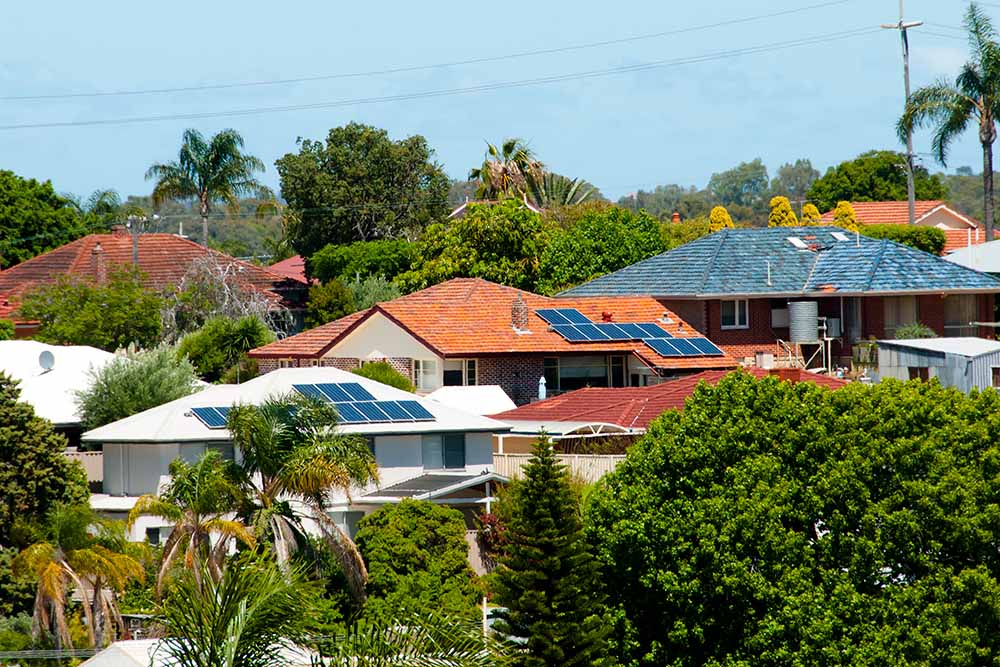
Australia leads the world in rooftop solar installations with over a third of homes now sporting a solar array. Last week another solar milestone was reached, when the 4 millionth Australian home installed rooftop solar.
Researchers from the University of Technology, Sydney, and the University of Twente in the Netherlands, have recently looked at the uptake of solar in every postcode in Australia, all 2,641, and quantified what factors influenced people to install solar.
They looked at things like education, income, employment status, government rebates, gender, marital status, age, etc. And some very surprising things have emerged. For one, postcodes with higher rates of unemployed have higher rates of rooftop solar.
“The unemployment rate is one of the strongest factors in solar PV adoption,” one of the report’s authors and Associate Professor of Engineering at the University of Technology, Sydney, Kaveh Khalilpour, said in the latest episode of the SwitchedOn podcast.
Khalilpour theorises that as the cost of installing solar has come down, and the cost of living has increased, the incentive to install solar has increased for people with job uncertainty as they look for ways to reduce their long-term energy costs.
“This is an amazing factor in terms of energy democracy and justice,” Khalilpour said. “It implies that solar energy is not rich people’s stuff. Lower income [householders] are looking at solar as a way of securing their costs and improving their family economy.”
Surprisingly, the analysis also found that factors such as gender, and the size of the land a house is built on, haven’t significantly influenced solar adoption.
Instead, marital status, household income, education, and the number of rented dwellings emerged as strong predictors of rooftop solar uptake.
You are more likely to install rooftop solar if you are married, and if you have a higher non-school qualification, which reflects a trend of more established and educated populations leading the renewable energy charge.
80% of an individual’s decision to install solar appears to be influenced by their income, education, age, marriage status, and employment status.
The remaining 20% is due to a factor the researchers didn’t initially set out to look for – the neighbourhood effect.
The neighbourhood effect is a common social phenomenon where our attitudes and behaviours are influenced by our residential or social environment.
“Everything around your neighbour’s lifestyle is technically affecting you,” Khalilpour argues. ‘Part of the influence is just unconscious, but we are being impacted.”
Khalilpour’s research shows that Australia’s embrace of solar isn’t just an economic choice – it’s also influenced by the choices our neighbours make. The more solar panels you can see in your neighbourhood, the more likely you are to also install them.
“In the postal areas that we studied every year, something in the range of 15 to 20 of the solar adoptions were because of the neighborhood effect,” Khalilpour said.
“In 2018, for example, we estimate the neighbourhood effect contributed an estimated 18% of that year’s total number of installations (224,850 installations).”
“The neighbourhood effect is real, and quite influential,” Khalilpour writes. “For policymakers and industry stakeholders, the question will be how to use it.”
Khalilpour argues that different policies and mechanisms will be needed to encourage the next wave of solar PV adoption, and these need to be more tailored and customised to individual householders or local areas.
“Targeted campaigns in specific suburbs could help accelerate the renewable transition.”
You can hear the full interview with Kaveh Khalilpour on the SwitchedOn podcast.

Anne Delaney is the host of the SwitchedOn podcast and our Electrification Editor, She has had a successful career in journalism (the ABC and SBS), as a documentary film maker, and as an artist and sculptor.