
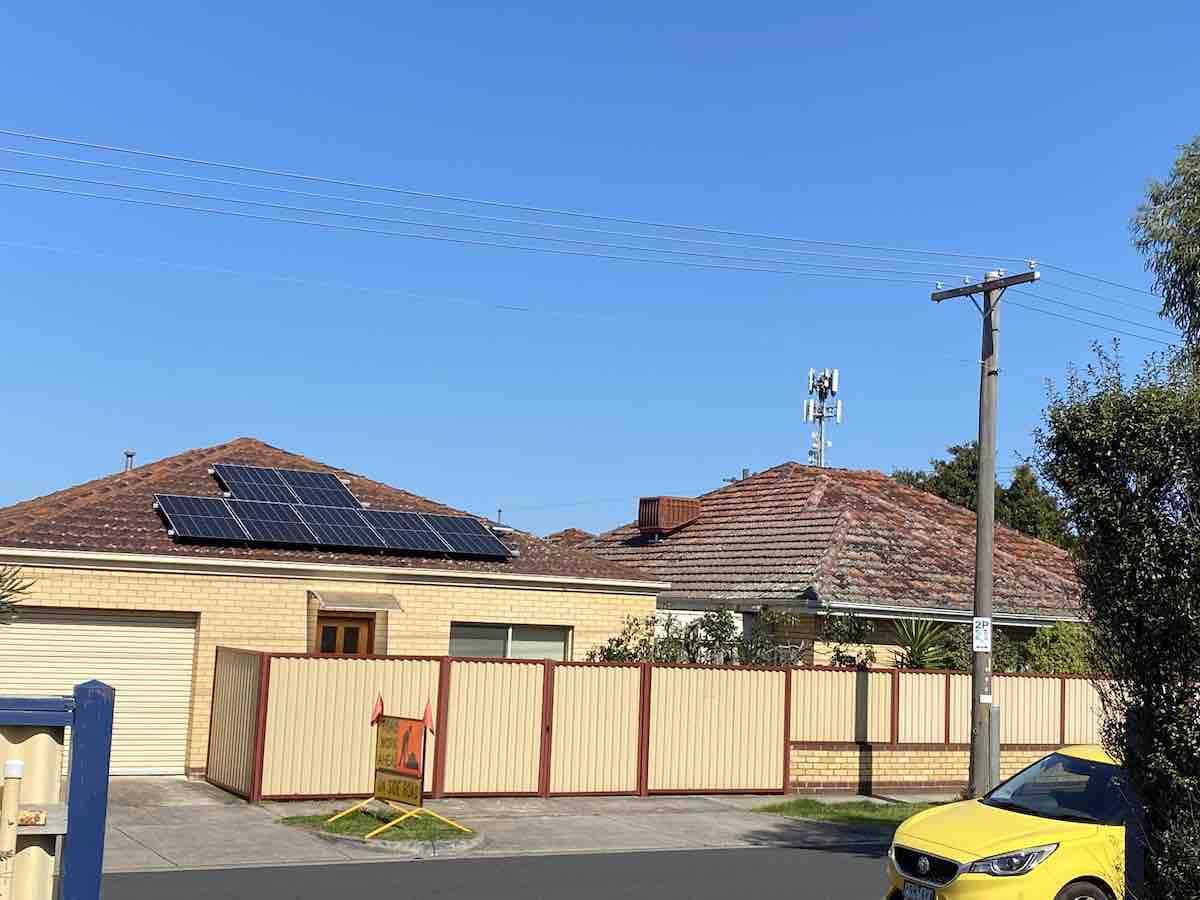

The Victorian network operator that hosts some of Australia’s top solar suburbs says it has boosted the rate of approval for residential rooftop solar exports, taking it from 60 per cent at the start of the year to 90 per cent, today, in nine key regions on its grid.
Powercor, which distributes electricity across the western suburbs of Melbourne and through central and western Victoria, said it had completed a major works program to better support rooftop solar uptake and exports.
Powercor’s general manager of electricity networks, Mark Clarke, said crews had worked across more than 30 sites a week over a period of more than three months, upgrading infrastructure, adjusting settings on street-level transformers, balancing voltage levels on powerlines and making adjustments at zone substations.
The more than 500 different network alterations had focused on nine key regions identified as having high levels of rooftop solar, include Ballarat, Bendigo, Bacchus Marsh, Point Cook, Sunshine, Portland, Maryborough, Hoppers Crossing and Melton.
Powercor said these areas were also among the most constrained parts of the network, with a new solar connections export approval rate of just above 60% at the start of the year – a number that rings true with solar industry reports that up to one in three installation jobs were being either heavily restricted or limited to zero on parts of the Victorian grid.
Since the works, however, the Powercor reports that these areas are now among the best areas for approval of new solar connections to export, at rates above 90%, which is even higher than its network-wide average of 89%.
Powercor said on Wednesday that the works had improved export capacity for incoming customers and reduced the risk of tripping for existing solar systems that could otherwise be caused by voltage issues when large amounts of excess solar was being sent into the network.
“We’re seeing a real lift in the number of customers able to export excess solar back into the grid in these areas, which were among the most constrained in our network only a few months ago,” said Clarke.
“These works are allowing most of our customers in these areas to export their excess solar, while also supporting Victoria to reduce emissions and increase the use of clean energy generated by customers at home.”
The huge improvement to some of Powercor’s most solar-challenged parts of the grid over such a short period of time is good news, not just for households in Victoria, but also for those customers spooked by visions of a grid that can take no more solar without complicated and costly changes to infrastructure and regulations.
That has been the picture painted over the course of the debate around the introduction of solar export charges, which, it has been argued, will be necessary to pay for grid upgrades required to accommodate more rooftop solar.
The possibility for networks to apply such a charge was approved, in theory, by the Australian Energy Market Commission just last month, but details of how – and where – such a fee would be applied remain foggy. And the jury is most definitely still out over whether it is either necessary or fair.
For its part, Powercor has no plans to introduce export charges anytime in the coming five years, given it has just kicked off its new five-year regulatory period.
For now it is getting on with accommodating the more than 1765MW of solar (large and small), wind and other renewables connected to its network, which also takes in four of Victoria’s Renewable Energy Zones. Currently, 21% of its residential have rooftop solar.
“We are at the forefront of finding innovative ways to support Victoria’s energy transition through projects and trials investigating community batteries, smart charging for electric vehicles, and microgrids and other community energy projects,” the company said this week.
“We recognise the future of energy is being driven by customer choices and these works are part of the ways we’re working to enable them,” Clarke added.
As for the solar customers on the recently upgraded parts of the grid whose exports had been severely limited – or even set at zero – Powercor says it has been in touch to encourage them to consider reapplying for exports if they’ve been unsuccessful in the past.
See the list of suburbs below and give them a call.


Sophie is editor of One Step Off The Grid and editor of its sister site, Renew Economy. Sophie has been writing about clean energy for more than a decade.