

The residential battery energy storage market is young, but its consumers want products that will live to a ripe old age. In the beginning, there was only the caveated assurances of battery manufacturers. Now there is freely available, independent test data and reporting.
Recognising the importance of residential battery storage in the Australian energy system, ARENA supported ITP Renewables’ Battery Test Centre with a $1.29 million ARENA grant, under its Advancing Renewables Program.
The Battery Test Centre conducts longitudinal performance testing of conventional and emerging battery technologies with the aim of independently verifying claims made by manufacturers about the performance, installation and operation of battery packs, and to disseminate the results to the public.
The Battery Test Centre is located at the Canberra Institute of Technology (CIT), and is the only facility we know anywhere in the world of to independently test a range of technologies and products over an extended period, and to publish results to the public.
Phase 1 of the trial started in mid-2016 and included eight batteries, with a further ten batteries installed as part of Phase 2 in mid-2017. In late 2019, an additional eight batteries were installed under Phase 3 of the trial.
ITP recently published its 10th public report on the trial. The report describes testing results, general observations, and issues encountered thus far with Phase 1, Phase 2, and Phase 3 batteries.
The batteries are mostly lithium-ion variants – either lithium iron phosphate or lithium nickel manganese cobalt chemistries. There are also a number of other chemistries including lithium titanate, lead-acid, lead-carbon, aqueous hybrid ion, zinc-bromine flow, and sodium nickel chloride technologies.
Testing procedure:
Lab conditions seek to mimic real-world, hot daytime and cool overnight temperatures. Each battery pack is charged over several hours, followed by a short rest period, then discharged over a few hours, followed by another short rest period. In total, there are three charge/discharge cycles per day for most batteries.
Originally the batteries were planned to be cycled at this rate for three years. However, additional funding from ARENA has allowed batteries that are still functional to continue cycling beyond this point, with some in operation for more than five years.
Time and use degrade battery capacity. Our testing monitors this capacity fade and other battery performance parameters over each battery pack’s lifetime.
Key Findings
Battery Overview:
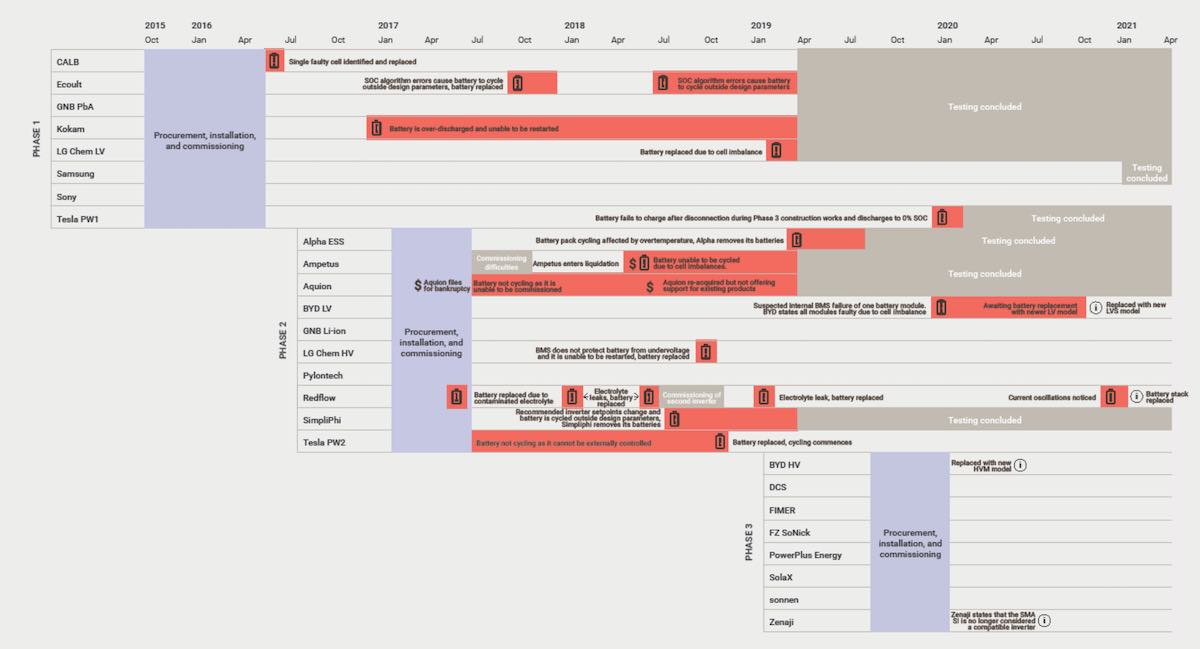
Below is a snapshot from the latest report, showing the testing phase and status of all 26 batteries which have been/are part of the trial.
Out of the eight Phase 1 batteries, the Sony battery pack has been running continuously since its commissioning in 2016 and ITP continues to report its capacity fade results. The testing for the Samsung battery pack, which had also been in operation since 2016, was recently concluded.
Of the ten Phase 2 batteries, four have concluded testing, while the remaining six have continued cycling. Some of these have been replaced during the testing period.
A further eight batteries were added in late 2019, and some capacity fade trends have started becoming apparent for batteries which have done more than 500 cycles since installation.
Capacity Fade:
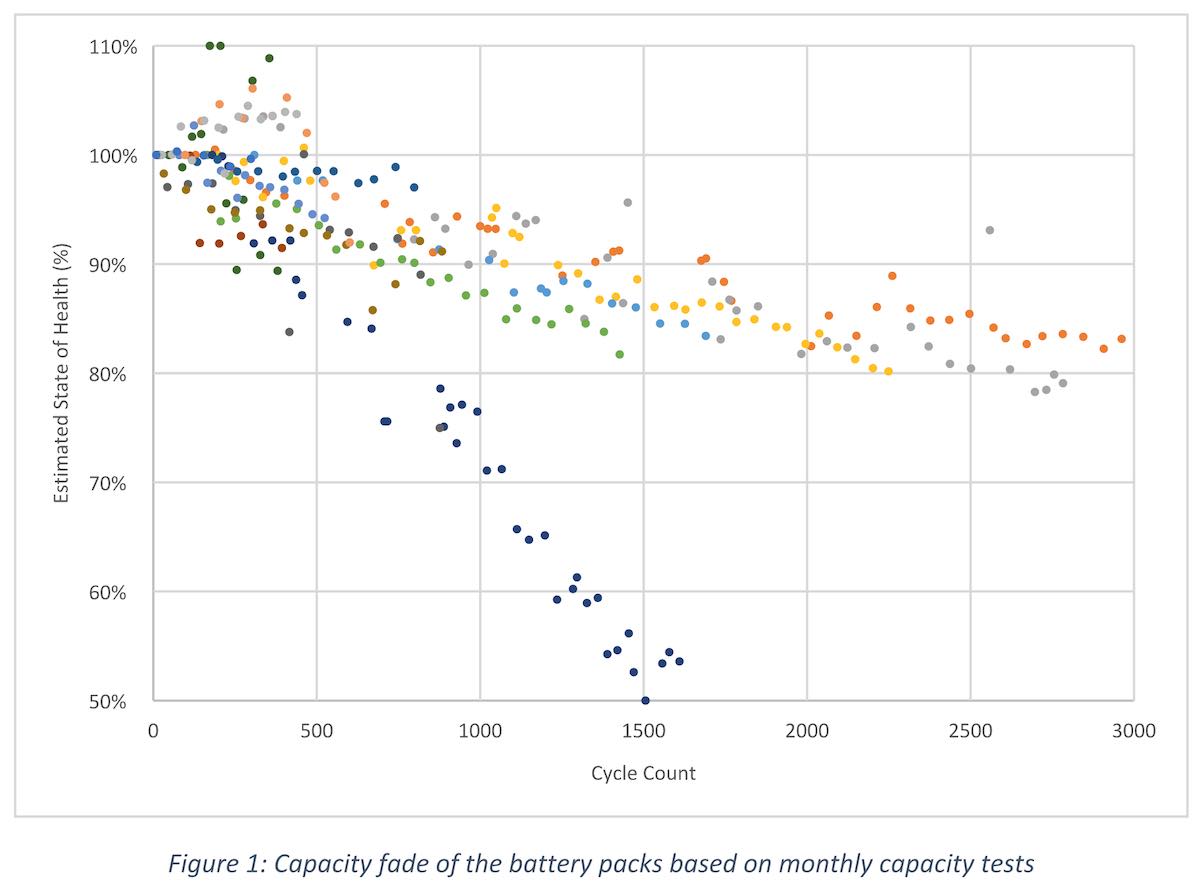
While some battery packs have experienced faults and/or failed prematurely, the Sony, Samsung, BYD, GNB Lithium, Pylontech, and Sonnen battery packs have generally demonstrated high reliability, with minimal issues encountered throughout the testing period.
Linear extrapolation of capacity fade to date suggests that cycle life varies significantly between products. The Sony, Pylontech, and Sonnen battery packs have demonstrated good capacity retention over a large number of cycles. Following replacements, the current BYD HVM and Redflow ZCell are also demonstrating excellent capacity retention, though the number of cycles completed was low when the last report was published.
ITP conducts monthly capacity tests for all batteries to compare the remaining capacity to its original capacity. This ratio is known as State of Health (SOH). Most of the batteries are following a similar general trend with their SOH, with just a few outliers as the graph shows.
Round Trip Efficiency:
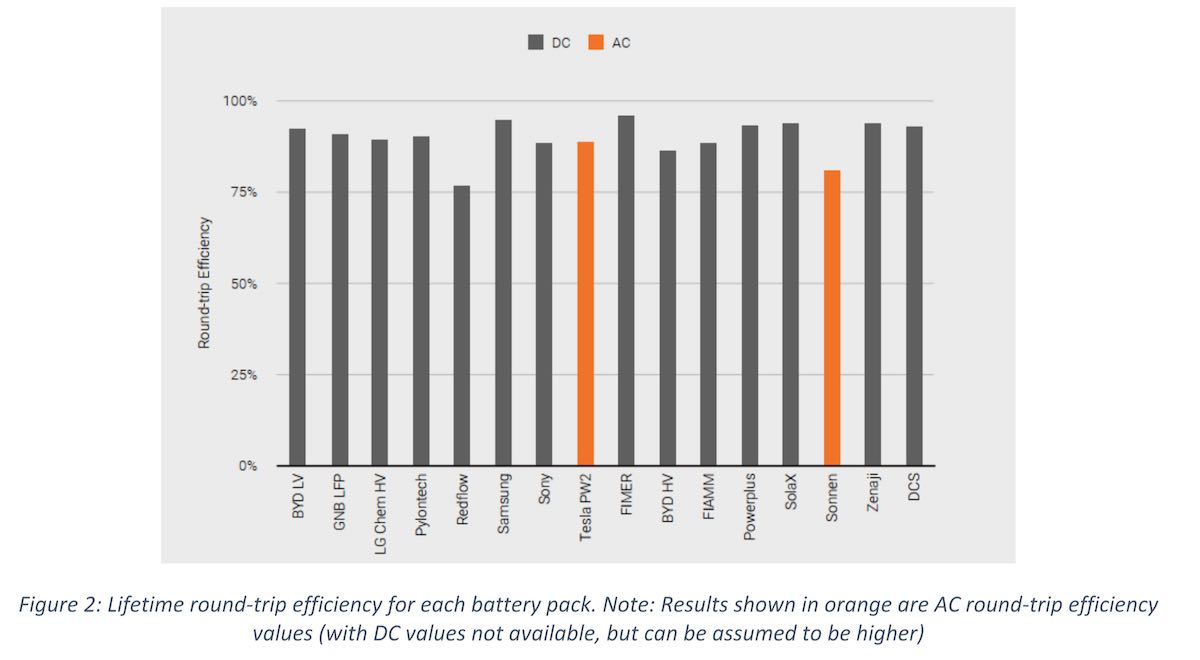
Round-trip efficiency appears more consistent between battery packs, with DC values as high as 95% for some lithium-ion battery packs, and as low as 78% for the zinc bromine ‘flow’ battery (which has more auxiliary loads such as pumps). The lifetime round-trip efficiency results are shown for each battery in the figure below.
Lessons Learned
Having been in operation for over five years now, the Battery Test Centre has revealed many valuable lessons, and greatly informed consumer decision making (noting that results have previously been published by Choice magazine).
The lessons learned relate not only to the performance of the batteries throughout the trial, but also to the performance of suppliers in delivering products and providing technical support during commissioning and operation.
The data published by ITP has provided great value to the members of the public, as the test centre website acts as a resource for them before they purchase any battery.
Lessons learned from the battery test centre are that not all batteries are created equal, price does not guarantee quality, reliability is just as important as capacity retention, and product support and warranties are more important than manufacturers’ performance specifications.
As the results are publicly available, we believe they have contributed to driving the battery storage industry towards an improvement in quality. Battery models have evolved and improved since the start of the testing.
Many manufacturers now ensure that battery products, and their compatibility with specific inverter models, are tested before market release. Manufacturers are now moving towards requiring batteries to be directly connected to the internet and available for external monitoring, which allows them to remotely diagnose faults.
Phase 3 started in 2020 and is scheduled to end in March next year, and there are still batteries from Phases 1 and 2 which will continue cycling.
As more cycles are completed, the value of the information and longitudinal data about battery performance increases. Increasingly ITP is receiving requests from international institutions for battery cycling data for use in energy storage modelling research.
As the industry develops, and until installations in the field have been operating for long enough, the Battery Test Centre’s results will continue to provide critical insights into the state of the battery storage market.
Ishpreet Chawla joined ITP Renewables in December 2019 and manages the Battery testing lab. He has a Masters in PV and Solar Energy Engineering from the University of New South Wales and a Bachelor of Electrical and Electronics Engineering from SRM University, Chennai.