
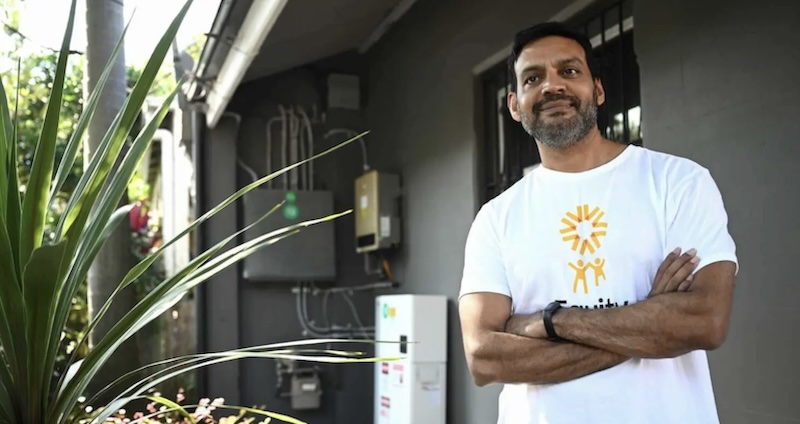
The Clean Energy Regulator has detailed the enormous success of the federal government’s Cheaper Home Batteries rebate – and how the soaring demand being generated by the scheme has pushed industry to “capacity.”
Federal energy minister Chris Bowen on the weekend revealed that 100,000 household batteries had been installed since the rebate’s launch in July, representing a total of two gigawatt-hours (GWh) of installed capacity.
As Bowen told media on Sunday at an event to mark the occasion, this is a “remarkable, remarkable achievement.” But the boom in battery uptake has also tested the capabilities of industry and regulators.
“The capacity of our industry is just about full,” the executive general manager of the CER’s scheme operations division, Carl Binning, told the 2025 All-Energy Australia conference in Melbourne on Wednesday.
“We’re starting to see an increased backlog in orders. So if you haven’t got your order in yet, I think, start moving. Wait times are at least three months.”
Binning says that when the rebate launched, there were 9,000 accredited solar installers across the country, but only about half that number qualified to install batteries.
In an effort to catch up to demand, roughly 100 newly trained and accredited battery installers are coming on board each week, Binning says – which is about the capacity of the established training networks.
The number of different battery brands and models that consumers have to choose from has also gone through the roof.
According to James Sturch, technical director at battery and inverter giant SolarEdge, the Clean Energy Council has seen an increase of around 30 per cent in the number of batteries being accredited since the beginning of the rebate.
“So the market is becoming, I would say, flooded. It’s like a tsunami of batteries,” he told the All Energy Australia conference on Wednesday afternoon.
“But at the same time, a lot of OEMs [manufacturers] still don’t have enough supply.
“So it’s [gone from] a lot of installers that used to do solar systems and occasional batteries, and now battery installers that occasionally do solar. It’s completely flipped.”
Sturch says a lot of manufacturers were caught off-guard by the speed and scale of the uptake of batteries through the rebate – as well as by the size of battery that consumers would go for.
“When you then look at the actual system sizes, again, no one really saw this coming – the average residential system size [through the rebate] is 25 kilowatt-hours (kWh),” he told the conference.
“The actual size of these systems is so oversized for what people require, it raises a lot of very interesting questions of, why are consumers doing this? Why are they putting in such big batteries?”
Sturch argues that it’s not because they want to help support the grid or earn a few extra dollars participating in virtual power plants, as the government and AEMO had hoped.
“The evidence will show us it’s not really because they want to contribute to the greater good,” he says. “It’s actually because they want to be more self reliant and to be more secure in their own minds and have other functions, like being able to have backup [power] and such.”
Ryan Wavish, the general manager of retail innovation at Engie in South Australia, says the feeling in his neck of the energy woods is ‘it’s finally happening’… closely followed by ‘gee, it’s happening really quickly.’
“I think there’s also that fundamental knowledge that … this is the market shifting,” he told the conference on Wednesday morning.
“You know, we’re already seeing the belly of the [rooftop solar] duck move to later in the day as more of that solar is being stored through the middle of the day.
“So there’s more than just the innovation team and the retail businesses looking at this. Now the whole of the business is looking at this and how it will shift energy markets. How will it impact other assets on the grid? And how do we make the most of this in supporting our customers to get more out of their battery systems?”
Meanwhile, the regulator is also keeping a close eye on the industry and keeping tabs on how batteries are being installed and whether all of the rules are being followed.
“We’re extremely happy with the rollout of the program, but we are in no way, shape or form, complacent, and one of our regulatory functions is to try and make sure that things are done right,” Binning told the conference.
“Four months in, we’ve had no reports of any harm to people or property as a result of the program,” he added. “And that’s really quite extraordinary.
“That volume adjustable electrical work you would expect there to be incidents and hazards and those sorts of things starting to be reported back to us.”
In a compliance update published last week, however, the regulator did express concern over minor installation issues mostly involving non-compliant labelling in around half of the roughly 100 solar battery systems they had inspected.
“While these findings align with previous compliance data from state schemes, such non-compliance remains unacceptable,” the CER said in a statement.
“We will continue working with state and territory regulators and SAA to improve installer capability through targeted information, training and enforcement action. Installers who repeatedly fail to meet compliance standards risk loss of accreditation.”
Speaking at the All-Energy conference on Wednesday, Binning elaborated on the findings of the compliance report.
“Just over half of the inspections are revealing some fall down in one or more of the 80 or so technical standards that are required.
“So we’ve been really digging into that, and over half of those failures against technical standards relate to labeling.
“Some of the labels are pretty important. Some of the labels speak to the shutdown, the isolation process, those sorts of things.
“And so we will be introducing a new control program which requires photographs to be taken of some of that critical labeling.
“We’re really pushing hard with additional training modules through Solar Accreditation Australia, we’re working really closely with our state and territory colleagues to make sure that the program continues to run out successfully.”

Sophie is editor of One Step Off The Grid and editor of its sister site, Renew Economy. Sophie has been writing about clean energy for more than a decade.