
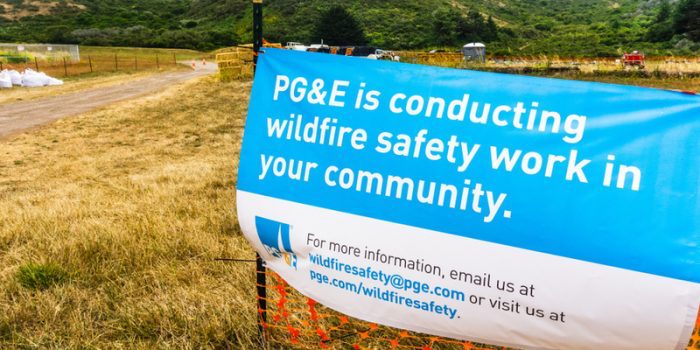

Racing to beat California’s next wildfire season, Pacific Gas & Electric (PG&E) is seeking companies to install microgrids near 20 substations.
The microgrids will be used to keep electricity flowing when the utility shuts down power lines that could spark wildfires during windy and dry weather.
California’s largest utility issued a solicitation for the microgrids last week and intends to move fast. It wants to have the microgrids installed by June 1, 2020 or at the latest Sept. 1, 2020. California’s wildfire threats are usually greatest in autumn.
The utility seeks companies willing to either build, own and operate the microgrids or build them on behalf of the utility, which would then own them.
Notice of intent due December 17
Bidders are asked to file a notice of intent by this Tuesday — December 17, 2020. Full proposals are due Jan. 15, 2020.
The 20 microgrids are part of a larger state regulatory requirement that PG&E secure 716.9 MW of resource adequacy capacity.
In a presentation before the California Public Utilities Commission last week, PG&E said that the microgrids are expected to keep power flowing to thousands if not tens of thousands of customers per substation during a power shutoff.
The utility hopes to cut the number of customers that lose power by nearly one-third, compared to its October 29 ‘public service power shutoff’ (PSPS), the term California uses to describe de-energizing power lines so that they won’t spark wildfires. From October 26-November 1, PG&E cut power to about 941,000 customers, the highest count for the wildfire season.
In addition to installing the 20 microgrids, PG&E says it plans to support state regulatory goals to make it easier for customers to do the same on their own.
Opportunity now exists for California utility customers to offset costs of energy storage — often part of a microgrid or nanogrid — through the state self-generation incentive program (SGIP), a $166 million/year ratepayer funded rebate program. The PUC made funds available within low-income communities and for medically vulnerable customers in areas threatened by wildfires.
The SGIP incentive of $1/Wh covers 98% of the $13,500 cost of a 13.2 kWh, two-hour residential storage system, according to the CPUC.
PG&E requirements for microgrids
In a webinar about its solicitation for the 20 microgrids, PG&E said the projects must be able to provide power to customers for at least 4-5 consecutive days.
When the microgrids are not providing backup power, they must serve the power grid and help bolster its resilience. The microgrids also must have blackstart capability, meaning they can start up without relying on a charge from the grid.
PG&E is open to two types of microgrid ownership models: 1.) third-party owned or 2.) engineering, procurement, construction (EPC).
A third-party project would be built outside of the substation on land designated by PG&E. The microgrid owner would sell PG&E microgrid services and market products, such as energy and ancillary service or green attributes. PG&E would sign a 10-year contract with the microgrid owner.
An EPC microgrid would be built by a third party but owned by the utility and could be located within the substation footprint.
If a project requires the use of natural gas, PG&E will arrange for delivery of renewable natural gas.
Choosing projects
In evaluating the offers, PG&E plans to use both quantitative and qualitative criteria. Quantitative evaluation will be based on a least-cost ranking. Qualitative criteria may include such factors as project viability, safety and bidder development experience financial strength and supply chain responsibility.
PG&E also is interested in proposals that offer to develop projects at multiple sites.
The utility expects to execute contracts Feb. 14, 2020 and submit them for regulatory approval Feb. 20, 2020. The full microgrid solicitation is available on PG&E’s website.
Track news about microgrid solicitations. Subscribe to the free Microgrid Knowledge newletter.
This article was originally published on Microgrid Knowledge. Republished here with permission