
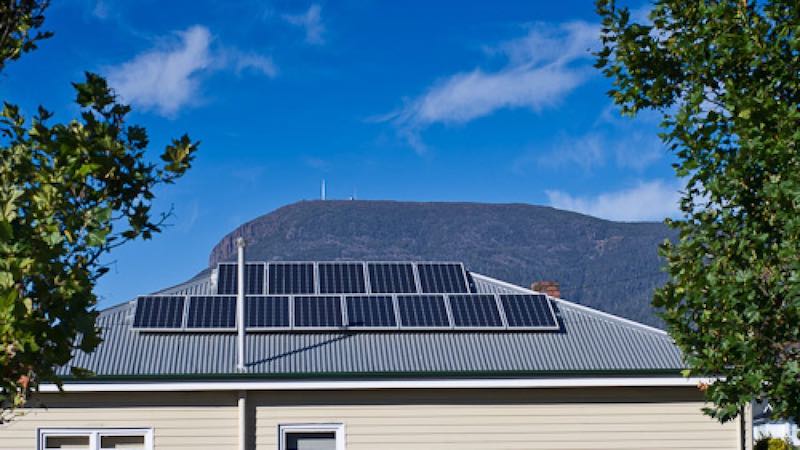
The City of Hobart has proposed buying and storing solar power generated by its residents – and paying a price higher than the current feed-in tariff – in a bid to drive the uptake of rooftop PV in Tasmania’s capital.
The strategy was proposed in this week’s draft Sustainable Hobart Action Plan, the city’s response to the challenge of climate change and bid to make the southern Tasmanian hub more environmentally, socially and economically sustainable.
The plan notes that while many Hobart residents have installed rooftop solar, many of that number were getting little benefit from it, with most power generated while they are at work, and with feed-in tariffs so low.
Tasmania has a poor record on rewarding the uptake of residential solar since the state slashed the FiT from 28c/kWh in the early 2010s down to 8c and then to just above 6c in 2015, prompting howls of protest from the state’s solar advocates.
As One Step reported, these low FiTs also resulted in a solar market contraction for the state, at a time where solar was booming almost everywhere else around the nation.
In 2016, research from the Tasmanian Renewable Energy Alliance (TREA) and Solar Citizens found that power generated from rooftop solar in the state should have been valued at between 17-22c/kWh – three times the rate of that year’s tariff – once health and climate benefits were factored in.
The situation has since improved, but only slightly. For 2020-21 Tasmania’s regulated minimum feed-in tariff rate is 8.471 cents per kilowatt-hour, a nearly 10 per cent reduction on the 2019-20 rate.
By comparison, Victoria’s Essential Services Commission currently recommends retailers pay solar households a minimum ‘single rate’ feed-in tariff of 10.2c/kWh, or a ‘time-varying’ minimum FiT of between 9.1-12.5c/kWh.
Regardless, Hobart now appears to be looking for a way around the eternal FiT fight, by proposing a potential “win-win” where the City acts as a virtual power hub, purchasing green electricity directly from residents at a higher rate than feed-in tariffs, but below retail electricity rates, and uses it to power its daytime operations.
“We will bring the energy-producing rooftops of Hobart into the City’s energy plan, buying and storing energy from our residents, giving the City a source of lower-cost energy, while still offering residents a higher price for their solar power than they can get from feed-in tariffs,” the draft plan says.
How residents will respond to the idea of their solar being used to power the council remains to be seen – consultation on the draft Sustainable Hobart Action Plan is currently open, with feedback invited via an online survey until 25 September.
In a statement on Tuesday, Lord Mayor Anna Reynolds said Hobart had been the first capital city in Australia to declare a climate emergency, and the draft action plan further responded to this challenge by developing targeted, localised actions.
“This draft plan aims to further develop and promote the City’s leadership in this area through a series of practical steps to make Hobart a more sustainable city,” she said.
“It includes programs aimed at fostering sustainability leadership among our young people, the investigation and trial of energy-efficient transport and technologies, and programs that encourage new ways of sharing, purchasing and storing energy.”
On energy storage, the plan says the City recognises this as “the missing link” in the renewables revolution and promises to trial innovative solutions ranging from batteries to pumped-hydro.
“As Hobart is a city of small to medium water sources sitting at various altitudes, many already interconnected with pipes. This provides the perfect opportunity to install pumped hydro, the world’s most successful and environmentally friendly bulk energy-storage method,” the plan says.
“We would engage with other stakeholders and industry to activate existing water reservoirs to provide stored renewable energy, including utilising and creating added savings from the investments the City of Hobart has made in solar panels, to reduce the cost of the City’s overnight power consumption in street lighting and other areas.”
To view the draft Sustainable Hobart Action Plan – Responding to Climate Change and to provide feedback, visit yoursay.hobartcity.com.au.

Sophie is editor of One Step Off The Grid and editor of its sister site, Renew Economy. Sophie has been writing about clean energy for more than a decade.