
Ever since New York announced plans four years ago to invest $13 billion to modernize John F. Kennedy International Airport — and include multiple microgrids — the project has intrigued microgrid watchers.
At the time, the aviation world was still unnerved by the 11-hour power outage in late 2017 that shut down Georgia’s Hartsfield-Jackson Atlanta International Airport, the world’s busiest airport. The industry was ripe for microgrids.
Several smaller airports have developed microgrids, but the JFK project promised to be a demonstration of a sophisticated microgrid at one of the 10 largest and busiest airports in the US.
Now the 11.34-MW microgrid is underway, with work being done by AlphaStruxure, a joint venture of Schneider Electric and global investment firm Carlyle. Today AlphaStruxure released details about the microgrid.
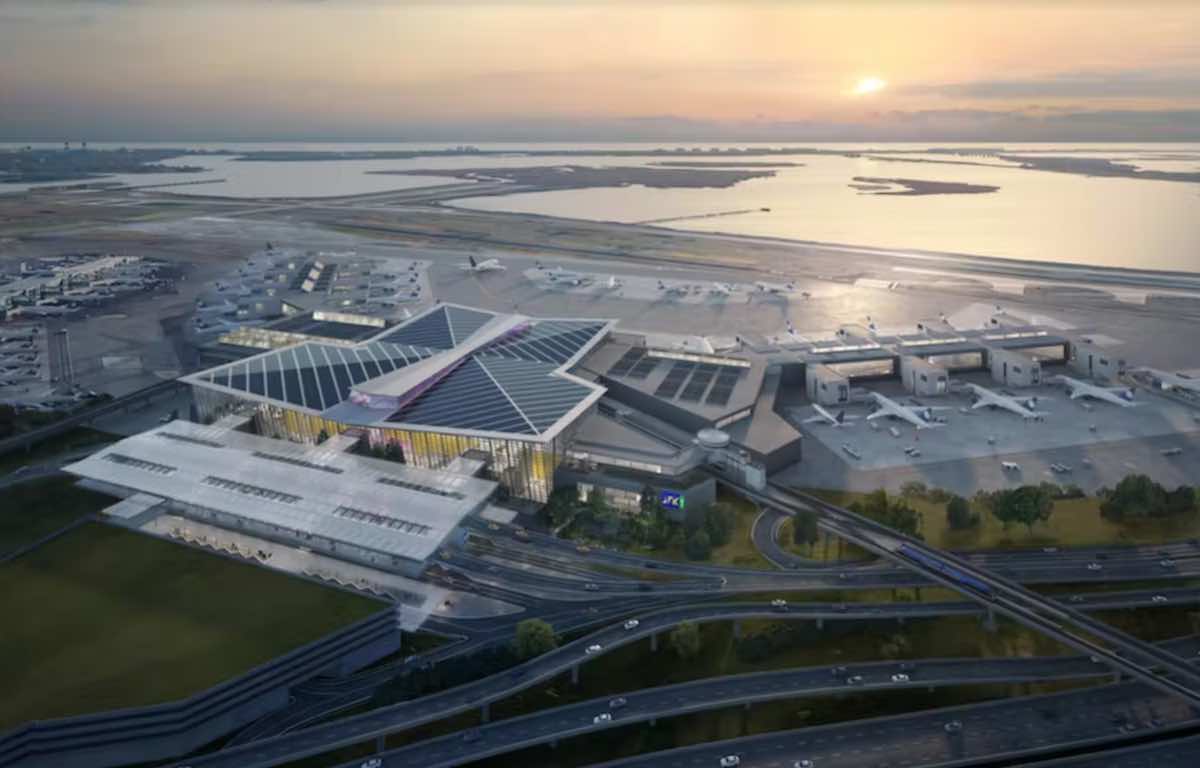
The microgrid will be built as part of the airport’s $9.5 billion first phase of New Terminal One, which will span 2.4 million square feet and serve as the largest international terminal within JFK.
A federated microgrid
The microgrid is actually four microgrids rolled into one. The four microgrids, also called power islands, can operate separately or collectively as one microgrid, making it a federated microgrid. Such energy sharing among microgrids — akin to microgrid clusters and microgrid nesting — is being rolled out by Schneider elsewhere as well, including a project in California that connects multiple communities and energy technologies. These connected systems are a stepping stone toward a futuristic industry goal to create ever larger grids made up of microgrids to achieve maximum efficiency, cost savings and emissions reductions.
During a power outage, the microgrid will operate independently of the grid. But when the grid is operating normally, it will integrate with the grid, buying and selling energy and services to achieve the airport’s energy goals — whether they be financial, environmental or both.
The JFK New Terminal One microgrid also has several other notable features.
Because it uses multiple resources — solar, battery storage and fuel cells — it can operate indefinitely during a grid outage — keeping 23 airport gates and more than 177,000 square feet of dining, retail, lounges and recreational space up and running.
Largest solar array in NYC
With 13,000 solar panels that provide 7.66 MW of energy capacity, the project represents the largest rooftop solar array on any US airport and the largest in New York City.
Had the airport chosen to use grid power rather than the microgrid, it would have emitted 38% more greenhouse gas. AlphaStruxure expects the microgrid to achieve even higher emissions reductions in later years when renewable natural gas or green hydrogen becomes available for use in its fuel cells. Until then, the fuel cells will operate on natural gas.
Largest single asset financing project
The $9.5 billion in financing for the new terminal modernisation — which includes the microgrid — is the largest single asset financing in US history, according to Carlyle, which is a project sponsor for New Terminal One along with JLC Infrastructure, Ullico and lead sponsor Ferrovial.
AlphaStruxure did not reveal the price tag for the microgrid, which will operate under an energy-as-a-service agreement. That means the airport makes no capital investment; instead AlphaStruxure owns and operates the microgrid over the life of the asset, acting as a service provider to the airport. Schneider is the technology partner, while Carlyle is handling the financial aspects of the deal.
“Energy as a service is a business model innovation that delivers the system to the customer designed to customer specifications to meet their objectives — whether resilience, reliability or economic objectives — and does this through a long-term power purchase agreement with zero upfront cost to the client,” said Juan Macias, CEO of AlphaStruxure in a press briefing.
Pooja Goyal, chief investment officer of Carlyle’s Global Infrastructure business, described the financing arrangement as a model that can “shape decarbonization in the transit sector.”
“We believe this is the kind of energy infrastructure that’s needed throughout the country to become more resilient to outages while providing a path to work toward achieving sustainability goals,” Goyal said.
New Terminal One is already under construction and is expected to be completed in 2030 with the first gates opening in 2026. AlphaStruxure is now working on the engineering for the microgrid and expects to begin construction in 2024 with completion in advance of the 2026 opening of the first gates, Macias said.
The JFK New Terminal One microgrid at a glance:
7.66 MW of rooftop solar.
3.68 MW of fuel cells.
2 MW/4 MWh of battery energy storage.
Capable of producing enough power for 3,570 average US homes for one year.
Several other airports have microgrids in planning or operation, among them the Pittsburgh International Airport and the Redwood Coast Airport.
Will the JFK airport microgrid launch encourage others to take the step? Its backers believe so.
“This project is paving the way for all transportation hubs and municipalities across the country. Not only is it about resilient energy, it’s about decarbonization, risk transfer and cost predictability via the energy-as-a-service business model,” said AlphaStruxure’s Macias.
Added Gerrard Bushell, CEO for New Terminal One development: “This is future-focused infrastructure that will facilitate the transition away from fossil fuels and sets a new standard for large-scale renewable development in New York and in the air transit sector.”
This article was originally published by Microgrid Knowledge. Republished here with permission. Read the original article here.