
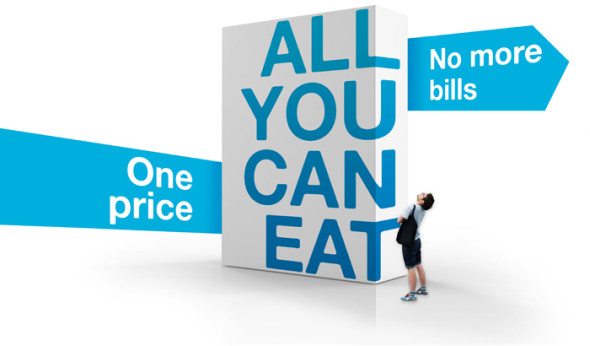

Over the past month in Australia, one start-up energy retailer, Sumo Power, and one major gentailer, Origin Energy, have launched new retail products which offer household customers fixed prices for uncapped electricity consumption.
Basically speaking, the retailer looks at a customer’s history electricity usage, asks “a few simple questions”, and then forecasts future usage over a 12 month period. The bill is replaced with a “statement” which can be paid for, in Sumo’s case, annually, biannually or quarterly.

Both the “All You Can Eat” (Sumo) and “Predictable Plan” (Origin) product are part of a shifting approach to billing by retailers, built around the well-founded theory that customers are feeling confused and angry about constantly rising electricity prices and powerless to do anything about it.
But is this the right response? Not according to Mike Swanston, an energy consumer advocate who spent years working on the other side of the fence with Queensland network operator Energex.
In a presentation to last week’s Solar and Energy Storage Conference in Melbourne, Swanston said the approach being taken by Origin and Sumo – and no doubt more retailers to come – was “totally unsustainable”, but also no great surprise under the circumstances.
“The last 10 years we’ve seen incredible price rises in energy costs to customers which really poked the bear and stirred the whole industry,” he said. “And it stirred customers into saying this is not good enough.
“People got very upset… Customers said, I’ve gotta buy power, the price is going up, there’s nothing I can do about it. The more I save, the more I tell the kids to turn the lights off and I use less power the bill just keeps going up. This is not right.”
Meanwhile, on the distributor side of the equation, the name of the game has fast become the recovery of costs on underperforming assets, as rooftop solar and energy efficiency have seen the “bum” fall out of demand.
“For years (networks) have covered their costs on the basis of volumetric charges,” said Swanston. “But when the volume falls…. then that’s less revenue. So the whole conversation has shifted now in network land to ‘how can I recollect my revenue?’ Which is a real pity.”
It’s also extremely confusing, as networks weigh up options for their distribution tariffs – Swanston describes this as “the other half of the bill” – leaving customers with no hope of responding.
“If it’s too hard, I’m not going to do anything. And of course you see that on the opt-in tariffs in Victoria for time of use. ‘It’s too hard, I can’t get my head around it, go away and leave me alone’.”
Indeed, the level of disempowerment and lack of trust felt among consumers has been so great as to inspire people to leave the grid, even when this doesn’t quite make economic sense.
But it has also led a lot of decision making and a lot of intimation of what customers are thinking out there that – according to Swanston – risks making matters worse.
“One of the big dangers that we’re seeing is the fixed charge.
“Now fixed charge is horrible, horrible animal. …Sure you can call it a different thing, you can call it a standard connection charge. Maybe that makes sense to customers. But a fixed charge is a dangerous thing.
“Utilities love fixed charges because it costs me $100 million dollars to run the grid each year and I’ve got a million customers. I charge them all one hundred bucks and life is great. I’ve got the money.
But, he adds, “a fixed charge does two terrible things: it further disempowers customers, cos the only way you can manage it is… to disconnect.
“The second thing is you lose the variable pricing segment, which is a dangerous thing.
“It’s like water at my place, where once you connect me you don’t care how much I use and when I use it, which is the polar opposite to the demand management message that distributors have been giving customers for the last 30 years.
“Put to one side of your mind all those complex tariffs and critical peak demand and all this sort of stuff, and remember that’s backhaul infrastructure. Nobody pays that bill directly. But the bill people do pay, where this filters through, is this bill here:” [Cue Origin Energy Predictable Plan ad]
“So here you’ve got the (network) company with all those wonderful new tariff and pricing signals… Yet you’ve got the guy that actually sells the bills saying we’re going to flatten it for you and take out all the signals. It’s totally unsustainable and it’s got to change.”
Swanston believes it is the demand management signal is the kind of empowerment that customers are really after – and not just a predictable bill.
“They like having control of the bill. The more I use the more I pay… I get that. I can control it, I can do it. It’s gotta be simple.
“When it comes to understanding how we take our market forward there are a couple of key messages,” he said.
“The first is: keep it simple. Put in place a time of use tariff and the one that works for me is the slogan that says can it wait til after 8? Customers get that. I’m gonna put in batteries, tell me how I’m going to save money.
“The second piece of the puzzle, if we’re wondering how people are going to react, this is the key one: if you’re going to back a horse in a race son, always back a horse called self-interest.”

Sophie is editor of One Step Off The Grid and editor of its sister site, Renew Economy. Sophie has been writing about clean energy for more than a decade.