
Signs of fallout from Covid restrictions and global supply chain ructions are starting to show in the Australian rooftop solar market, with an 11.1 per cent drop in installations between September and October marking the lowest volume since mid-way through last year.
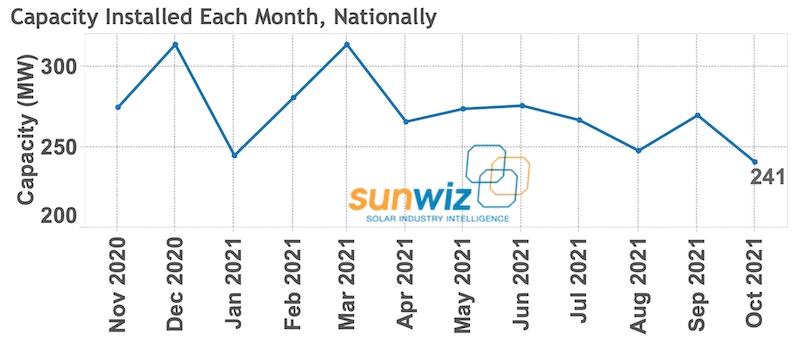
The latest data from industry analysts SunWiz on the market for solar PV systems sized up to 100kW shows the total capacity installed across Australia for the month of October at 241MW, down from 271MW in September when the market recorded its first true upward movement recorded since June.
SunWiz managing director Warwick Johnston said this week that the dip was largely due to a slowdown in installs in the residential segment (6.3-8kW) which had been “affected significantly” by various market headwinds.
This shows up in the data as an increase in average system size – to 8.72kW – which doesn’t suggest households are necessarily installing bigger systems, but the fall in average-sized household installs (6.6kW) in the mix has driven the overall average up.
SunWiz says that this effect – that is, the decrease in home rooftop solar installs – has been concentrated in Queensland and Victoria in October, with New South Wales also declining but to a lesser extent.
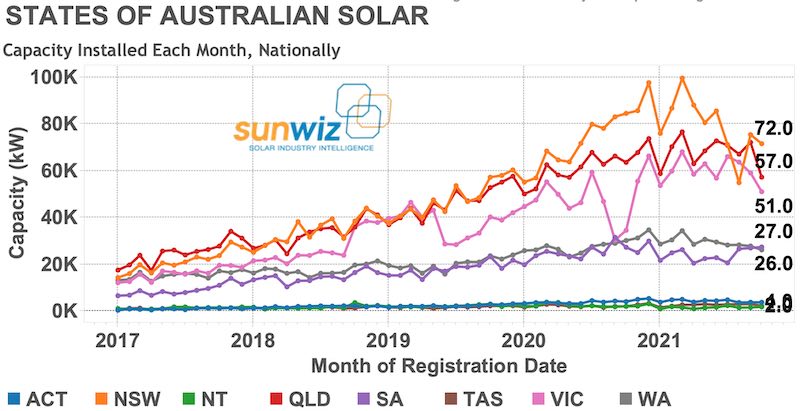
Essentially, however, the decrease in installs was across the board, across all size segments – except for 15-30kW which held steady – and all states, although some of the smaller volume states and territories held steady.
The biggest drops in registered new capacity were in Queensland (57MW compared to 72MW in September), Victoria (51MW compared to 60MW last month), and New South Wales (72MW down from 75MW) – but NSW still topped the market for the second month in a row.
The commercial segment fared better, overall, the data shows, with an increase in volume in both the lower and upper ends of the market in NSW and Western Australia, while Queensland and Victoria observed a decrease.
Even factoring in the drop in installs in October, the market continues to show a 13 per cent lead over the same time last year for registered month-on-month volume. SunWiz notes that this is, however, a 2% drop since last month, as the annual growth rate continue on a gradual decline.
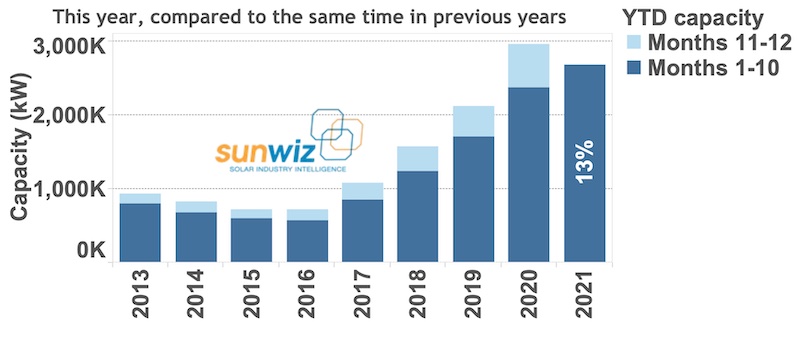
All of that noted, the total rooftop solar capacity installed around Australia at the end of October sits at a remarkable 15.8GW, up from the also remarkable 13GW at the end of 2020, with the residential sector doing the heavy lifting for the vast majority of the time. And as you can see in the chart above, the market is still headed for a new record of more than 3GW of installs.
As reported on One Step sister site RenewEconomy, the PV in Australia Report for 2020, published on Monday as part of the International Energy Agency PV Power Systems analysis, last year was a record-breaking year for rooftop solar, with total of 370,000 new systems installed on homes and businesses.
The addition of 3GW on rooftops helped Australia’s solar uptake grow to 810W of solar per person at the end of 2020, that report said, putting it ahead of Germany with 650W/person, and on top of the world on that metric.
Other notable data points included that, at the end of 2020, an average of more than 31% of free-standing households in Australia had panels on their roof, while both Queensland and South Australia averaged close to 40% of free-standing homes powered by solar.
And while this sort of growth cannot go on forever, the current slow-down is not a sign that Australia has reached its peak in rooftop solar installs, but rather a result of the massive hikes in the cost of polysilicion, and smaller rises in silver, copper, aluminium and glass, compounded by supply chain bottlenecks and manufacturing slow-downs in China.
As RE has reported, this has caused manufacturing costs of solar PV modules to surge from $US0.20 per watt peak (Wp) in 2020 to between $US0.26 and $US0.28 per Wp in the second half of 2021 – the highest levels since 2017. And that puts solar industry players in the unenviable position of deciding whether to reduce their margins, delay projects or increase prices.
Listen also to: Great Solar Business Podcast: The big solar supply crunch

Sophie is editor of One Step Off The Grid and editor of its sister site, Renew Economy. Sophie has been writing about clean energy for more than a decade.