


Amid the South Australia-led race to better manage thousands of megawatts of residential rooftop solar within a rapidly changing grid, a Queensland network trial focusing on accommodating more, and smarter commercial solar has quietly shown the way on how it may work for consumers.
The Energy Queensland-led Cleveland Solar Dynamic Operating Envelope (DOE) Trial was shortlisted last month by Energy Networks Australia for its 2020 Industry Innovation Award, alongside efforts from Western Power, Transgrid (NSW), and SA Power Networks – the latter for its nation-leading VPP Grid Integration trial.
And while VPP trials, new inverter standards, and most recently “dynamic” or “flexible” control trials in South Australia and Victoria tackle Australia’s huge and booming residential solar resource, Energy Queensland has zeroed in on a local level problem that has discouraged many C&I customers from installing solar, due to strict rules preventing any daytime exports at all.
“Commercial and industrial customers are installing solar PV at increasing rates, and this can have implications for the network,” Energy Queensland explained in this LinkedIn post in September.
“The traditional network response has been to limit the amount of energy these customers can export, to minimise the impact to the network. This however, limits the value these customers can extract from their solar panels.”
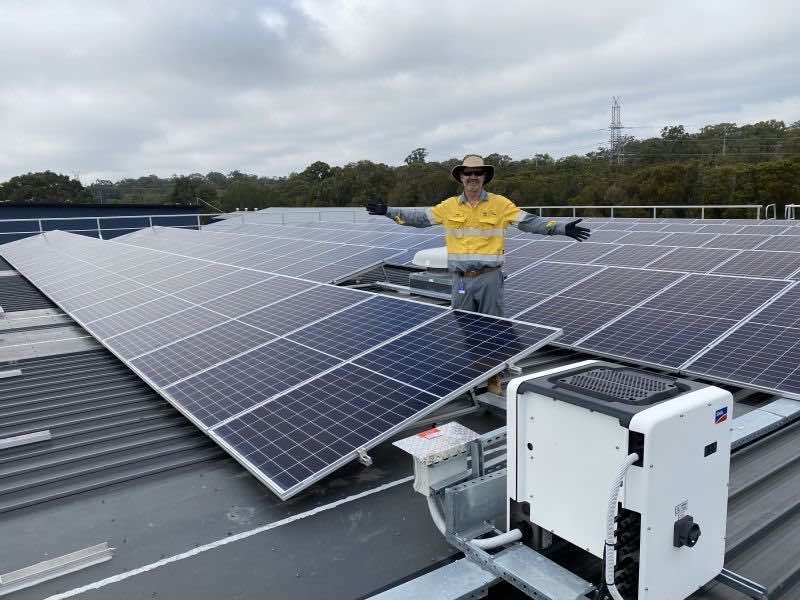
The DOE trial that has been nominated for the award was based out of the operational site at Energex’s Cleveland Depot, and initially monitored just one 50kW commercial solar array.
Using an innovative platform that retrieves real-time data from network monitors polled each minute, it allowed an operating envelope to be calculated for the site based on current network conditions.
A continually updated DOE was then published to a webpage monitored by an IoT Gateway installed onsite – a one-way broadcast approach that kept things simple and allowed for swift action and minimisation of cyber security risks.
The software processed site data to determine if PV generation levels should be decreased based on the existing site load and what was going on in the operating envelope and, depending on the supply-demand equation, the commercial solar system’s PV inverter could be sent a reduced generation limit.
The experiment was a resounding success, providing a range of allowable export values which the local network could accommodate based on real-time conditions – and the system was rarely completely blocked from export. The trial is now being expanded to four more sites.
Even better, the trial required no complicated changes technology, technology standards or energy market rules, but rather a combined brains trust of stakeholders including engineering firms, electrical installations, programming, security and communications.
“It’s a really exciting piece of work that the guys have done,” said Energy Queensland’s executive general manager of engineering, Peter Price, in an interview with One Step on Wednesday.
“Queensland, like South Australia, like the rest of Australia, has got this issue with the high penetration of solar impacting midday minimum demand, and creating some challenges at the big end of town for AEMO.
Price says that while the kind of macro problems the Australian Energy Market Operator is facing, in terms of keeping whole networks running require complex big-picture solutions, Energy Queensland has found that this particular problem can be addressed with a relatively simple approach.
“This is a simply partnership between us as a distributor and the customer. And we don’t have to worry about the impact on other customers, in terms of costs passed down the line.
“Clearly, in Queensland, we’ve got a stock of old inverters, although we brought a new standard in a couple of years ago. But we can get this [DOE solution] to work with only about 25% penetration of smart meters,” he adds.
“This is a multi-faceted problem,” he tells One Step. “In Queensland, a lot of commercial solar systems are constrained off to no export because of local level problems. Often, there’s a blanket rule – don’t do it.
“But Queensland has a renewable energy target of 50% by 2030, and we’re not going to get there if customers can’t connect solar.
“Clearly, the best way [to manage rooftop solar] is for customers to self consume, so we’ve set up tariffs to encourage this, simple demand management solutions for air-conditioning and hot water.
But for business and industrial customers it is rarely this straightforward. Price cites the example of a local child day-care centre that was approached by the Energex team about the possibility of participating in the expanded DOE trial.
“And the owner actually said, ‘Can I be part of the pilot next week?’, when it was explained to him, because it meant he got to have his panels and get the best out of it.”
As Price explains, for businesses like these, who self-consume very well during the week but are closed on the weekends and often have reduced self-consumption on holidays, this kind of dynamic export solution is a game changer.
“These businesses can go from no export, to exporting 50% of the time, then they’re generating an extra revenue stream that helps pay off their capital investment.”
And while the trial’s current focus is on the commercial and industrial market, Price says it could come to include residential exports as well.
And then when customers take the “logical next step,” and put batteries in, this potentially enables them to participate – if they wish – in the more complex markets being developed.
“I think there’s a place for complex markets,” Price adds. “And then for local level problems, like this one, there’s an equally important place for simple solutions… that don’t require 100% penetration of advanced technology.”

Sophie is editor of One Step Off The Grid and editor of its sister site, Renew Economy. Sophie has been writing about clean energy for more than a decade.