

Earlier this week, Greenpeace International released a report predicting that the world could shift to 100 per cent renewable energy by 2050, and, more importantly, it could do so for a net economic gain – the savings from avoided fuel costs alone more than compensating for the investment necessary to build renewable generation capacity and transform grids.
The report, Greenpeace’s Energy [R]evolution scenario 2015, maps the phase-out of coal, oil, gas and nuclear energy as fast as technically and economically possible, by expanding the renewable energy share to 42 per cent in 2030, 72 per cent in 2040 and 100 per cent in 2050.
In a nutshell, the 364-page report finds there are no major economic or technical barriers to shifting the world to 100 per cent renewable energy by 2050. All we need is the political will to do it.
So where does this leave consumers? According to the Energy [R]evolution scenarios, the assumption is that – as early as 2030 – all private consumers and small and medium enterprises (SME) that can, will meet most of their electricity needs with solar PV and storage.
This is because, already, we are at a point where households and small businesses can produce their own solar power for the same or a lower cost than rates for grid electricity, says the report; “on-site power generation – a term usually used for industry – now makes economic sense for the private sector.
“Therefore, utilities will lose most of their customers connected to the distribution grid until 2030 for electricity sales from centralised power plants.”

Of course, how smoothly this transition plays out will come back down to political will; it will require the adaptation of energy policies for “prosumers” – consumers who produce their own energy.
However it plays out, the end result will be the same: that utilities will have to move from selling energy, to selling energy services, by managing the operation and dispatch of decentralised generation capacity, as well as larger-scale renewable energy generation, including solar thermal plants and wind farms.


Further, there will be stand-alone systems for heating and cooling either connected to district heating networks or for a single building supply, such as solar thermal collectors, bio-energy heat systems and (geothermal) heat pumps.
“All these decentralised technologies can be commercialised for domestic users to provide sustainable, low-carbon energy,” the report says.

Industry and business, meanwhile, can use cogeneration power plants and cogeneration batteries for on-site power generation to cover their own power needs.
“Surplus power will be sold to the grid, while excess heat can to be piped to nearby buildings, a system known as combined heat and power,” the report says.
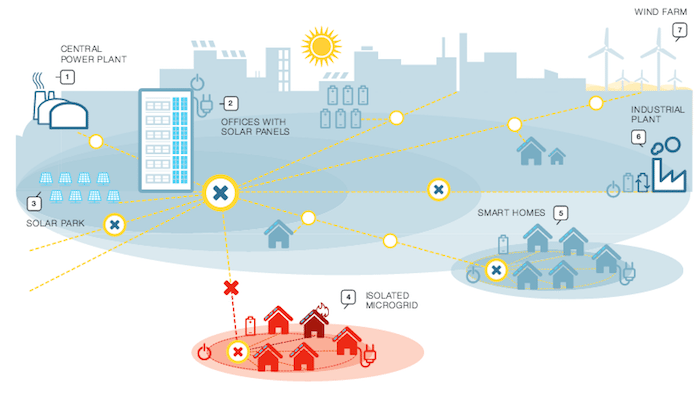
And for interest’s sake, here’s what the grid profile of 2050 might look like…


Sophie is editor of One Step Off The Grid and editor of its sister site, Renew Economy. Sophie has been writing about clean energy for more than a decade.