
Two months ago I moved into a new house and I feared the worse. The last house I lived in didn’t look that efficient: It was effectively a tent made out of wood.
Somehow though, probably thanks to its gas fired hot water, and despite my daughter’s hair dryer, the electricity bill never seemed that big. There was no air con –there’s not much point in a tent – and consumption rarely moved above 10kWh in a single day, even with four inhabitants.
This new house is a different challenge. There is only two of us now, but it’s off grid gas and off-grid sewage, which means that it is pretty much all electric. And there is a swimming pool. So every time we use water, a pump switches on, the pool has to be kept clean, the hot water system is like a very big kettle, and there is even air-con, and electric heaters – neither of which we have used yet.
My fear was that the daily usage of the household would be somewhere between 20kWh and 30kWh. With the two of us, it’s not so bad, and we can usually scrape in at around 15kWh. But with guests, many showers, and the oven in regular use, it’s been damn hard to keep it under 30kWh – and that is without the air-con or the electric heaters.
So, what to do? How much solar should I put on the east-west facing roofs (pretty clear but for a line of trees that would brink sunset to any panels an hour early).
And when I do put in solar PV – that’s inevitable – should I start planning ahead for the day when I might add an electric vehicle, or add battery storage. Or both.
And if I am thinking about battery storage – what do I want to get out of it? Do I want to use it as a revenue raiser, or to offset more bills. Do I just want to install excess solar power on a matter of principal, or do I want it as back-up (it’s on a semi-rural line that faces regular blackouts – the previous owner had a generator installed just for that purpose.
Should I use solar PV to heat the water, or add a solar hot water system – flat plate or evacuated tube? Is a heat pump an option?
Should I change the pool pumps? Actually they are pretty efficient and run about 0.3kWh, but is there some way of using them less?
And what should I do – if anything – about the heating options. The electric heaters are in bizarre places – the study and a corridor – and the reverse cycle air con is in the main bedrrom and the open living area. Is there some way of making the insulation better?
I’m not really worried about air-con. The house is sitting high on a ridge and it gets plenty of breeze, and there are fans in most rooms if it gets too still and sticky.
It occurred to me that I am facing the same questions that confront many in the community – so many options, so many different brands, so many technologies – particularly in battery storage – that are difficult to grasp.
The first thing I did though – and one of the reasons why I am across the daily usage – is to install a monitoring device. I got one from Solar Analytics which gives me a monthly, weekly, daily, and intra day readings – right down to 5 second intervals.
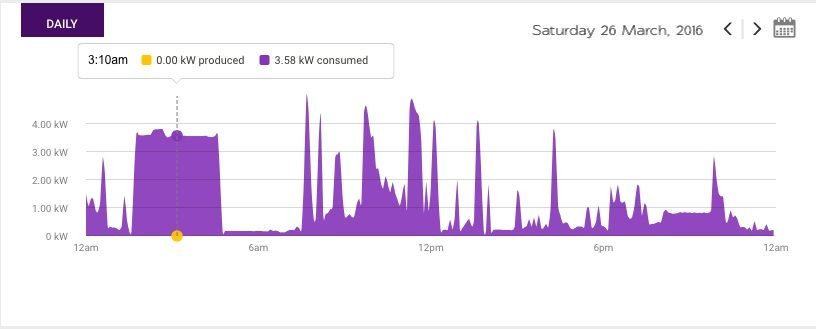
This has given me remarkable insight into the variable or our demand. For most of the day, not much happens. The pool pump comes on, and raises demand a bit, and ditto in the evening with the lights (mostly LEDs).

The jump in the kettle is a bit of a shock, but nothing compared to the hot water, which comes on around 1.40am and will gobble up 7kWh pretty quickly, or in this case above, more than 10kWh in just a few hours.
But it gives me a few ideas about my demand profile, and what my options might be for solar, and eventually battery storage, and how I might change my consumption patters. More on that at another time.

Giles Parkinson is founder and editor of One Step Off The Grid, and also edits and founded Renew Economy and The Driven. He has been a journalist for 35 years and is a former business and deputy editor of the Australian Financial Review.