

Australian network companies are being encouraged to test out different ways to charge for electricity on a rapidly changing grid where electrons flow two ways: from the grid to customers, and to the grid from customers, mostly generated by rooftop solar.
As One Step Off The Grid reported earlier this week, some distribution network service providers are working up plans to trial the use of newly approved solar export tariffs, to disincentivise rooftop PV exports at times when demand is low and solar generation is high.
But in Victoria, the DNSPs are so far taking a slightly different approach. Rather than an export tariff, the networks are working up time-of-use tariff trials for households that will signal to both solar and non-solar customers – via their retailers – when it’s best to use power, and when it’s best not to.
On top of that, Powercor, CitiPower and United Energy are also all looking at incentivising the installation of non-distributor owned community batteries, to soak up excess solar on certain parts of the network and store it for use during times of peak demand.
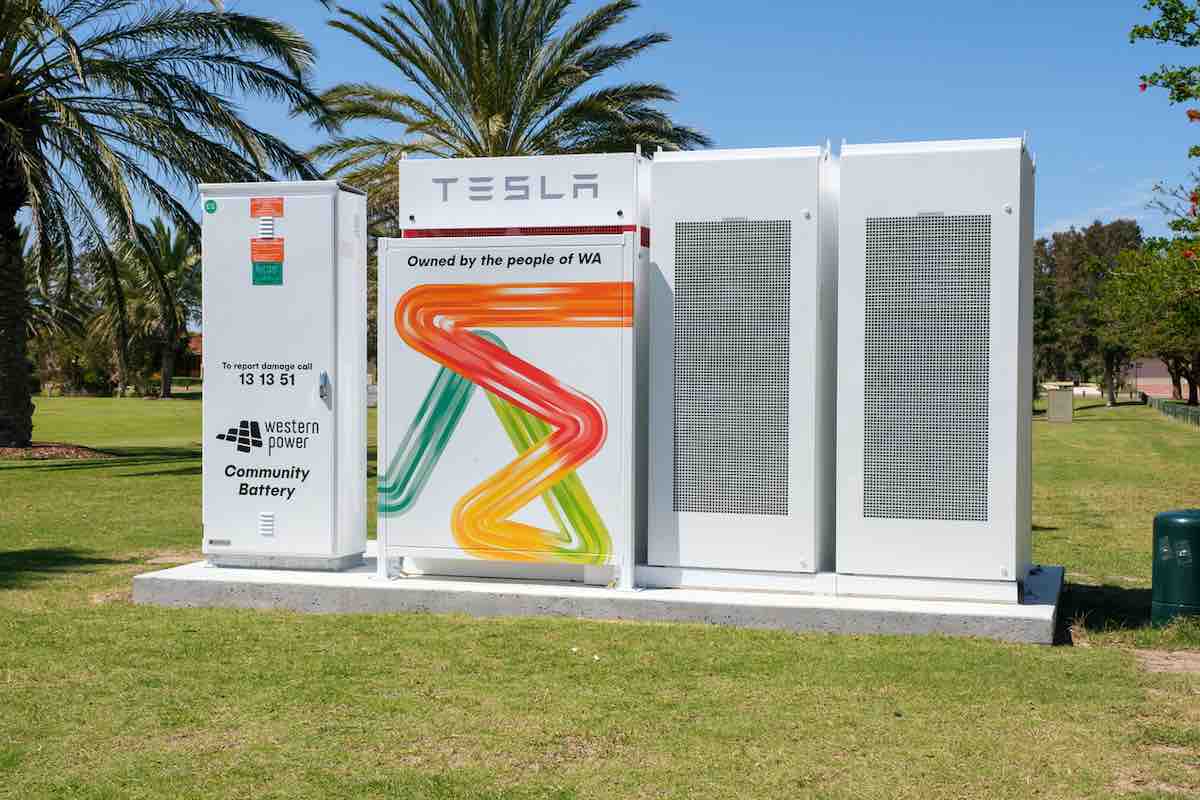
This is not a new concept. Network companies – including in Victoria, but most prominently in Western Australia – have been installing battery energy storage systems for this purpose for some time now.
But AER updates to ring-fencing guidelines late last year, and allowances to explore tariff trials, mean that DNSPs can test out incentives to encourage the installation of network-connected batteries by retailers or community groups.
And in Victoria, that is what some are proposing.
Powercor, CitiPower and United Energy – who between them cover the a big chunk of Victoria’s distribution networks, not including the most of the east of the state which is serviced by AusNet – have all submitted trial tariff proposals to the AER for non-distributor owned community batteries, that they plan to offer starting in July.
Each of those tariff plans look like this:
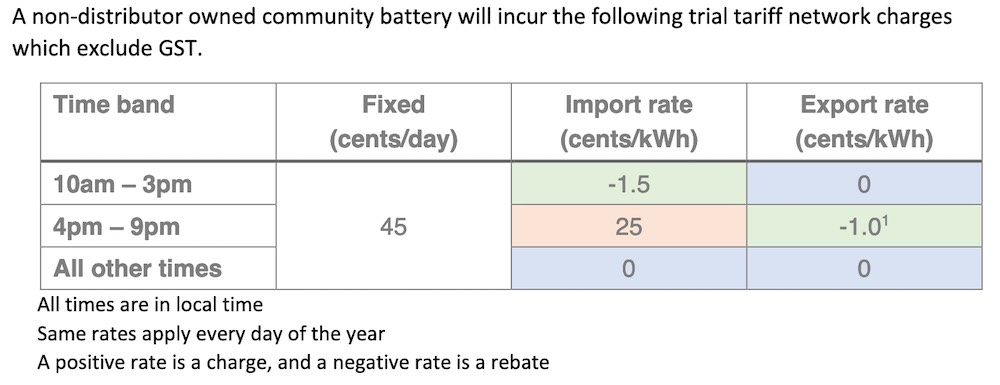
The DNSPs say that the trial tariffs are intended to work in tandem with an operating envelop that will safeguard that part of the network from potential harm.
They will do that by encouraging network usage when there is generally low network demand and discouraging network usage when there is generally high network demand.
The DNSPs say the trial tariff should result in a “net rebate to community batteries which generally flatten the local demand/export profile.
“The net rebate is effectively an option payment to negotiate a future network support agreement should the need arise.”
The batteries would have to be no bigger than 240kW (storage capacity not defined) and while all DNSPs say they have had no engagement with retailers about the tariff, yet, they report to have had some engagement with community battery proponents.
Are community batteries the answer to Australia’s “problem” of rooftop solar abundance? Certainly not the answer, but definitely an answer.
Here’s how Powercor’s general manager of electricity networks, Mark Clarke, explained it around this time last year.
“[Community batteries] will provide benefits for local customers, whether they have solar or not, by providing the community with access to local renewable energy, improving the reliability of electricity during peak demand times,” Clarke said.
“Community batteries can play a part by supporting more people export their excess rooftop solar, helping us avoid costly network upgrades and reducing greenhouse emissions.
“This technology also has enormous benefits for reliability and maintaining power quality within neighbourhoods helping keep power reliable and safe for all of our customers.”
Community batteries are also fairly well supported by state and territory governments, in terms of grant funding, while federal Labor has proposed to underwrite a major rollout of community batteries if it is elected in the upcoming election.

Sophie is editor of One Step Off The Grid and editor of its sister site, Renew Economy. Sophie has been writing about clean energy for more than a decade.