
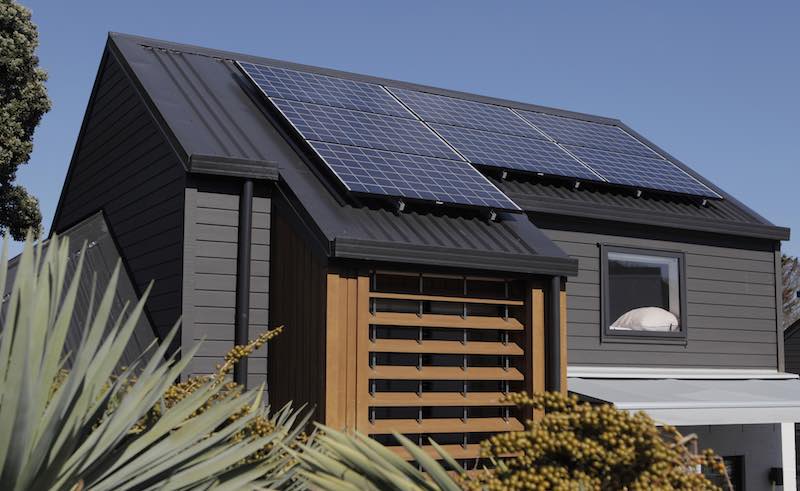


The New Zealand government is coming under increasing pressure to introduce what would be its first ever subsidy for residential rooftop solar, with the launch of a new campaign by Greenpeace.
The campaign calls on the government to subsidise the installation of both solar and battery storage on 500,000 homes in the Land of the Long White Cloud, where distributed PV currently contributes just 0.2 per cent of electricity.
In a call to arms published last Friday, Greenpeace New Zealand said the country had “fallen behind” the rest of the world on small-scale solar uptake, with fewer than 18,000 homes with PV installed.
Greenpeace also proposes that the government pay for the solar and storage roll-out with funds re-directed from existing fossil fuel subsidies.
According to the findings of a recent Low Emissions Economy inquiry conducted by the New Zealand Productivity Commission, government provided between $78-88 million a year worth of support to fossil fuel production and consumption.
(That claim has been disputed by the Petroleum Exploration and Production Association of New Zealand, which says most of that figure comes from “a simple rebate for fuel-excise taxes.”)
The Commission also recommended these subsidies be phased out, given they were not aligned with NZ’s international climate commitments or low-carbon policies.
And Greenpeace agrees. “For too long, the rules have been rigged in favour of big energy companies. And it’s holding us back. It’s time to take the power back,” the campaign statement says.
“By kitting out half a million homes with solar and batteries, we could quite quickly provide a much-needed injection of clean electricity into the New Zealand energy system,” said Greenpeace NZ campaigner Amanda Larsson.
“Not only would this help to reduce our climate pollution, but it would put power back into the hands of New Zealanders, increase the resilience of our national grid, and lower energy bills across the board.”
Greenpeace has momentum on its side, at least, after the April announcement by Prime Minister Jacinda Ardern of ban on all new offshore oil and gas exploration permits – a “significant win” for which the NGO takes some credit.
Certainly, in many other areas, such as electric vehicles and large-scale renewables, New Zealand is well ahead of countries like Australia.
It currently gets around 80 per cent of its electricity supply from big renewables, but as noted above, distributed solar PV contributes just 0.2 per cent of that – including more than 19,000 rooftop solar systems, almost 18,000 of which are residential.
Pressure has been growing for the government to help amend that situation, particularly after April storms left more than 100,000 of the homes in Auckland without power, some for more than a week.
“If we believe storms like this are going to occur more frequently in the future, then the resilience of the electricity supply becomes an issue,” said University of Auckland researcher Dr Kiti Suomalainen in comments to the NZ Herald in June.
“This as much as economics will be more and more on the minds of people – and is motivation to look at solar as an alternative.”
As Rob Passey wrote on RenewEconomy almost two years ago, NZ could even use its slow start on rooftop solar to its advantage – considering that batteries are now becoming financially viable, and with more and more smart energy management technologies coming to market.
“The simultaneous uptake of batteries in NZ (would) mean that PV continues to offset OCGT electricity (rather than ‘eating down’ into the contribution from existing renewables), and as a result emissions would be reduced by an estimated 8 million tCO2-e, worth $NZD500 million, between 2016 and 2040,” Passey wrote at the time.

Sophie is editor of One Step Off The Grid and editor of its sister site, Renew Economy. Sophie has been writing about clean energy for more than a decade.