
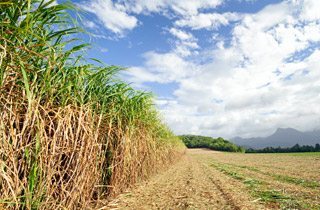

A Queensland sugar cane growing family has decided to install enough solar energy to quit the grid entirely, in a bid to beat soaring electricity prices.
The Bundaberg family says it will build a ground-mounted solar power system that will take its 80 hectare farm completely off the grid of state government-owned electricity network Ergon Energy.
The Bundaberg News Mail reports the Griffin family has so far laid three long concrete strips in a cane field to provide the hard standing for the system.

“This is a direct response to the soaring power prices which have been crippling farmers like us for years now,” said Kelvin Griffin, who runs the farm with his wife Helen and adult children.
“If we used Ergon’s power for irrigation, if we could afford it, we would be putting at least $40,000 to $50,000 a year into this power giant’s pocket.
“We won’t, and can’t, do that. But we can take our custom away completely and go off-grid.
“From now on, our power money goes to pay off our solar system, and make us independent of this government-run giant which obviously does not want to listen to farmers and ordinary families who simply cannot afford their huge electricity costs.”
The family says it has taken on a $100,000 debt to pay for the solar system.
“We sat down and discussed the future of the farm and whether it would be here for our kids,” said Jason Griffin, 33, who lives on the farm with wife Felicity and two daughters.
“We had to make a hard decision – $100,000 is a big debt to take on with the tough economic times – but we worked out we could have it paid off in six or seven years for around the same money as we are paying right now to Ergon, even without using our irrigation capabilities.
“By irrigating using solar, we also can increase our production back to the 7000 tonnes a year we used to get when we irrigated fully.
“If we could afford to irrigate using Ergon electricity, which would cost us at least $10,000 a quarter, we could have it paid off within two and a half years.
“We have to face facts that for around the price of buying a new 120-horsepower tractor, we can get our own solar and escape the ongoing pressures of government-run electricity.”
Kelvin Griffin told the paper the system’s 25-year guarantee meant that once it was paid off, the farm could enjoy decades of cost-free power.
“We’re powering off the grid to power on,” he said. “For us, and many farmers, there is no choice.
“There are many farms which have been handed on for seven, eight generations and to walk away because the government is acting in a way that is economic madness for such a core industry is not acceptable.”
Of course, the cost of irrigation – whether grid-powered or powered by diesel – is a growing problem for farmers all around Australia, and not just in Queensland.
Last month, we reported that a cotton farm in NSW had switched to an off-grid, hybrid solar pl ant to power the irrigation of its crops.
The cotton farm in the town of Moree – also the host to one of Australia’s biggest solar projects, the under-construction 56MW Moree Solar Farm – has added a 70kW ground-mounted solar array with back-up battery storage to its diesel engine direct drive pump, with the aim of cutting its diesel consumption by 60 per cent.
In Western Australia, a large-scale farming irrigation system made by South Australian engineering company REAQUA, is being used to provide fuel savings over traditional diesel and grid-powered pumps.
One system, including more than 400 solar panels, pump controllers and submersible pumps was installed at a cattle farm in Western Australia to pump water from a bore through a central pivot irrigation system. With an installation cost of around $300,000 the savings on fuel will return the investment in under five years.

Sophie is editor of One Step Off The Grid and editor of its sister site, Renew Economy. Sophie has been writing about clean energy for more than a decade.