
Two Queensland workplace regulators are recommending that all battery storage units not be placed in either the home or the garage, and should instead be installed in a free standing, weatherproof enclosures.
 The Electrical Safety Office, part of the Office of Industrial Relations, and WorkCover Queensland have issued the advice ahead of – and apparently anticipated – strict new guidelines that are due to be released by Standards Australia in April.
The recommendations to not install battery storage in garages or sheds, and instead put them in a separate enclosure, have caused controversy in the industry, which fears that the cost of installation could rise by thousands of dollars, and are “over-reach” in the case of quality equipment.
They point out that battery storage has been installed in tens of thousands of homes in Germany, mostly in garages, and there are thousands of installations already in Australia, including in the Sydney harbourside property of prime minister Malcolm Turnbull.
The industry has accused authorities of being too conservative, although they recognise the risk of low cost, low quality technology with poor installation standards.
Still, they fear that the industry could be stopped in its tracks if their are effective bans or restrictions, just as the battery storage industry is tipped to take off in response to high electricity prices, the high installation of solar, and the falling costs of storage.
Network companies in Australia and retailers such as AGL Energy have announced plans to install thousands of battery storage devices in trials designed to create “virtual power plants” and save on network upgrades.
Some ask whether the ruling would effectively stop electric vehicles, laden with even bigger arrays of battery storage, from being parked in garages. Others point to the risk of liquid fuels, and wonder if stand-alone enclosures would subject battery storage to even more heat.
Revelations last week by RenewEconomy that Standards Australia was to introduce regulations that would effectively ban lithium-ion battery storage from inside homes and garages caused such a blow-back that the release date was delayed by nearly two months and the public consultation period extended to 9 weeks from 6 weeks.
The Queensland guidelines, issued last week, appear to affect all battery storage technologies, not just lithium ion.
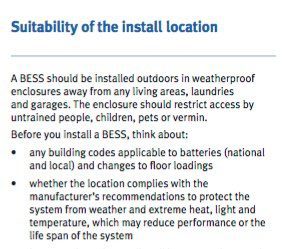
“A BESS (battery energy storage system) should be installed outdoors in weatherproof enclosures away from any living areas, laundries and garages. The enclosure should restrict access by untrained people, children, pets or vermin,” the Electrical Safety Office writes on its website.
The guidelines say that a range of battery technologies is available in Australia – the most common being lead-acid, lithium technologies, nickel-based, flow technologies and hybrid-ion technology. “Hazards can result from overheating, over-charging and emissions from hazardous chemicals,” it says.
WorkCover Queensland, in an update from February 16, also identifies the range of battery technologies, including lead-acid (advanced, flooded-cell and sealed); lithium (ion and polymer); nickel-based (metal hydrides and cadmium); flow (zinc bromine and vanadium redox); and hybrid ion.
“We recommend that no battery parts of a BESS should be installed inside a home or building attached to a home. Instead, they should be installed in a suitable fire and weatherproof enclosure or other purpose built structure.”
Originally published on RenewEconomy. Reproduced with permission.

Giles Parkinson is founder and editor of One Step Off The Grid, and also edits and founded Renew Economy and The Driven. He has been a journalist for 35 years and is a former business and deputy editor of the Australian Financial Review.