
Rooftop solar retailers could soon be required to provide written estimates of the expected payback period, or energy savings, of each new PV system they sell, as part of a suite of changes that will tighten the rules governing the federal government’s solar rebate scheme.
The draft rule changes, detailed in a consultation webinar on Wednesday by the Clean Energy Regulator, are part of a series of recommended reforms to the Small-scale Renewable Energy Scheme to come out of last year’s Integrity Review of the Rooftop Solar PV Sector.
One of the key goals of the proposed reforms has been to place greater accountability with solar retailers for the installation of rooftop systems in compliance with the rules that ensure eligibility with for federal government SRES rebate.
“Solar retailers are often the first point of contact for consumers and are usually responsible for the acquisition of the solar PV system components and their installation (or for sub-contracting the installation),” CER documents say.
“However, retailers are not currently subject to the regulatory framework of the SRES (unless the retailer is also a registered agent).”
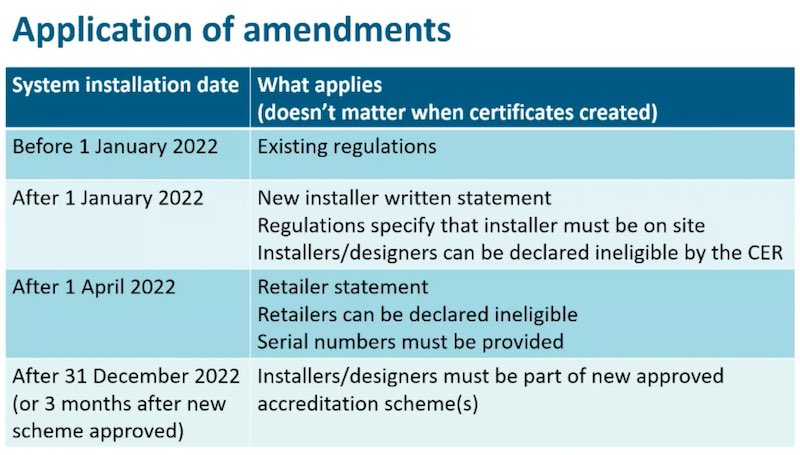
To rectify this, the CER is proposing that, from April 2022, any new rooftop solar system applying for small-scale technology certificates via the SRES must have a written statement from the solar retailer attesting to key details of the system’s components, its installation, and its future performance.
The statement would include the name of the accredited installer of the unit and whether or not that installer was an employee or a subcontractor of the solar retailer; confirmation that the unit would perform in accordance with the contract of sale; and verification that it was installed to the agreed design.
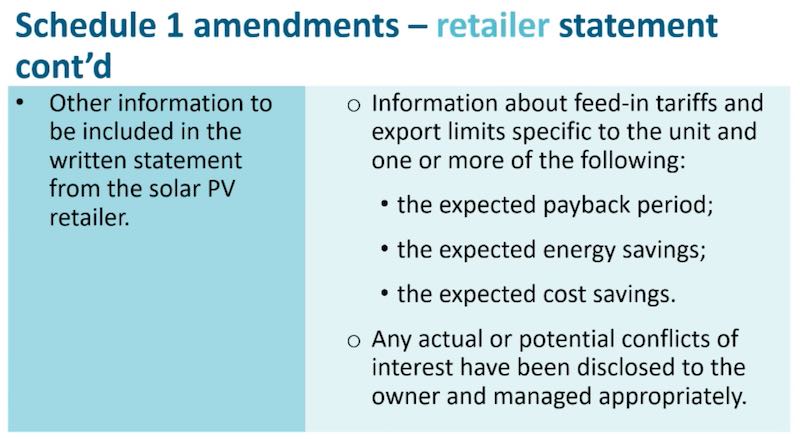
Further to that, the CER proposes that the retailer statement would also need to provide details on the feed-in tariffs and export limits specific to the system; and one or more of either the expected payback period, the expected energy savings, or the expected cost savings.
The requirements of the proposed Retailer Statement are clearly intended to make retailers more accountable for the promises they make to customers about the solar systems sold to them – and as the CER team noted on Wednesday, many retailers are already supplying this information as a matter of course.
But the proposal to make these steps mandatory in order to for a system qualify for STCs did seem to raise some virtual eyebrows among the attendees of the webinar – or at least a number of questions around how this would work in practice.
“When there are export limits on the system, it is not possible to put an expected return on performance as consumer or consumption patterns in as unknown,” said one comment.
“If the system does not perform as per the statement/contract, is there a standard clawback mechanism for the price the customer paid?” asked another – and the CER’s answer was that anything ouside of STC eligibility fell under consumer and contract law and was not a matter for regulation.
After a lot of questions, some answered and some not, the CER team said it would endeavour to publish a Q&A document in coming weeks, addressing the main concerns raised around each proposed reform.
The Regulator seemed prepared to raise a “lot of interest” in the new retailer requirements, and perhaps that is why it has delayed the introduction of this particular proposed reform until April, when many others will come into play on January 01, 2022.
Another key change is for installers, who will be required, from the beginning of the new year, to be on site during the installation, and provide evidence of this, such as as photographic evidence with time and date metadata or geo-location data.
“It is intended that the accredited installer responsible for the installation is on site for the majority of the time that the installation takes place,” the CER says.

Sophie is editor of One Step Off The Grid and editor of its sister site, Renew Economy. Sophie has been writing about clean energy for more than a decade.