
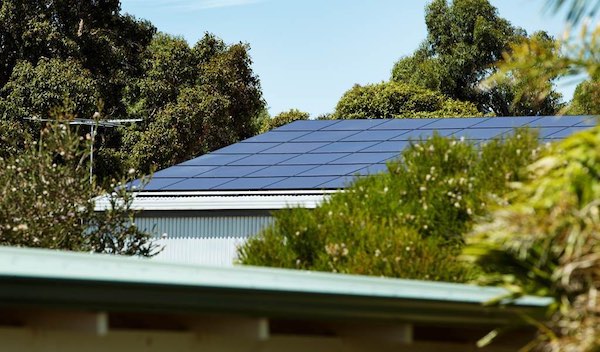

The Australian Energy Market Commission’s recently drafted proposal to effectively tax the nation’s solar households by charging a fee for excess generation exported to the grid has elicited no shortage of responses – good, bad, indifferent – from industry and the media. But what do consumers think?
According to a survey of 1,300 Australian solar households by industry lobby group Solar Citizens, the vast majority of respondents (95%) do not support the introduction of a rooftop solar export fee, with more than half (63%) saying they would consider going off-grid rather than pay it.
The lack of popular support for what has been dubbed a “solar tax” – or “sun tax” by Solar Citizens – is hardly surprising. But the threat of mass grid defection is something no one in the industry wants to hear, followed closely by the term “network death spiral.”
A network death spiral, as Solar Citizens helpfully explains, is triggered when an increasing number of households go off grid, resulting in higher network charges for customers remaining connected to the grid, and so on in a vicious circle that would not be for the greater good.
It’s a term that got a fair bit of traction in the mid-2010s, when ballooning electricity prices – inflated further by overzealous network pole-and-wire expansion – combined with increasingly cheap solar and supporting technologies sent a collective chill through the incumbent industry.
So much so that, in late 2016, Australia’s main network lobby proposed a new tariff for stand-alone power systems to encourage households with large amounts of solar and battery storage to stay connected to the main networks, rather than lead an exodus.
The proposal was based on a report commissioned by the Energy Networks Association that predicted that by 2050 some 10 per cent of consumers – or 1.25 million households – would leave the grid because solar and battery storage would offer a cheaper solution.
Five years later, electricity prices have come down to more reasonable levels, thanks largely (and with no small irony) to the Australia’s world-leading rooftop solar penetration, and home solar and batteries have been embraced by the Australian Energy Market Operator as an integral part of planning for the future renewable grid. And so, the threat of the network death spiral has subsided. …Or has it?
“The results of our survey indicate that solar households are upset about the proposed sun tax and are willing to take matters into their own hands,” said Ellen Roberts, Solar Citizens’ national director.
“It’s hardly surprising that solar owners are concerned. The big network companies are failing to manage grid voltage and now they want to pass the bill to everyday Australians.
“We know that grid voltages are too high even at night, so it’s time to stop blaming Australians who have made an investment in solar,” Roberts said.
“Ninety five per cent of solar owners we polled didn’t support the sun tax, so it’s time for state governments to use their power and rule out these changes.
“Already we’ve seen the Queensland and Victorian governments indicate they don’t support slugging solar households, so now we need to see states like New South Wales and South Australia also step up.”
This much is true. Queensland state energy minister Mick de Brenni confirmed just last week that his department’s incoming submission to the AEMC was expected to indicate that measures such as investment in more battery storage were “preferable” to a solar tax.
“There is no doubt that intermittent renewables like solar are putting pressure on the network and stability needs to be addressed across the National Electricity Market,” de Brenni was quoted as saying.
“My department is preparing a response to the proposal and I expect it will indicate that system-wide measures, especially investment in more storage, will encourage more solar and are preferable to the proposed rule change.”
In its own submission to the AEMC’s initial consultation paper last year, Victoria’s Department of Environment, Land, Water and Planning said the Andrews Labor government did not support export charging, because the case for implementing it had “not been demonstrated at this time.”
The submission argued that the introduction of a solar tax, as proposed by the AEMC, would require “substantial changes to cost allocation principles” while offering “uncertain benefits” that – all told – would be a hard sell to consumers.
The Solar Citizens survey results certainly backs that theory. The question remains, however, whether consumer sentiment is enough to change the AEMC’s mind.
“It’s in the best interest of everyone for rooftop solar to keep thriving. Solar homes and businesses provide cheap local energy to the grid which drives down the wholesale price of electricity,” said Roberts.
Further reading:

Sophie is editor of One Step Off The Grid and editor of its sister site, Renew Economy. Sophie has been writing about clean energy for more than a decade.