
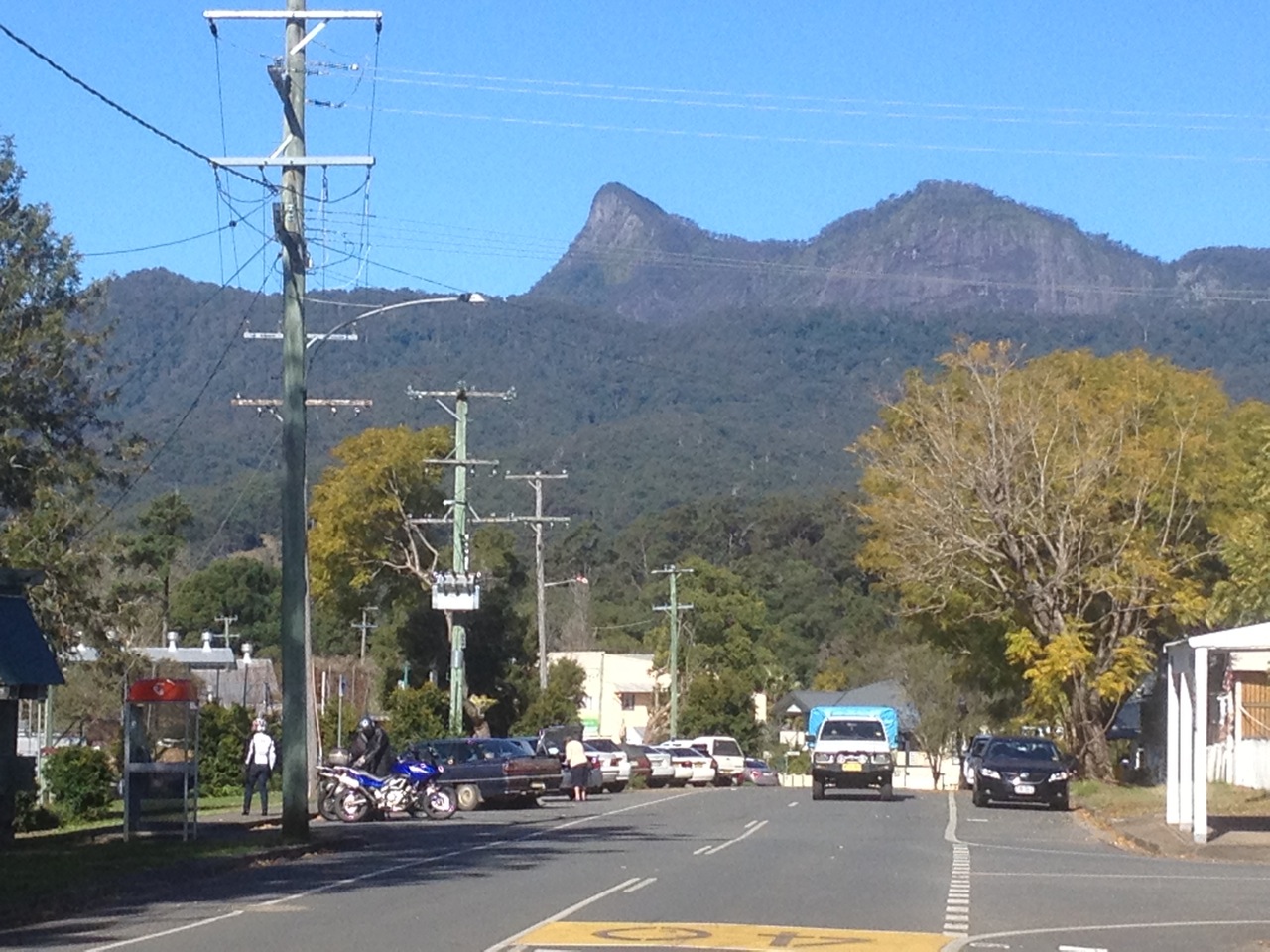

The northern NSW town of Tyalgum is considering a proposal to go 100 per cent renewable and to possibly quit the grid altogether, in what would be the first such move by a township in Australia.
Tyalgum is one of a number of towns in northern NSW and Victoria looking to become “zero emissions” towns, but the community of 120 homes and more than 250 people could be the first to actually achieve it. And in doing so, it could provide a blue-print for others to follow.
 Tyalgum could be the first to move because it is a small town at the end of the grid, experiences numerous blackouts due to storms, and it has a community that appears to be right behind the concept. The local council, Tweed Shire, now headed by a Greens mayor, is also supportive.
Earlier this year, Tyalgum received a small grant from the NSW government to pursue “community energy” concepts, and it commissioned consultancy group Energy for the People to do a feasibility study into their options.
That study has now been released, and presents several options and two core scenarios: looking after its own energy needs with a renewables-dominated micro-grid; or aiming for 100 per cent renewable energy but using the grid as a back-up.
Energy for the People estimate that it will only require 2.5 hectares of solar PV, and 30 square metres of battery storage, to meet those needs.
 Based on four peak sun hours a day after losses, it estimates that 1.7MW of solar power would be needed to make the town “net zero emissions” based on current energy demand, and assuming no energy efficiency measures are undertaken.
Up to 2.7MW of solar power and 2.7MWh of battery storage (complemented by a backup generator) would be appropriate if the town was to become energy self-sufficient by going “off grid”.
And how the likes of Essential Energy respond to the proposal will be key for the decisions made by Tyalgum and other similar communities.
While network operators in Western Australia, as we report here, are looking for tenders to take small communities off grid to save the cost of grid maintenance and upgrades, and other networks in Queensland and South Australia can see the future in renewable-based micro-grids, the idea has not really been tested.
As Szatow states clearly in the report: it’s not the technology that is the issue, that already exists. It’s the structure of the grid that counts, and how people work together. The network operator – and the pricing of its assets – will play a critical role.
That would deliver savings of as much as $580,000 per annum, with every home and business having their own battery storage system, and with most customers having their own solar system, although some households will not have suitable roof space due to roof condition or overshadowing. A lot of the output would be shared.
The economics, however, will depend on what Essential Energy does with the tariffs. Raising the fixed price component could change the equation in a major way. it could halve the returns to the town of Tyalgum if it insisted on maintaining its current revenues.
This estimate assumes the one-off cost of “buying back” the local grid (so power can be shared) for around $200,000.
“We have assumed the grid would be priced fairly, given it is an old asset, paid for many times over by customers since it was originally built, even factoring in the costs of recent work to re-conduct the lines,” Szatow says.
Kacey Clifford, a local resident who is spearheading the Tyalgum Energy Project with Andrew Price, her boss at local wind tower monitoring company Australian Radio Towers, says there is a strong community push for the idea.
“We are in a really good position,” Clifford tells One Step Off The Grid. “We are at the end of the grid, we don’t get a lot of attention from the energy companies here, because we have only got 120 households. We get blackouts all the time because of storms, there is no reliability, and there is a real push for sustainability.”
 Clifford says the next phase is to build enthusiasm and awareness of the project, and the potential. This might start with some crowd-funding for community-solar on the rooftops of the local schools, and advancing the Tyalgum natural energy centre, based in the old butter factory bought by Price’s business – and now its headquarters – a few years ago.
Clifford says that Energy for the People estimate that the town could achieve its goals within five years – say by 2020.
“I think that’s a pretty good time line. We have quite a significant amount of houses already with solar, the main business are interested in solar and some remote homes already asking about going off the grid.
Clifford says the main idea is to share the power, the essence of community energy. How that takes shape, however, is the big question. “The technology exists, but it is a jig-saw puzzle. The big unknown is how we move through management side of things.”

Giles Parkinson is founder and editor of One Step Off The Grid, and also edits and founded Renew Economy and The Driven. He has been a journalist for 35 years and is a former business and deputy editor of the Australian Financial Review.