
RMI

Kit Carson Electric Cooperative (KCEC) has long been a proponent of supplying its 29,000 customers in northern New Mexico with renewable energy. The rural electric cooperative now says it wants to serve all its customers during the summer peak with 100 percent solar power by 2023. While this is in line with goals of some other cities such as San Francisco and Los Angeles, what is unique is that this is a voluntary goal from the utility company itself, and not imposed by a state or city.
KCEC’s goal would have been impossible only a year ago because, under a contract with its wholesale supplier—Tri-State Generation and Transmission—that didn’t expire until 2040, KCEC was allowed to generate only 5 percent of its total energy from local renewables. However, in 2015, KCEC participated in RMI’s eLab Accelerator as part of the Renewable Taos team.
Renewable Taos has a goal of generating 100 percent renewable energy for north-central New Mexico by 2030. In order to do this affordably, Renewable Taos knew that KCEC had to be involved so that people wouldn’t have to go through third-party providers to put solar “behind the meter.” This led KCEC to look for a new wholesale energy provider and leave Tri-State. In June 2016, Guzman Renewable Energy Partners agreed to front the $37 million exit fee to buy KCEC out of its Tri-State contract. The co-op is paying back the money through an electricity surcharge.
“KCEC and its members have shown that that they want to decide their energy strategy and control their energy future,” says RMI Senior Associate Kevin Brehm. And this strategy involves local renewable energy. “As member-owned utilities, co-ops try to meet community goals, but ultimately they are responsible for providing low-cost, reliable power,” adds Brehm. “KCEC didn’t set this goal based only on sustainability reasons. It sees local solar as part of a long-term economically viable strategy.”
Reaching 100% through community-scale solar
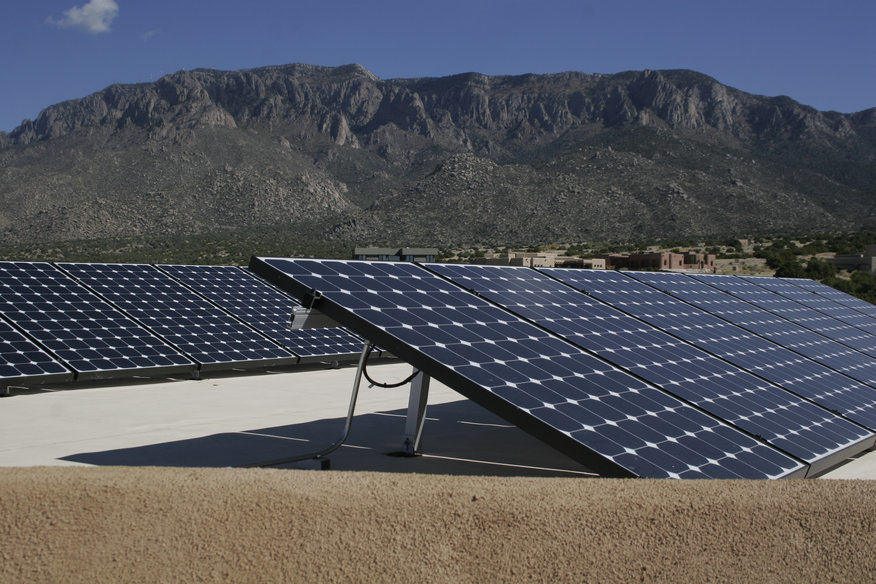
Right now, KCEC has approximately 5 MW of solar capacity that it owns or purchases. KCEC’s summer peak was 35.6 MW in 2015. To reach its ambitious goal of 100 percent renewable electricity, the co-op is planning to add over 30 MW of solar projects to its portfolio by placing multiple 1 MW solar arrays throughout its service territory.
These relatively small arrays—referred to as community-scale or distribution-scale solar—can have great value for rural electric cooperatives. They can be easily sited, and integrated into the system without major upgrades. Many co-op-controlled distribution substations do not have adequate capacity to integrate utility-scale generation, but are large enough to accommodate community-scale installations.
The co-op will also benefit from community-scale solar projects because having the same size and type of system across a portfolio can lead to standardization, bringing down the costs. According to RMI Principal Joseph Goodman, “We at RMI expect standardization and utility engagement will unlock the community-scale solar market to beat wholesale plus transmission prices in most of the country.”
RMI’s Shine team, which has been working with KCEC and other rural electric cooperatives to help them incorporate community-scale solar, found that when community-solar is developed through a portfolio of projects, it can be built with prices comparable to utility-scale solar. For example, Shine recently held an RFP for community-scale solar PPAs in New Mexico and the prices came in at or below $50/MWh. This has led KCEC to believe it can reach solar prices as low as 4.5 cents/kWh, which is equivalent to what it would have received under their Tri-State contract.
KCEC has also said it will explore different strategies related to storage to determine the best technology and utilization to enhance overall solar performance, and to allow the solar facilities to operate as firm resources rather than intermittent resources.
Community benefits
There are many other benefits of KCEC’s goal to meet its peak summer demand with 100 percent solar energy. Luis Reyes, CEO of KCEC, believes that solar energy can stabilize rates without requiring additional investment from the co-op. “I believe that solar now has rate parity with other fuel sources. Fixing low-cost solar for 20 years gives our community rate certainty for a long time,” says Reyes.
It can also be a driver for economic development by giving the community an advantage in attracting businesses that value a greener electric supply portfolio, while providing labor and construction jobs. Reyes adds, “Having these 30 solar arrays built with local labor gives us a great economic development opportunity that we can use locally and export our expertise to help other communities have solar generation as a reality.”
Installing community-scale 1 MW solar facilities throughout KCEC’s service territory will also better distribute the resource for system reliability and ensure that all members of Kit Carson have access to solar energy, an important piece for the co-op.
Hopefully KCEC’s ambitious and voluntary goal to provide 100 percent of the summer peak power with solar energy can be a model for other cooperatives and communities looking to provide clean, reliable, and accessible energy to their customers.