
RenewEconomy
VSUN Energy, the vanadium redox flow battery storage offshoot of mining group Australian Vanadium, has firmed up plans to target Australia’s nascent home energy storage market – most likely with a base model of 15kWh – and to set up a local manufacturing base as it works to drive down battery costs and catch the wave of home solar and storage.
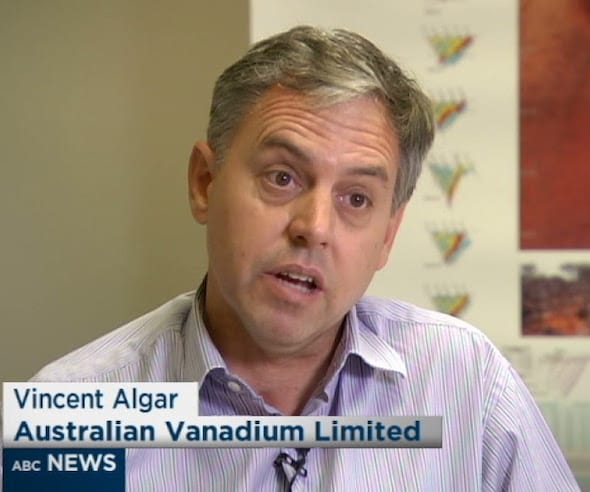
Australian Vanadium managing director Vincent Algar said on Friday that the company was “very well advanced” in negotiations with a number of international manufacturers of vanadium redox flow batteries, including the German based outfit, Schmid, which already makes a residential VRB system for the European market.
Algar said that the company was also working on meeting certain technical “tick the box” inverter compatibility requirements, necessary to the introduction of domestic-scale VRB into the the Australian market.
Australian Vandium this week revealed that it had terminated its exclusive dealership agreement with German vanadium flow battery maker, Gildemeister, on the basis it was too restrictive to VSUN Energy’s growth plans.
It will, however, continue to market the company’s CellCube battery stacks, on a non-exclusive basis, while it continues negotiations with a number of VRB makers.
In an interview with RenewEconomy on Friday, Algar said he was excited about the technology’s prospects in the Australian residential energy storage market, despite differences in cost, and a yet-to-take-off market already crowded with competitive li-ion options.
Currently, a 15kWh VRB system sits somewhere at the $25,000 mark, he said, but – as has happened with lithium-ion – he says projections are that VRB will start to come down the cost curve as the money and focus of the clean tech market turns more and more towards innovative stationery storage solutions.
“What we are absolutely trying to do is bring down the price, to compare with lithium-ion,” Aglar said.
But at the time, he added, it should be noted that the VRB systems serve a different purpose to other chemistries, being much more about “serious load shifting.”
“We know that the pricing will be slightly higher initially, but we’re comfortable,” he said. “It’s a bit of a trade off… between much longer life battery; much lower degradation cycle.
In an ASX announcement published on Thursday, Australian Vanadium said a recent strategic analysis had revealed a strong financial case for VSUN home battery systems, and “significant points of difference” to its main competitors, including lead-acid and lithium-ion battery systems.
“Increasing (electricity) network charges, up 200 per cent in the last 10 years, are a constant source of financial concern,” the update says.
“High cycle, multi-hour energy storage systems at the domestic and multi-residential level will have a part to play in the market.
The company, which has previously focused on larger systems in the commercial and industrial sector, said that while a home VRB system would have a “slightly higher upfront capex” that some other models on the market, it offered “much stronger” economics, overall.
“When analysed over their lifespan of 20-plus years and with unlimited cycling, the systems show themselves to be a much stronger economical solution for the householder,” the company said.
VSUN says the base model 5kW/15kWh unit the company is considering would supply 5kW of power, with 15kWh of energy storage, providing 3 hours of power at constant load of 5kW.
“In typical Australian residential environments, this system will provide 4-8 hours of energy,” the company said.
And – in a nod to recent controversy over the setting of Australian safety standards for home battery installation – VSUN notes that the low fire risk of VRB battery systems offer another key point of sale.
“The low-risk operation and longer life of VRB for energy storage is also likely to appeal to many residential customers.”
The report also claims that costs of VRB systems are expected to decline rapidly as mass production of core components ramps up.
Algar says it the VRB systems’ core components – the battery ‘stack’ – that are where the costs lie.
“But we’re reaching a turning point,” he adds, “where these costs are going to come down,” aided in no small part by an increasing scale of production.
On this front, VSUN has already flagged setting up a local manufacturing facility, to develop a residential VRB product in Australia, to reduce the cost of transportation and the overall cost of batteries to customers.
In its statement this week, the company said it was further researching this possibility, and was engaged in discussions with a number of manufacturers of VRB systems about introducing their products to the Australian energy storage market.
The other VRB models the company expects to make available to market include 5kW/25kWh, 5kW/30kWh and 5kW/45kWh systems for small-scale commercial and telecoms applications.

Sophie is editor of One Step Off The Grid and editor of its sister site, Renew Economy. Sophie has been writing about clean energy for more than a decade.