
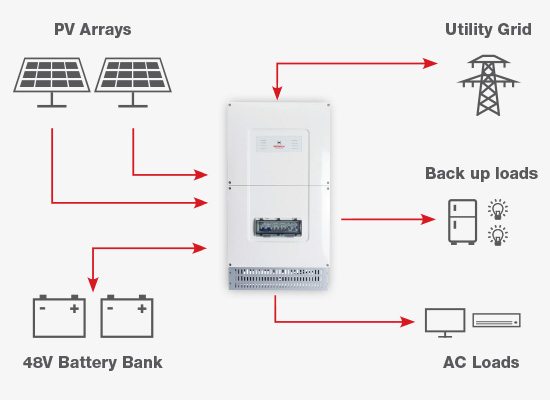

While thousands, and eventually millions, of households are looking at battery storage options to maximise their use of rooftop solar installations, particularly in the face of declining feed-in tariffs, Redback argues that the most effective way to do this is to use smart software to maximise “self-consumption”.
The technology, underpinned by Redback’s proprietary “Ouija” board technology, could lift “self consumption” levels from around one-third of solar output, to more than half.

This is a critical point, as most of the 1.5 million Australian households are now exporting electricity back to the grid for between 6c and 7c/kWh, yet are paying 22-28ckWh for imports from the grid.
Phil Livingston, the founder and CEO of the Brisbane-based Redback, which now employs some 20 people, says smart software can dramatically increase the financial benefits of rooftop solar.
An average house that consumes around 22kWh of electricity a day, and with a 5kW system, might use only 35 per cent of the output, offsetting nearly $800 of costs a year, and getting a “payback” on their solar installation in about seven years.
Using smart inverters, Livingston says, can increase the self consumption to 58 per cent, increasing the cost offers to more than $1,300, and reduce the pay-back time of the installation (including the added cost of the Redback inverter) to 4.5 years.
Livingston says this will improve the payback from solar panels, reduce the consumption of fossil-based fuels, and also mean that if households want to invest in battery storage to control more of their energy use, then they don’t need as big a system as otherwise.
The key to the technology is the cloud-enabled intelligent system for analytics and remote control, which monitors consumption patterns and weather forecasts, and moves the use of appliances such as pool pumps and hot water into the “solar window” so they can be optimised to maximise the consumption of rooftop solar.
“The idea is to maximise the energy you’re producing by using your appliances before you store it in batteries,” Livingston says. Batteries, he notes, are expensive.
Because the software is cloud enabled, it means that it can be constantly upgraded and refreshed – rather like an iPhone or even a Tesla car – and doesn’t have to be replaced.
Livingston says this is important because, for most people and under the most likely tariff structures, battery storage costs will need to fall below $200/kWh before they hit “parity”.
He says Redback’s software is better than rivals’ because, for instance, it incorporates data from the Bureau of Meteorology. He says retailers and utilities are also interested in how the software can deliver benefits to them at significantly lower costs to their current options.
“I think you will see utilities will tailor tariffs to encourage battery storage. It helps a retailer or a network operator significantly and we can provide services to them at a much lower cost to what they can do for themselves, although it is very much an Uber-esque experience for them than what they are used to.”
Half of Redback’s staff are software developers and Livingston expects 80 per cent of future hirings will be software developers too.
“Software can solve the problems we are facing. It will revolutionise the industry, make the equipment faster and smarter, and turn (solar and storage) more quickly into a ubiquitous technology where the fossil fuels are left out,” he said.

Giles Parkinson is founder and editor of One Step Off The Grid, and also edits and founded Renew Economy and The Driven. He has been a journalist for 35 years and is a former business and deputy editor of the Australian Financial Review.